
The Internet of Things revolution has accelerated the demand for wireless technologies that combine long-range connectivity, ultra-low power consumption, and minimal infrastructure cost. Among the emerging communication protocols, LoRa (Long Range) has gained substantial traction precisely because it addresses all three requirements. Developed by Semtech, LoRa uses chirp spread spectrum modulation to achieve multi-kilometre communication ranges while consuming microwatts of power in sleep mode.
Understanding the full LoRa LPWAN network architecture and device classes is essential for any team building production-grade IoT systems. Where short-range protocols such as Wi-Fi or Bluetooth fall short — especially in rural or infrastructure-sparse environments — a correctly designed LoRa LPWAN network architecture and device classes stack delivers scalable, sustainable connectivity. From precision agriculture to smart cities, the design decisions made at the architecture and device-class level determine whether a deployment succeeds or fails. Embien's product engineering services team works with customers to navigate exactly these choices from concept through to production.
What Is LoRa and LoRaWAN?
At a fundamental level, LoRa is a modulation technique based on Chirp Spread Spectrum (CSS). It transmits small packets of data across long distances with very low power consumption, making it ideal for battery-operated devices that send data infrequently — sensors measuring temperature, humidity, soil moisture, GPS location, or patient vital signs.
LoRaWAN (LoRa Wide Area Network) is the communication protocol and network architecture built on top of the LoRa physical layer. It governs how devices connect to the network, how data is authenticated, routed, and secured across the ecosystem. LoRaWAN operates on unlicensed ISM bands (868 MHz in Europe, 915 MHz in the US, 433 MHz in Asia) and uses a star-of-stars topology where end devices communicate with gateways that relay traffic over IP to a central network server. The full picture of LoRa LPWAN network architecture and device classes spans all layers from radio modulation to application server logic.
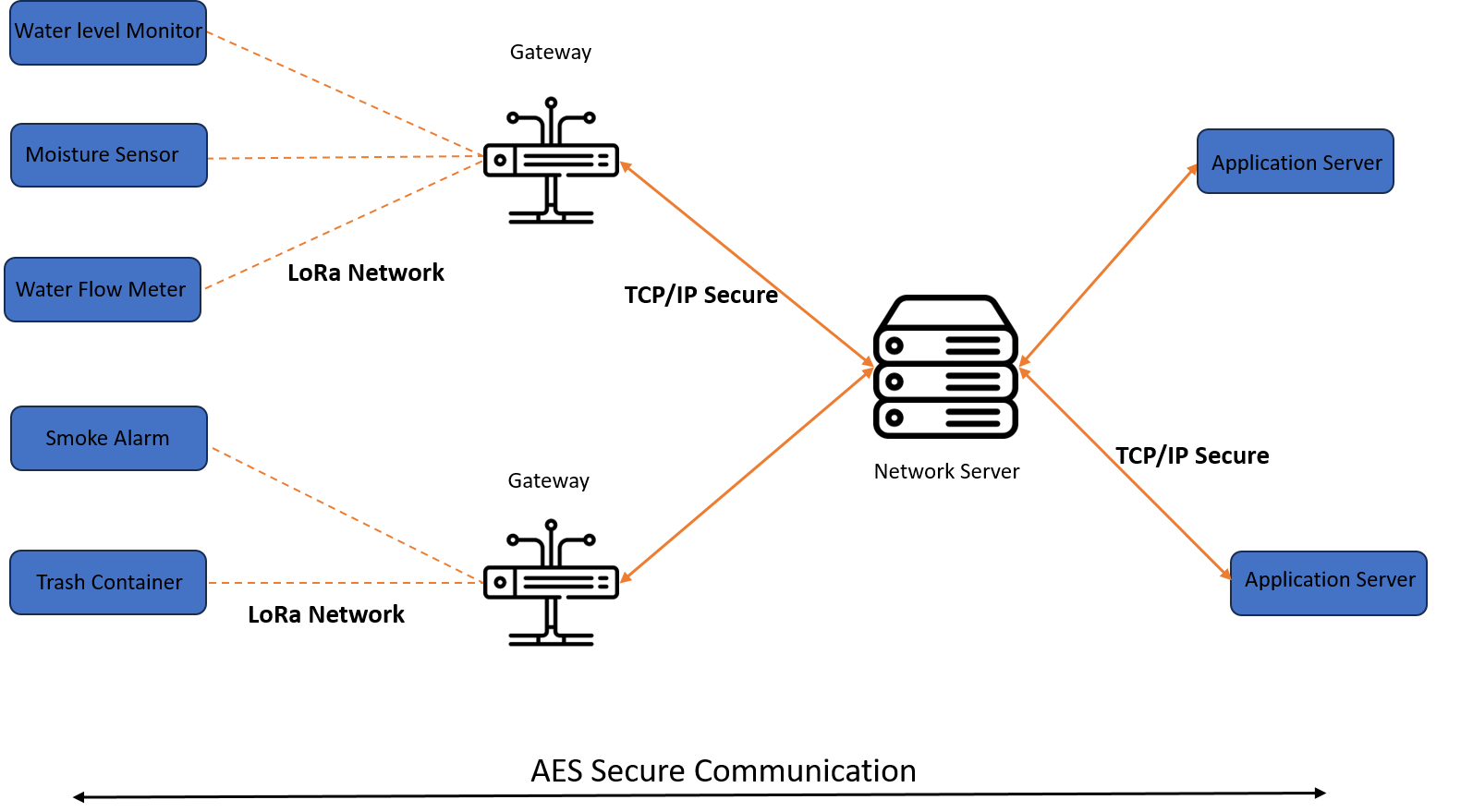
LoRa Technologies
Core Components of the LoRa LPWAN Network Architecture
A working LoRa LPWAN network architecture and device classes deployment comprises four logical layers:
- End Devices: Sensors or actuators in the field. They communicate wirelessly via LoRa modulation to nearby gateways. Device class selection (A, B, or C — detailed below) determines power profile and downlink latency.
- Gateways: Radio relay stations that receive LoRa signals from end devices and forward decoded packets over IP (Ethernet, Wi-Fi, or 4G/LTE) to the network server. A single gateway can serve thousands of end devices.
- Network Server: The intelligence layer of the LoRa LPWAN network architecture and device classes stack. It performs packet de-duplication (when multiple gateways hear the same uplink), device authentication, session key management, and Adaptive Data Rate (ADR) control to optimise range versus throughput per device.
- Application Server: Receives decrypted, de-duplicated payloads, applies business logic, and forwards data to cloud platforms, dashboards, or databases. Embien’s teams leverage Cloud Infrastructure Services to integrate LoRaWAN application servers with scalable, reliable cloud platforms.
How LoRaWAN Works: Communication Flow and Device Classes
The LoRa LPWAN network architecture and device classes specification defines three device classes, each making a distinct trade-off between downlink responsiveness and power consumption. Choosing the right class is the single most important firmware-level decision in any LoRaWAN design.
- Uplink Communication: An end device wakes from sleep, samples its sensor, and transmits using LoRa modulation. One or more gateways receive the frame and forward it to the network server.
- Downlink Communication: The network server may send a reply (e.g., to actuate a relay or update configuration) through a gateway. Downlink frequency depends on device class.
- Device Classes — the heart of LoRa LPWAN network architecture and device classes:
- Class A — Mandatory for all LoRaWAN-compliant devices. Most energy-efficient. The device opens two short receive windows only immediately after each uplink transmission. Downlink is only possible in these windows, making Class A optimal for battery-powered sensors that do not need frequent commands. Typical battery life: several years on AA cells.
- Class B — Builds on Class A by adding scheduled receive windows synchronised to periodic network beacons. This enables predictable downlink timing (useful for smart lighting, valve control, or environmental monitoring) at the cost of additional beacon-synchronisation power draw.
- Class C — Keeps the receive window open almost continuously, enabling near-instant network commands. Power consumption is significantly higher, so Class C is best suited to mains-powered devices such as industrial actuators, alarms, or smart meter concentrators.
Pros and Cons of LoRa Technology
Advantages:
- Long Range: 2–15 km in rural areas; up to 5 km in dense urban settings.
- Low Power Consumption: Class A devices can run for years on a single battery — a key enabler of effective Low-Power IoT Design.
- License-Free Spectrum: No recurring spectrum fees, making large-scale deployments economically viable.
- Good Penetration: Sub-GHz operation allows signals to pass through buildings and reach below-ground sensors.
- Strong Ecosystem: Backed by the LoRa Alliance, with open-source stacks and broad cloud integrations available.
Limitations:
- Low Data Rate: Not suitable for high-bandwidth applications such as video streaming or real-time audio.
- Latency: ALOHA-based MAC and duty-cycle restrictions make LoRa unsuitable for time-critical control loops.
- Network Collisions: As device density grows, packet collisions increase on shared channels.
- Regional Variation: Different frequency regulations across regions (EU vs. US vs. Asia) complicate global hardware SKUs.
LoRaWAN Adoption in Key Domains
Low-Power IoT Design for Agriculture
Agriculture is one of the highest-impact application areas for lorawan network development for smart agriculture. LoRa nodes monitor soil moisture, irrigation valves, weather stations, and livestock movement across fields that may span hundreds of hectares. Because Class A devices can operate for years on a small battery, frequent maintenance visits are unnecessary — a major operational advantage for remote farmland. lorawan network development for smart agriculture deployments typically use a single gateway mounted on a silo or water tower to cover an entire farm, with data flowing to a cloud dashboard for agronomists to act on in real time.
Custom Mesh Networking Protocol for IoT in Smart Cities
Urban deployments leverage LoRaWAN's long range and low cost for smart lighting, parking meter management, garbage bin level sensing, and utility metering. Municipalities can deploy gateways on existing buildings or streetlight columns to achieve city-wide coverage. For scenarios where a pure star topology is insufficient, teams sometimes augment LoRaWAN with a Custom mesh networking protocol for IoT overlay that enables multi-hop routing in dense indoor environments such as underground car parks or large factory floors.
LoRa-Based Patient Tracking Device Development in Healthcare
Healthcare is an emerging but fast-growing LoRaWAN use case. LoRa-based patient tracking device development addresses the challenge of monitoring patients and elderly residents across large hospital campuses or care-home buildings where Wi-Fi coverage is inconsistent. Battery-powered wearable badges or bed-side sensors transmit vital signs or location beacons at regular intervals. Because LoRa penetrates building materials well, a small number of gateways can cover an entire multi-storey facility. LoRa-based patient tracking device development solutions typically combine Class A end devices for periodic vital-sign reporting with Class B devices where scheduled downlink check-ins are needed to confirm device status.
Industrial Automation
In factories and industrial plants, LoRaWAN enables condition monitoring, gas-leak detection, and predictive maintenance for assets spread across large sites. Its ability to coexist with existing industrial fieldbus networks makes it a non-intrusive addition to legacy infrastructure.
Asset Tracking and Logistics
LoRa-based asset trackers offer a cost-effective alternative to GPS/GSM solutions for indoor or campus-level tracking. Multiple gateways can triangulate the position of containers, vehicles, or machinery across a facility or supply chain without the recurring SIM costs associated with cellular tracking.
Environmental Monitoring
Air quality monitoring, river water level sensing, and disaster early-warning systems all benefit from LoRa's ability to reach remote locations. Devices can be deployed in forests, on riverbanks, or in mountain terrain to transmit data back to central dashboards for real-time analytics — a natural fit for lorawan network development for smart agriculture and environmental science alike.
Conclusion
Mastering LoRa LPWAN network architecture and device classes is the foundation of any successful long-range, low-power IoT deployment. Choosing the right device class (A for maximum battery life, B for scheduled downlink, C for always-on responsiveness), sizing the gateway infrastructure correctly, and designing the network server for ADR and de-duplication are all decisions that must be made in concert.
LoRa is not the right fit for every use case — high-bandwidth or ultra-low-latency applications still require Wi-Fi, 5G, or wired alternatives. But for the vast space of smart city, agricultural, healthcare, and environmental monitoring applications where data volumes are modest and battery life matters, the LoRa LPWAN network architecture and device classes framework is hard to beat.
At Embien, we support customers through every stage of LoRa-based patient tracking device development and lorawan network development for smart agriculture — from RF link budget analysis and PCB antenna design through firmware, network server integration, and cloud dashboards. Visit our cloud consulting services page to learn how we connect LoRaWAN deployments to scalable cloud backends, or explore our broader product engineering services to see the full range of embedded and IoT capabilities we bring to every engagement.