CASE STUDY SNAPSHOT
Customer : An Indian defence OEM specializing in secure communication systems and military-grade encryption solutionsSize : 200-1000
Project vertical : Embedded systems for mission-critical applications
Challenge : Develop a sophisticated FPGA-based PCIe card to enable high-speed data encryption/decryption for classified communications
Solution : Custom-engineered FPGA PCIe card with optimized Windows and Linux kernel driver for secure, high-performance data processing
Services Availed : Turnkey Product Engineering , Linux Device Driver Development, FPGA Hardware Development, Embedded Software Development, OS Porting and BSP Development Services
Tools and Technologies :
- Hardware: AMD/Xilinx Artix 7 FPGA with military-grade components
- Programming Languages: C(kernel and user space), Verilog HDL
- Hardware Design Tools: Xilinx Vivado Design Suite, OrCAD Cadence Professional
- Software Development: Linux Kernel Development Environment, Windows Driver Development, GCC Toolchain Optimization
- Frameworks: Linux Device Driver Framework with custom extensions, Windows DDK
- Protocols: Ethernet, Wi-Fi, PCIe Gen3, High-performance DMA
INTRODUCTION
A leading Indian defence OEM required a high-performance FPGA-based PCIe communication Card to enable secure data encryption and decryption for critical communication systems. The solution needed seamless integration with a Linux-based host PC over PCIe. Embien took complete responsibility for developing the custom FPGA hardware and Linux device driver, ensuring robust performance and compliance with stringent defense requirements.
CHALLENGE
The project demanded a tailored solution to process sensitive data at high speeds while maintaining security and reliability. Key challenges included:
- Hardware Complexity: Designing a custom FPGA PCIe card to handle encryption/decryption with precise PCIe interfacing acting as communication card.
- Driver Development: Creating both Windows and Linux kernel driver to enable efficient data transfer between the FPGA and host PC using DMA over PCIe.
- Performance and Security: Ensuring low-latency, high-throughput data processing while adhering to defense-grade security standards.
SOLUTION
The FPGA-based PCIe communication Card was meticulously designed to perform real-time data encryption and decryption operations, seamlessly interfacing with a Windows/Linux host PC through PCIe for secure and reliable communication over Ethernet and Wi-Fi. Embien's experienced turnkey team delivered a comprehensive end-to-end solution that encompassed both sophisticated hardware design and advanced software development, ensuring all components worked in perfect harmony.
FPGA-based PCIe communication Card
Embien's systematic development process included:
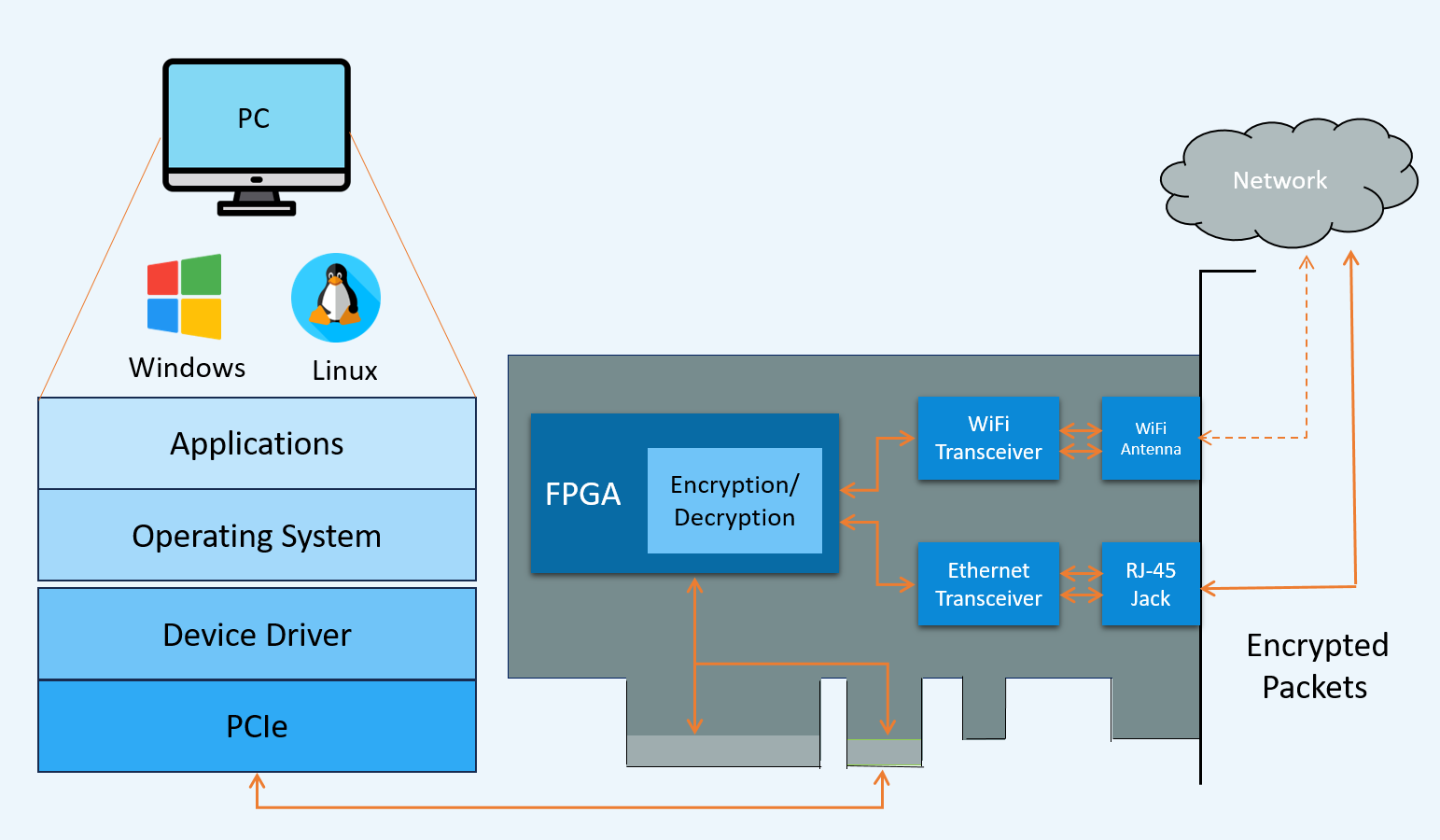
FPGA Based PCIe Encryption Card - Design and Driver Development
Hardware Development
Engineered a sophisticated custom PCIe card featuring a high-performance Xilinx AMD Artix 7 FPGA specifically optimized for encryption and decryption operations. The dedicated hardware engineering team leveraged Xilinx Vivado Design Suite for comprehensive FPGA logic design and implementation, while utilizing OrCAD Cadence Professional for detailed PCB schematic development and layout. The Ethernet and Wi-Fi interfaces are provided as the external communication interface. The team ensured strict adherence to PCIe specifications and maintained exceptional signal integrity for high-speed data paths. The custom card incorporated advanced DMA controller functionality to enable high-throughput, low-latency data transfers between the host system and FPGA, maximizing overall system performance.
FPGA Firmware
Implemented military-grade encryption and decryption algorithms utilizing Verilog HDL on the FPGA platform, with extensive optimizations for maximum throughput and minimal latency. The firmware architecture incorporated sophisticated state machines and pipelined processing units to achieve optimal performance. The implementation featured a robust PCIe endpoint interface module that enabled seamless and reliable communication with the host system, including advanced interrupt handling and error recovery mechanisms. The firmware design emphasized modularity and configurability to support future algorithm updates and enhancements.
Linux Device Driver Development
The device acts as a transparent PCIe communication card and hence will be visible as regular network interfaces to the system. Embien developed a highly optimized Linux kernel device driver implemented in C programming language to orchestrate seamless FPGA communication over the PCIe interface. The driver incorporated sophisticated handling mechanisms for device initialization sequences, efficient memory mapping operations, and high-performance DMA transfer management. The implementation ensured consistently low-latency data exchange while maintaining system stability. The driver architecture exposed well-documented user-space APIs through a clean interface, enabling straightforward integration with higher-level applications while maintaining kernel-level security and performance.
Windows Device Driver Development
Embien also designed and developed the Windows device driver for the card. All the features as supported in Linux, are supported under the Windows Device Driver framework. The whole system is successfully tested in the Windows environment for full performance. We also helped the customer get the certificate for the Windows Driver by ensuring the quality parameters of Microsoft defined driver development are met.
Integration and Testing
We developed custom extensions to configure the encryption/algorithm keys. We executed comprehensive integration of the custom driver and FPGA card components within the target Linux host system environment. Conducted extensive testing procedures including detailed performance benchmarking across various operational scenarios, rigorous stress testing under maximum load conditions, and thorough security validation protocols. The testing regime incorporated automated test suites for regression testing and continuous validation of system stability and reliability. Performance metrics were carefully monitored and analyzed to ensure consistent operation under sustained high workloads, with particular attention to data throughput, latency, and system resource utilization.
Compliance
Maintained strict adherence to defence-grade standards throughout the development process, ensuring hardware reliability and data security met or exceeded military specifications. The team provided comprehensive support during various certification processes, including documentation of compliance measures, participation in audit procedures, and addressing certification authority requirements. Regular compliance reviews were conducted to ensure ongoing adherence to evolving security standards and requirements.
The complete solution was delivered as a fully functional and extensively tested prototype, accompanied by comprehensive technical documentation covering hardware specifications, driver implementation details, firmware architecture, and integration guidelines. The delivery package included ongoing support services for system integration into the customer's existing infrastructure, ensuring smooth deployment and operation.
BENEFITS
- High-Performance Hardware: The FPGA-based PCIe communication Card delivered exceptional real-time encryption and decryption capabilities with consistently low latency, meeting demanding military performance requirements.
- Efficient Driver: Acting as a regular communication card with optimized Windows/Linux kernel driver implementation, featuring sophisticated DMA support, ensured maximum data transfer rates while maintaining system stability and security.
- Defence-Grade Security: Both the FPGA firmware implementation and hardware design adhered to stringent military security requirements, incorporating multiple layers of protection and secure processing capabilities.
- Rapid Development: Embien's extensive expertise in FPGA development and Linux driver implementation enabled accelerated project delivery while maintaining high quality standards.
- Scalability: The modular solution architecture supported future enhancements and modifications, including the integration of additional encryption algorithms and security features.
CONCLUSION
The sophisticated FPGA-based PCIe communication Card and Windows/Linux device driver solution enabled the Indian defense OEM to achieve secure, high-speed data encryption and decryption capabilities for their critical communication systems. Embien's comprehensive expertise in hardware development and Linux driver programming resulted in a reliable, defense-compliant solution that exceeded both performance and security objectives. This successful project implementation demonstrates Embien's capability to address and resolve complex embedded systems challenges within the demanding defense sector.