SOME/IP Server Stack
Overview
RAPIDSEA supports SOME/IP protocol as explained in the SOME/IP Protocol page. This page explains the server architecture and details how the user should interface the stack with their custom logic and realize the ECU implementation quickly. It also provides guidelines on adopting the stack for different systems.
The below diagram captures the block level diagram of the SOME/IP server and how it interfaces with other modules.

Application Interface
While the RAPIDSEA SOME/IP server stack can handle most of the functionality such as message validation, service discovery management, subscription handling, Notification process etc, the business logic has to implement the application functionality. the RAPIDSEA SOME/IP server clearly defines API and callback functions that are essential for the user to use/implement.
The below table captures the function that are to be called from the application logic.
Function |
Description |
|---|---|
rs_some_server_open |
To initialize the SOME/IP server instance structure for both discovery and notification process. |
rs_some_server_run |
To be called to set the run state for state machine for both discovery and notification process. |
rs_some_server_sd_service_set_state |
To set the service state (online/offline) for the given SOME/IP server service instance. |
rs_some_server_set_tx_msg_buf |
To set up the transmit buffers to be used for the SOME/IP server communication. |
rs_some_server_set_rx_msg_buf |
To set up the receive buffers to be used for the SOME/IP server communication. |
rs_some_server_req_stop_offer_service |
To frame and send the stop offer service |
rs_some_server_process |
To be called to call the discovery and notification’s state machine and process respectively and notification event send function. |
rs_some_server_subscribe_init |
To initialize the SOME/IP subscription details structure associated with the server |
rs_some_server_set_reboot_flag |
To be called to set the reboot flag in SOME/IP server instance. |
rs_some_server_send_notify_event |
To be called to send notification events from server |
rs_some_server_close |
To free the SOME/IP server handle |
There are many functions through which the SOME/IP server stack retrieves information from the application logic or indicate actions to be performed. These functions are captured in the below table.
Function |
Description |
|---|---|
rcb_some_server_get_serialized_config_option |
called to get the serialized data of configuration option |
rcb_some_server_get_load_balancing_option_info |
Called to get the data of load balancing option |
rcb_some_server_set_deserialize_config_option |
Called to set the deserialized data of configuration option |
rcb_some_server_send_notification_event |
Called to send a notification event |
rcb_some_server_rx_resp_err_handler |
Called to handle the error response |
rcb_some_server_get_mem |
Called to get memory |
Method setter/getter callbacks |
This callbacks must mapped into event information under service details information |
SOME/IP Server Configuration Parameter:
Function |
Description |
|---|---|
server_addr |
SOME/IP Server IP address |
sd_addr |
SOME/IP SD Multicast or Unicast IP address |
sd_port |
SOME/IP SD Port number |
protocol_ver |
SOME/IP protocol version |
interface_ver |
SOME/IP interface version |
initial_delay |
SOME/IP SD initial wait time |
repetitions_base_delay |
SOME/IP SD repetition base delay |
repetitions_max |
SOME/IP SD repetition max |
sd_ip_version |
SOME/IP SD IP Version (IPv4/IPv6) |
log_level |
SOME/IP Server log level |
These functions are documented in detail in the below sections. It is important for the server to implement these functions correct for proper operation of the system.
Implementation Guide
This section explains how the SOME/IP server can be implemented using the RAPIDSEA stack. The stack is available in source form; the steps to be followed are
Initialize the server configuration.
Implement the Callback functions mentioned above
Initialize the buffers necessary for the operation
Initialize the SOME/IP stack function.
Periodically call the rs_some_server_process functions so that internal timeouts are handled.
High level flow chart is depicted below:

The below diagram captures the high level sequence of operations associated with the SOME/IP stack.

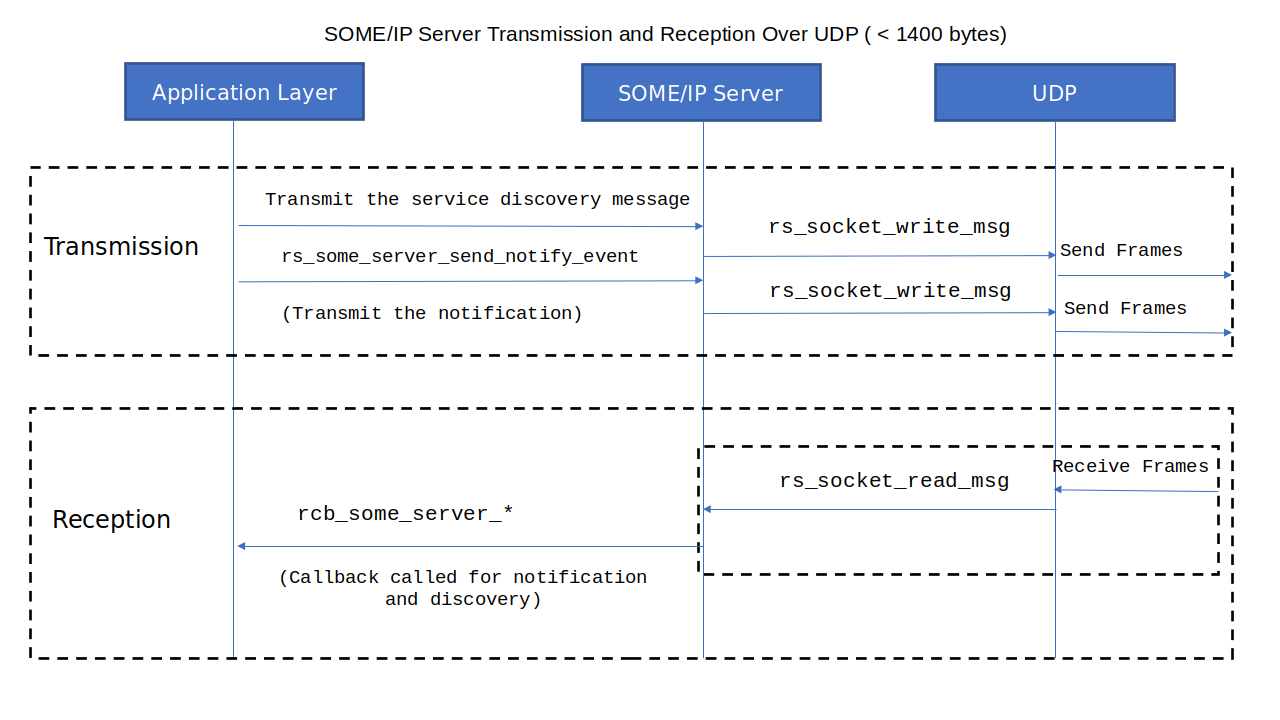
SOME/IP Server Transmission and Reception Over UDP ( < 1400 bytes)
Transmission:
For payloads smaller than 1400 bytes, SOME/IP directly uses UDP transport without TP segmentation. The message is wrapped in a SOME/IP header and transmitted in a single frame.
The below block diagram captures the SOMEIP/IP Server Transmission Over UDP

Reception:
When a SOME/IP message under 1400 bytes is received via UDP, it’s directly delivered to the SOME/IP layer for parsing and dispatching to the respective application handler
The below block diagram captures the SOMEIP/IP Server Reception Over UDP

The below sequence diagram captures the SOMEIP/IP Server Transmission and Reception Over UDP
SOME/IP Server Transmission and Reception Over UDP ( > 1400 bytes)
Transmission:
For payloads exceeding 1400 bytes, SOME/IP uses SOME/IP-TP over UDP. The TP layer breaks the data into smaller frames and sends them sequentially.
The below block diagram captures the SOMEIP/IP Server Transmission Over UDP with TP

Reception:
Large payloads received over UDP are reassembled by the SOME/IP-TP layer. Segments are combined until a complete message is reconstructed, which is then passed to the application
The below block diagram captures the SOMEIP/IP Server Reception Over UDP with TP

The below sequence diagram captures the SOMEIP/IP Server Transmission and Reception Over UDP with TP

SOME/IP Server Transmission and Reception Over TCP
Transmission:
For reliable, connection-oriented communication, SOME/IP messages are transmitted using TCP. TCP ensures delivery and order, but latency can increase due to retransmissions.
The below block diagram captures the SOMEIP/IP Server Transmission Over TCP

Reception:
SOME/IP over TCP is used when guaranteed message delivery is needed. The TCP stream ensures all bytes arrive in sequence.
The below block diagram captures the SOMEIP/IP Server Reception Over TCP

The below sequence diagram captures the SOMEIP/IP Server Transmission and Reception Over TCP

This can be implemented in a bare-metal system or over RTOS or over full fledged OS such as Linux etc.
SOME/IP Server Stack Buffer Details
The SOME/IP Server stack maintains dedicated buffers and memory structures to manage service discovery, event notifications, and request–response exchanges with multiple clients over TCP and UDP.
Each server instance allocates transmit (TX) and receive (RX) buffers to handle message framing and reassembly. By default, the buffer size is configured to approximately 5 KB, suitable for standard SOME/IP and SOME/IP-TP operations.
In compliance with the AUTOSAR SOME/IP and SOME/IP-TP specifications, the maximum size of a SOME/IP message that fits within a single Ethernet frame is limited by the MTU (≈1400 bytes). When payloads exceed this limit, the stack uses SOME/IP-TP for segmentation and reassembly. Thus, the TP buffer size must always be identical to the SOME/IP buffer size to prevent data loss or truncation during fragmentation or reassembly.
The following summarizes the memory handling modes for the server:
Configuration Mode |
Description |
|---|---|
Without TP (Standard SOME/IP) |
Handles single-frame transmissions within Ethernet MTU (≈1400 bytes). Only the SOME/IP layer is active, and TX/RX buffers of 1400 bytes are sufficient. |
With TP Enabled (SOME/IP-TP Mode) |
Handles multi-frame payloads segmented by SOME/IP-TP. The SOME/IP buffer size and TP buffer size must be equal (e.g., 5 KB) to maintain consistency between segmentation and reassembly logic. |
This ensures that both SOME/IP and SOME/IP-TP operate seamlessly during multi-segment message exchanges.
SOME/IP Server Memory Allocation Details
The SOME/IP Server stack uses static and dynamic allocations to manage service
information, subscriptions, TCP/UDP sockets, and event notifications.
These allocations are configured through compile-time macros defined in
rs_someip_server.h.
The following table outlines key structures, macros, and their impact on memory footprint:
Structure / Field |
Macro / Size |
Description & Impact |
|---|---|---|
|
10 (default) |
Maintains UDP notification socket information for service event transmission.
Each element holds an |
|
10 (default) |
Holds TCP notification socket instances for event publishing. Each includes socket configuration, handle, and up to five client connections. Memory grows proportionally with socket count. |
|
5 (default) |
Represents active TCP clients connected to the server for SOME/IP notification. Each instance tracks session state and handle. Increasing this improves concurrency but raises static RAM usage. |
|
Structure type: |
Represents SOME/IP message transmit and receive buffers. The payload buffer inside this structure is typically ~5 KB. If TP mode is enabled, TP buffer size must equal SOME/IP buffer size. |
|
User Defined Size |
Points to service configuration details such as eventgroup lists, port number, and protocol type. Each instance corresponds to one advertised SOME/IP service. |
|
User Defined Size |
Holds subscription information for connected clients.
Each |
|
Static structure |
Encapsulates notification sockets (UDP and TCP) for the server instance.
Defined by |
|
Static structure |
Contains Service Discovery (SD) UDP socket information, used to broadcast service availability and respond to find-service requests. |
rcb_some_server_get_mem |
Size depends on the user |
This function is used to get memory for the given user size. |
Note
All macros (e.g.,
RS_SOMEIP_SERVER_MAX_NOTIFY_UDP_SOCKET) define compile-time constants that directly influence the static memory footprint.Increasing these macros enhances scalability (e.g., more clients or notifications) but proportionally increases RAM consumption.
Reducing any of these may lead to runtime connection limits or dropped event notifications.
TX/RX buffer sizes in SOME/IP and SOME/IP-TP must always be equal when TP mode is active.
Ensure total memory usage remains within target MCU or OS resource limits, particularly when enabling multi-client TCP notifications.
See also
All the
rs_someip_server_xxcalls are must be called in a single thread.For reference, see the
apps/someip_server_demounder RS source directory page
SOME/IP Server Stack Memory Usage
Platform |
Memory |
Size |
|---|---|---|
Micro controller (iMXRT) |
ROM |
77KB |
Micro controller (iMXRT) |
RAM |
29KB |
Platform |
Memory |
Size |
|---|---|---|
Micro controller (iMXRT) |
ROM |
294KB |
Micro controller (iMXRT) |
RAM |
164KB |
Note:
The above table captures the memory usage for five services. Each service has two or one event groups, and across these eventgroups, a total of ten events are mapped. If you add or remove services, the memory usage will increase or decrease accordingly.
Dependency
This stack depends on the below RAPIDSEA interfaces that can be obtained or custom implemented.
Example demo
An example implementation is available along with the release and is described in SOME/IP Server Demo.
SOME/IP Server Header Details
Documentation from the relevant header as follows:
SOME/IP server based APIs.
This file have declaration of SOME/IP server based functions
- Author
Embien RAPIDSEA Team
- Copyright
Embien Technologies India Pvt. Ltd.
Defines
-
RS_SOMEIP_SERVER_VERSION
SOME/IP server version.
-
RS_SOMEIP_SERVER_MAX_NOTIFY_UDP_SOCKET
SOME/IP Server Maximum Number of Notification UDP Sockets.
-
RS_SOMEIP_SERVER_MAX_NOTIFY_TCP_SOCKET
SOME/IP Server Maximum Number of Notification TCP Sockets.
-
RS_SOMEIP_SERVER_MAX_NUM_OF_TCP_CLIENT_CONN
SOME/IP Server Maximum Number of TCP Client connections.
-
RS_SOMEIP_SERVER_SD_UNICAST
-
RS_SOMEIP_SERVER_SD_MULTICAST
-
RS_SOMEIP_SD_SERVER_SERVICE_DOWN
-
RS_SOMEIP_SD_SERVER_SERVICE_AVAILABLE
Typedefs
-
typedef struct tag_rs_someip_server_service_info rs_someip_server_service_info_t
Contains information about SOME/IP Server service details.
-
typedef struct tag_rs_someip_server_subscribe_info rs_someip_server_subscribe_info_t
Contains information about SOME/IP subscribe details.
-
typedef struct tag_rs_someip_tcp_conn_instance rs_someip_tcp_conn_instance_t
Contains information about SOME/IP TCP Client connection details.
-
typedef struct tag_rs_someip_server_tcp_info rs_someip_server_tcp_info_t
Contains information about SOME/IP TCP Server Socket details.
-
typedef struct tag_rs_someip_server_notify_info rs_someip_server_notify_info_t
Contains information about SOME/IP Server notification process.
-
typedef struct tag_rs_someip_server_config rs_someip_server_config_t
Contains information about SOME/IP server configuration.
-
typedef struct tag_rs_someip_server_instance rs_someip_server_instance_t
Contains information about SOME/IP server instance.
Functions
-
rs_handle_t rs_some_server_open(rs_someip_server_instance_t *ptr_instance, rs_someip_server_config_t *ptr_config)
Function Declarations.
Initialize the SOME/IP instance structure with initial values.
This function initialize the SOME/IP instance structure with initial values.
- Parameters:
ptr_instance – [in] - Pointer to the SOME/IP server instance
ptr_config – [in] - Pointer to the SOME/IP server configuration
- Returns:
Handle of the SOME/IP instance information
-
rs_ret_val_t rs_some_server_run(rs_handle_t handle, uint32_t u32_run)
Assign the initial state of the state machine for SOME/IP Server.
This function assigns the initial state of the state machine for SOME/IP Server.
- Parameters:
handle – [in] - Handle of the SOME/IP server instance.
u32_run – [in] - State will be set according to this value.
- Returns:
Zero on success or negative error code on failure.
-
rs_ret_val_t rs_some_server_sd_service_set_state(rs_handle_t someip_server_handle, rs_someip_service_details_t *ptr_serv_details, uint8_t u8_state)
Set the state of a SOME/IP server service.
This function sets the service state (online/offline) for the given SOME/IP server service instance.
- Parameters:
someip_server_handle – [in] - Handle of the SOME/IP server instance
ptr_serv_details – [in] - Pointer to the service details
u8_state – [in] - Service state value to set
- Returns:
Zero on success or negative error code on failure.
-
rs_ret_val_t rs_some_server_set_tx_msg_buf(rs_handle_t handle, uint8_t *ptr_data_buff, uint16_t u16_buff_len)
Set up the transmit buffer to be used for the SOME/IP server stack.
This function sets up the transmit buffer to be used for SOME/IP server stack
- Parameters:
handle – [in] - Handle of SOME/IP server instance
ptr_data_buff – [in] - Pointer to the data buffer
u16_buff_len – [in] - Buffer length in bytes
- Returns:
Zero on success or negative error code on failure.
-
rs_ret_val_t rs_some_server_set_rx_msg_buf(rs_handle_t handle, uint8_t *ptr_data_buff, uint16_t u16_buff_len)
Set up the receive buffer to be used for the SOME/IP stack.
This function sets up the receive buffer to be used for SOME/IP stack
- Parameters:
handle – [in] - Handle of SOME/IP server instance
ptr_data_buff – [in] - Pointer to the data buffer
u16_buff_len – [in] - Buffer length in bytes
- Returns:
Zero on success or negative error code on failure.
-
rs_ret_val_t rs_some_server_req_stop_offer_service(rs_handle_t handle)
Frame and send stop offer service.
This function frame and send the stop offer service.
- Parameters:
handle – [in] - Handle of the SOME/IP server instance
- Returns:
Return 0 if success negative value if failure.
-
rs_ret_val_t rs_some_server_subscribe_init(rs_handle_t handle, rs_someip_server_subscribe_info_t *ptr_subscribe_info, uint32_t u32_num_subscription)
Initialize the subscription structure.
This function initialize the subscription structure in given instance structure to store subscribe information.
- Parameters:
handle – [in] - Handle of the SOME/IP server instance.
ptr_subscribe_info – [in] - Pointer to subscription structure.
u32_num_subscription – [in] - Max number of subscription.
- Returns:
Return 0 if success or negative if failure.
-
rs_ret_val_t rs_some_server_process(rs_handle_t someip_server_handle)
Called to call the discovery and notification’s state machine and process respectively and notification event send function.
This function called to call the discovery and notification’s state machine and process respectively and notification event send function.
- Parameters:
someip_server_handle – [in] - Handle of the SOME/IP instance information
- Returns:
Return 0 if success or negative value if failure.
-
rs_ret_val_t rs_some_server_send_notify_event(rs_handle_t someip_server_handle, rs_someip_notify_event_info_t *ptr_notify_event_info)
Called to send notification events from server.
This function called to send notification events from server.
- Parameters:
someip_server_handle – [in] - Handle of the SOME/IP server instance.
ptr_notify_event_info – [in] - Pointer to the notification event information
- Returns:
Return 0 if success or negative if failure.
-
rs_ret_val_t rs_some_server_set_reboot_flag(rs_handle_t someip_server_handle, uint8_t u8_reboot_val)
Called to set the reboot flag in SOME/IP server instance.
This function called to set the reboot flag in SOME/IP server instance.
- Parameters:
someip_server_handle – [in] - Handle of the SOME/IP instance information
u8_reboot_val – [in] - Reboot value.
- Returns:
Return 0 if success or negative value if failure.
-
rs_ret_val_t rs_some_server_close(rs_handle_t someip_server_handle)
Called to free the SOME/IP server handle.
This function called to free the SOME/IP server handle.
- Parameters:
someip_server_handle – [in] - Handle of the SOME/IP instance information
- Returns:
Return 0 if success or negative value if failure.
-
uint8_t *rcb_some_server_get_mem(uint32_t u32_size)
Called to get memory.
This function called to get memory.
- Parameters:
u32_size – [in] - Needed size
- Returns:
Return pointer to a SOME/IP buffer if available or NULL
-
rs_ret_val_t rcb_some_server_get_serialized_config_option(rs_handle_t handle, rs_someip_config_opt_info_t *ptr_opt_info, uint8_t u8_serv_type)
Callback function to get the serialized data of configuration option.
This is a callback function to get the serialized data of configuration option
- Parameters:
handle – [in] - Handle of the SOME/IP server instance
ptr_opt_info – [out] - Pointer to the configuration option information
u8_serv_type – [in] - Service type
- Returns:
Return length of the payload data
-
rs_ret_val_t rcb_some_server_get_load_balancing_option_info(rs_handle_t handle, rs_someip_load_opt_info_t *ptr_load_opt_info, uint8_t u8_serv_type)
Callback function to get the data of load balancing option.
This is a callback function to get the data of load balancing option
- Parameters:
handle – [in] - Handle of the SOME/IP server instance
ptr_load_opt_info – [out] - Pointer to the load balance option information
u8_serv_type – [in] - Service type
- Returns:
Return length of the payload data
-
rs_ret_val_t rcb_some_server_set_deserialize_config_option(rs_handle_t handle, rs_someip_config_opt_info_t *ptr_config_opt_info, uint8_t u8_serv_type)
Callback function to set the deserialized data of configuration option.
This is a callback function to set the deserialized data of configuration option
- Parameters:
handle – [in] - Handle of the SOME/IP server instance
ptr_config_opt_info – [in] - Pointer to the configuration option data information
- Returns:
Return length of the payload data
-
rs_ret_val_t rcb_some_server_send_notification_event(rs_handle_t handle, rs_someip_req_resp_info_t *ptr_req_info)
Callback function to send notification event.
This is a callback function to send notification event
- Parameters:
handle – [in] - Handle of the SOME/IP server instance
ptr_req_info – [in] - Pointer to the request data information
- Returns:
Return length of the payload data
-
rs_ret_val_t rcb_some_server_rx_resp_err_handler(rs_handle_t handle, rs_someip_notify_event_info_t *ptr_evt_info, uint8_t u8_err_code)
Callback function to handle the error response.
This is a callback function to to handle the error response.
- Parameters:
handle – [in] - Handle of the SOME/IP server instance
ptr_evt_info – [in] - Pointer to the notification event information
u8_err_code – [in] - Error code
- Returns:
Return length of the payload data
-
struct tag_rs_someip_server_service_info
- #include <rs_someip_server.h>
Contains information about SOME/IP Server service details.
Public Members
-
rs_someip_service_details_t serv_details
Server service details.
-
uint16_t port
Port Number.
-
uint8_t ip_version
IP Version (IPv4/IPV6)
-
uint8_t proto_type
Protocol communication type (UDP/TCP)
-
uint8_t service_state
Server SD Service State.
-
uint16_t num_of_eventgrp_list
Number of eventgroup.
-
rs_someip_eventgrp_info_t *ptr_eventgrp_list
Pointer to the eventgroup list information.
-
rs_someip_service_details_t serv_details
-
struct tag_rs_someip_server_subscribe_info
- #include <rs_someip_server.h>
Contains information about SOME/IP subscribe details.
Public Members
-
rs_someip_service_details_t *ptr_serv_details
Service details of subscription.
-
rs_someip_eventgrp_info_t *ptr_eventgrp_info
Subscribe Eventgroup ID.
-
uint16_t client_id
Subscribe Client ID.
-
rs_sock_addr_t socket_info
Subscription unicast socket IP and port information.
-
rs_sock_addr_t sd_socket_info
Subscription SD socket IP and port information.
-
uint8_t comm_type
Communication type.
-
uint8_t ip_version
IP Version (IPv4/IPv6)
-
uint16_t reserved
Reserved.
-
rs_handle_t transport_handle
Transport handle.
-
uint32_t last_sub_time
Last subscribe time in ms.
-
uint32_t sub_ttl
RX subscribe TTL Value.
-
rs_someip_service_details_t *ptr_serv_details
-
struct tag_rs_someip_tcp_conn_instance
- #include <rs_someip_server.h>
Contains information about SOME/IP TCP Client connection details.
-
struct tag_rs_someip_server_tcp_info
- #include <rs_someip_server.h>
Contains information about SOME/IP TCP Server Socket details.
Public Members
-
rs_tcp_server_instance_t tcp_socket_instance
SOME/IP TCP Server socket instance(Information)
-
rs_socket_config_t tcp_socket_config
SOME/IP TCP Server socket configuration.
-
rs_handle_t comm_tcp_handle
SOME/IP TCP Server socket handle.
-
uint32_t num_of_clients
Number of client connections.
-
uint8_t state
SOME/IP TCP Server socket state.
-
uint8_t run_state
SOME/IP TCP Server socket run state.
-
rs_someip_tcp_conn_instance_t client_inst[RS_SOMEIP_SERVER_MAX_NUM_OF_TCP_CLIENT_CONN]
SOME/IP TCP Server socket connection instance.
-
rs_tcp_server_instance_t tcp_socket_instance
-
struct tag_rs_someip_server_notify_info
- #include <rs_someip_server.h>
Contains information about SOME/IP Server notification process.
Public Members
-
rs_someip_udp_proto_info_t notify_udp_info[RS_SOMEIP_SERVER_MAX_NOTIFY_UDP_SOCKET]
SOME/IP Server notification UDP Socket info.
-
rs_someip_server_tcp_info_t server_tcp_info[RS_SOMEIP_SERVER_MAX_NOTIFY_TCP_SOCKET]
SOME/IP Server notification TCP Socket info.
-
rs_someip_udp_proto_info_t notify_udp_info[RS_SOMEIP_SERVER_MAX_NOTIFY_UDP_SOCKET]
-
struct tag_rs_someip_server_config
- #include <rs_someip_server.h>
Contains information about SOME/IP server configuration.
Public Members
-
uint8_t server_addr[RS_SOMEIP_IP_ADDR_LEN]
SOME/IP Server IP address.
-
uint8_t sd_addr[RS_SOMEIP_IP_ADDR_LEN]
SOME/IP SD IP address.
-
uint8_t sd_tx_mode
SOME/IP SD TX Mode.
-
uint8_t protocol_ver
SOME/IP protocol version.
-
uint8_t interface_ver
SOME/IP interface version.
-
uint8_t repetitions_max
SOME/IP SD repetition max.
-
uint8_t sd_ip_version
SOME/IP SD IP Version (IPv4/IPv6)
-
uint8_t log_level
SOME/IP Client log level.
-
uint16_t sd_port
SOME/IP SD Port number.
-
uint32_t cyclic_offer_delay
SOME/IP SD cyclic offer delay.
-
uint32_t initial_delay
SOME/IP SD initial wait time.
-
uint32_t repetitions_base_delay
SOME/IP SD repetition base delay.
-
uint8_t server_addr[RS_SOMEIP_IP_ADDR_LEN]
-
struct tag_rs_someip_server_instance
- #include <rs_someip_server.h>
Contains information about SOME/IP server instance.
Public Members
-
rs_someip_server_config_t *ptr_config
Pointer to containing server configuration.
-
rs_someip_udp_proto_info_t discov_udp_info
SOME/IP Service Discovery UDP information.
-
rs_someip_server_notify_info_t notify_process_info
SOME/IP server notification process information.
-
rs_someip_server_subscribe_info_t *ptr_subscribe_details
Pointer to subscribe structure information.
-
rs_someip_server_service_info_t *ptr_service_info
Pointer to the SOME/IP service information.
-
uint32_t number_of_subscribe
Number of subscribers.
-
uint32_t number_of_services
Number of services.
-
uint32_t last_offer_time
last offer service sent time
-
uint8_t enable_main_phase
SOME/IP main phase.
-
uint8_t repetitions_count
SOME/IP repetition count.
-
uint8_t reboot_flag
SOME/IP Client reboot flag.
-
uint8_t sn_udp_tx_mode
SOME/IP Server notification tx mode (unicast or multicast)
-
uint8_t sd_udp_tx_mode
SOME/IP Server discovery tx mode (unicast or multicast)
-
rs_handle_t tp_handle
SOME/IP-TP Handle.
-
rs_someip_msg_t tx_msg
SOME/IP Server TX Message.
-
rs_someip_msg_t rx_msg
SOME/IP Server RX Message.
-
rs_someip_server_config_t *ptr_config