
In today's automotive landscape, the Electronic Power Assisted Steering (EPAS) system represents a significant advancement in vehicle steering technology. Unlike traditional hydraulic power steering systems, Electronic Power Assisted Steering delivers assistance through an electric motor, controlled by the Electronic Control Unit (ECU). This shift from hydraulic to electric systems illustrates a broader trend towards increased vehicle electrification.
The EPAS ECU plays a pivotal role in managing the system's operations. By processing various inputs such as vehicle speed, steering angle, and driver inputs, the EPAS ECU adjusts the level of steering assistance to provide optimal performance. This adaptability not only improves fuel efficiency by reducing the load on the engine but also enhances safety by offering precise control in critical driving conditions. With no constant hydraulic pump running, Electronic Power Assisted Steering helps save energy as well. As we explore the operating principles, architecture, and design considerations of the EPAS ECU, we'll uncover how it contributes to a more responsive and efficient steering experience.
To appreciate the operating principle of the Electronic Power Assisted Steering system, we must first consider the components that interact with delivering steering assistance. At its core, the EPAS system uses a combination of sensors, an electric motor, and the EPAS ECU to provide variable steering assistance.
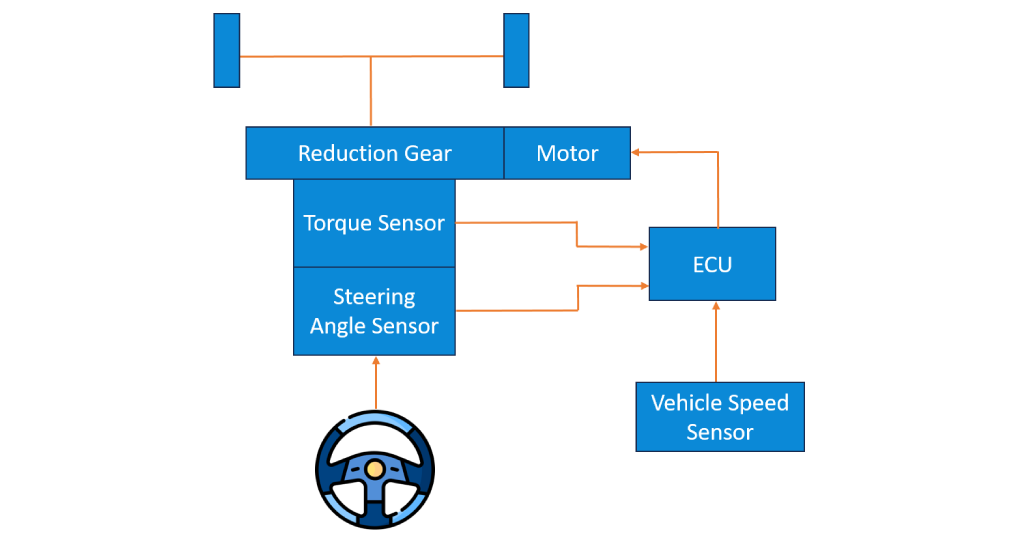
EPAS – Operating Principle
The assist motor can be placed in one of the different configurations in the electric power steering (EPS) systems. Understanding each electric power steering variant is essential for engineers working on automotive vehicle control unit integration:
The electric motor and gear are located within the steering column, providing assistance as the driver turns the steering wheel. This electric power steering configuration is common in smaller vehicles.
The motor is connected to the pinion shaft (the small gear) that engages with the rack, assisting with the steering action.
The motor directly drives the steering rack itself, providing a more direct and precise feel. D-EPS configurations are often used in higher-performance cars.
The motor and gears are positioned within the rack and pinion mechanism to provide assistance, usually with the motor directly driving the rack.
Proper automotive ECU Engineering ensures the EPAS ECU is matched to the correct electric power steering topology for the target vehicle class. Learn about STMicro device expertise that powers high-performance EPAS ECU implementations.
The hardware architecture of the EPAS ECU is meticulously designed to handle the complex computations and control tasks required by the Electronic Power Assisted Steering system.
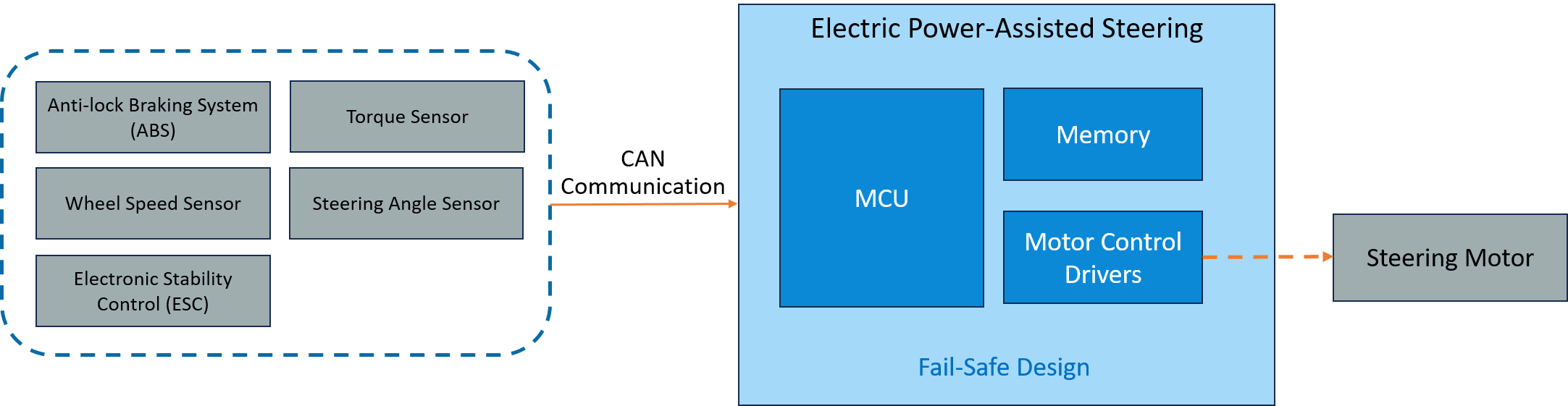
EPAS – Hardware Architecure
At the heart of the EPAS ECU is a microcontroller unit (MCU), which processes sensor inputs and executes control algorithms. The MCU's processing power is crucial for managing the real-time demands of the Electronic Power Assisted Steering system, ensuring precise and timely steering assistance.
These are responsible for regulating the voltage and current supplied to the electric motor, allowing for smooth and efficient motor operation.
Typically, over CAN, these enable the EPAS ECU to interact with various sensors to acquire torque and speed information. The EPAS ECU also interacts with other vehicle systems, such as the anti-lock braking system (ABS) and electronic stability control (ESC), enhancing overall vehicle safety and performance.
The memory components include non-volatile memory (like EEPROM or Flash) for retaining data during power-off states and volatile memory (RAM) for runtime operations. Calibration data ensures the EPAS ECU can adapt to different vehicle configurations and driver preferences.
Safety is a paramount consideration in the hardware architecture of the EPAS ECU. Redundant systems and fail-safe mechanisms are integrated to ensure continued operation in the event of a component failure. This focus on reliability is essential, as the Electronic Power Assisted Steering system plays a critical role in vehicle control and safety.
The software is responsible for interpreting sensor data, executing control algorithms, and managing communication with other vehicle systems. This complex software environment requires meticulous design and validation to ensure optimal performance and safety.
One of the key challenges in developing EPAS ECU software is achieving real-time performance. The software must process large volumes of data and execute control algorithms with minimal latency, ensuring that steering assistance is provided seamlessly and instantaneously. Advanced programming techniques and efficient algorithms are essential to meet these demanding requirements.
Moreover, the software architecture must be designed with flexibility in mind, allowing for updates and enhancements as new technologies and features are developed. This adaptability is crucial in a rapidly evolving automotive landscape, where the integration of new technologies such as autonomous driving and advanced driver-assistance systems (ADAS) is becoming increasingly common. By maintaining a flexible and robust software architecture, the EPAS ECU can continue to meet the demands of modern vehicle design.
Functional safety is a critical consideration in the design of the EPAS ECU, given its role in vehicle steering and control. The Automotive Safety Integrity Level (ASIL) classification system provides a framework for assessing and mitigating risks associated with automotive systems. The Electronic Power Assisted Steering ECU is typically designed to meet ASIL-D requirements, the highest safety integrity level, reflecting its importance in vehicle safety.
Meeting ASIL-D requirements involves rigorous risk assessment and the implementation of comprehensive safety measures. This includes the development of fault detection and diagnostic capabilities, ensuring that any potential failures are identified and addressed promptly. The EPAS ECU must also incorporate redundancy and fail-safe mechanisms to maintain system operation in the event of a component failure.
In addition to hardware and software safety measures, the development process for the EPAS ECU must adhere to stringent safety standards. This includes thorough testing and validation to ensure that the system meets all safety requirements. Sound automotive ECU Engineering practices and robust security audit and OS hardening measures are equally important for protecting EPAS ECU firmware integrity.
Designing an EPAS ECU involves a careful balance of performance, safety, and cost considerations. One of the primary design challenges is optimizing the ECU's performance to deliver precise and responsive steering assistance while minimizing energy consumption. This requires a deep understanding of both hardware and software design principles, as well as the interactions between the two.
Safety is another critical consideration in the design of the EPAS ECU. As mentioned earlier, the system must meet ASIL-D functional safety requirements, necessitating the implementation of robust safety measures. This includes the integration of fault detection and diagnostic capabilities, as well as redundancy and fail-safe mechanisms. Cost considerations also play a significant role in the design of the EPAS ECU.
Applying established automotive ECU Engineering methodologies — including model-based development, HIL simulation, and requirements traceability — is critical to delivering a production-quality Electronic Power Assisted Steering ECU on schedule and within budget.
The Electronic Power Assisted Steering ECU does not operate in isolation. As an automotive vehicle control unit, it must interface seamlessly with the powertrain ECU, ESC module, and ADAS stack, exchanging torque and speed data over CAN-FD to enable coordinated vehicle dynamics control. Embien’s Product Engineering Services enable seamless EPAS ECU integration with ADAS, ESC, and CAN-FD vehicle networks
In conclusion, the Electronic Power Assisted Steering (EPAS) ECU represents a significant advancement in vehicle steering technology. Through its sophisticated electro-mechanical architecture, advanced hardware and software design, and adherence to stringent safety standards, the Electronic Power Assisted Steering system provides a responsive, efficient, and safe steering experience. As automotive technology continues to evolve, the EPAS ECU will play an increasingly important role in the development of advanced vehicle systems, including autonomous and semi-autonomous driving technologies.

Embien's embedded computing platforms provide the processing foundation for automotive and industrial applications, from low-power MCU-based designs to high-performance SoC solutions.

Embien offers comprehensive electronics product development services, covering schematic design, PCB layout, prototyping, and production-ready embedded system development.

A case study on instrument cluster development for an electric tractor — showcasing Embien's embedded systems expertise in CAN integration, motor control display, and automotive-grade MCU programming.