
Introduction
As the Chief Technology Officer at Embien Technologies, I've seen countless innovative designs falter when they reach the manufacturing floor. It's a lesson learned time and again: a product that shines in simulations or prototypes can unravel during production if it's not built with manufacturing in mind. Design for Manufacturability (DFM) is more than a catchphrase—it's a disciplined approach that bridges the gap between design brilliance and production success. This guide dives into how early-stage design decisions shape manufacturing yield and cost, offering practical DFM for electronics tips to ensure your product scales efficiently. Whether you're a startup eyeing your first production run or an enterprise refining your process, these insights—laced with strategies like component selection for automated assembly, panelization techniques, and robust design for testability DFT in embedded systems—will help you reduce production costs and succeed in electronics manufacturing. Engaging professional DFM Services early in the cycle is one of the most cost-effective investments a product team can make.
What is Design for Manufacturability (DFM)?
Design for Manufacturability (DFM) is the art and science of crafting products to optimize their production. It's about making choices that simplify assembly, minimize defects, and cut costs, all while preserving functionality and quality. In electronics manufacturing, where precision and scale amplify every decision, Design for Manufacturability (DFM) becomes indispensable. A single oversight—a poorly chosen component or an inaccessible test point—can cascade into yield losses, rework, or delays. At Embien Technologies, we embed Design for Manufacturability (DFM) into our workflow from day one. This proactive stance, supported by our comprehensive DFM Services, ensures our clients' designs transition seamlessly from concept to production, saving time and money while meeting stringent specifications.
Design for Manufacturability (DFM)
The Impact of Early-Stage Design Decisions
Too often, engineers prioritize functionality over manufacturability in the initial design phase, deferring production concerns until later. This gamble rarely pays off. Choices made early—like component selection, PCB layout, and testability—directly dictate manufacturing outcomes. Consider these examples:
- Component Selection: Opting for rare or end-of-life components can snarl supply chains and inflate costs.
- PCB Layout: A cluttered or inefficient layout can slow assembly, increase defects, or complicate testing.
- Test Points: Skimping on test points can cripple quality assurance, pushing defects downstream.
Addressing these elements upfront—an essential part of sound DFM for electronics practice—boosts yield, trims expenses, and speeds up market entry.
Actionable DFM Tips for Electronics Manufacturing
Here are battle-tested Design for Manufacturability (DFM) strategies we champion at Embien Technologies. These tips have guided our clients to smoother production runs and lower costs.
Component Selection for Automated Assembly: Automated assembly drives efficiency in modern electronics manufacturing, but it demands smart component choices:
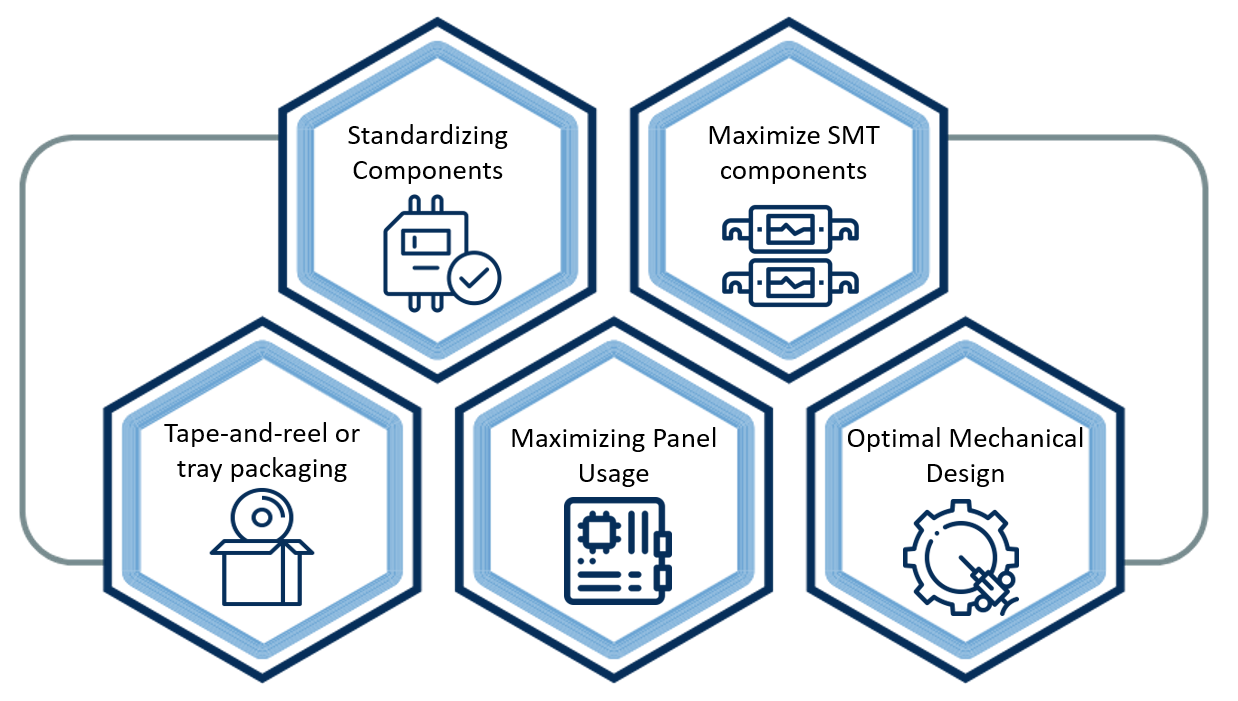
- Standardize Components: Stick to widely available parts to dodge supply chain headaches. Exotic components might edge out performance slightly but often bring delays and higher prices.
- Favor SMT: Surface-mount technology (SMT) components outpace through-hole parts in assembly speed and ease. Lean toward SMT wherever feasible.
- Packaging Matters: Select components in tape-and-reel or tray formats for automated pick-and-place systems, cutting errors and boosting throughput.
Build a preferred parts list (PPL) to unify component choices across projects, streamlining procurement and cost management.
Panelization Strategies: Panelization—arranging multiple PCBs on a single panel—can make or break manufacturing efficiency:
- Maximize Panel Use: Size panels to fit as many PCBs as possible within standard manufacturer dimensions, minimizing waste and cost.
- Choose Separation Methods: Use V-scoring for straight cuts and tab routing for intricate designs. Proper techniques ensure clean breaks without board damage.
- Add Alignment Aids: Include fiducial marks and tooling holes on panels for precise assembly and testing alignment.
Test panel layouts early in design to spot issues and refine for production readiness.
Designing Robust Test Points: Testing safeguards quality, yet it's often an afterthought. Well-designed test points are non-negotiable—they form the basis of strong design for testability DFT in embedded systems:
- Ensure Accessibility: Position test points where automated test equipment (ATE) can reach them easily—no hiding under components or in tight corners.
- Cover Critical Areas: Place test points to monitor all vital nets and components, catching defects before they escape.
- Size Them Right: Use pads around 1mm in diameter for reliable probe contact.
Sync with your manufacturing partner to align test point design with their testing capabilities.
Additional DFM Best Practices: Beyond the core tips, consider these practices:
- Simplify PCB Layers: Fewer layers mean lower costs. Design with the minimum layers needed for performance.
- Ease Tolerances: Set tolerances that standard processes can hit. Tight specs can spike costs and defects.
- Support Reflow Soldering: Optimize for reflow soldering—common in SMT—with proper pad and solder mask designs.
Design for Assembly DFA: A Critical Companion to DFM
Design for assembly DFA is closely related to Design for Manufacturability (DFM) but focuses specifically on making the physical assembly process faster and less error-prone. Effective design for assembly DFA principles include reducing part count, ensuring components have obvious orientation cues, and designing connectors and fasteners that snap into position without ambiguity. When DFM Services incorporate design for assembly DFA from the start, assembly line throughput improves markedly and defect rates drop. A key insight from design for assembly DFA analysis is that simplifying the assembly sequence often reveals opportunities to consolidate parts, cut costs, and improve reliability simultaneously.
Mechanical Designing for Manufacturability
A brilliant mechanical design is only as good as its ability to be manufactured efficiently and cost-effectively. Key considerations for Mechanical Design for Manufacturability (DFM) include:
- Simplicity: The fewer the parts, the easier and cheaper the assembly. A well-designed product will consolidate parts where possible and use simple, easy-to-handle geometries.
- Standardization: Using standard components and fasteners reduces costs and simplifies the supply chain.
- Tolerances: Tolerances define the acceptable variation in the dimensions of a part. Specifying overly tight tolerances can be expensive and unnecessary. A good design will use the loosest possible tolerances that still allow for proper assembly and function.
- Assembly: The design should facilitate easy assembly. This includes considering the order in which parts are assembled, providing clear access for tools, and using features like snap-fits to reduce the need for screws.
- Molding and Tooling: For plastic parts, the design must consider the injection molding process. This includes factors like draft angles (to allow the part to be easily ejected from the mold), wall thickness (to prevent sink marks and warping), and the location of gates and ejector pins.
The DFM Checklist: Your Go-To Resource
To streamline Design for Manufacturability (DFM), we've crafted a DFM checklist for engineers and designers. Key items include:
- Component Selection:
- Are components active and easy to source?
- Have through-hole parts been minimized?
- PCB Layout:
- Is the layout automation-friendly?
- Are fiducials and tooling holes included?
- Panelization:
- Does the panel optimize material use?
- Are V-scoring and tab routing applied correctly?
- Testability:
- Are test points accessible and comprehensive for design for testability DFT in embedded systems?
- Do they match the manufacturer's testing methods?
Customize this checklist to your project and partner capabilities—it's a launchpad for success in DFM for electronics projects.
The Cost of Ignoring DFM:
Skipping Design for Manufacturability (DFM) in the design process invites trouble. Some of the impact of the same includes:
- Higher Defects: Bad design choices raise defect rates, piling on rework and scrap.
- Slower Production: Tricky designs bog down lines, pushing back launches.
- Rising Costs: Waste, labor, and delays add up fast.
Conversely, embracing DFM for electronics with professional DFM Services can reduce production costs by up to 30%, lift yield, and pave the way for scaling. Our cross-domain embedded expertise drives DFM-ready designs, supported by Electronic Manufacturing Services for efficient production.
Conclusion
By considering these factors early in the design process, companies can avoid costly redesigns and ensure a smooth transition from prototype to mass production. Design for Manufacturability (DFM) isn't optional—it's the backbone of scalable, cost-effective production. Thoughtful early decisions sidestep pitfalls, enhance yield, and reduce production costs. At Embien Technologies, we're dedicated to guiding clients through DFM for electronics with proven DFM Services. From design for assembly DFA reviews to design for testability DFT in embedded systems checks, our team covers every dimension of manufacturability. From a basic PCB to a sophisticated system, the mantra holds: don't just design it, manufacture it.