
Part 1 covered the five primary and integrated enclosure-to-strap attachment mechanisms. This part addresses the mechanisms that build on or complement that foundation, clamping and supplementary mechanisms that eliminate residual failure modes the primary mount leaves open, and two specialised attachment approaches for medical and industrial body-worn categories.
Why Supplementary and Clamping Mechanisms Matter
Real-world wearable use introduces forces from multiple directions simultaneously, gravitational, inertial, torsional. A primary mechanism optimised for one direction of loading may be underspecified for another. A loop-through mount prevents the enclosure from lifting off the strap but does not prevent it from sliding longitudinally or rotating 90 degrees. Secondary retention mechanisms close that gap.
5. Bracket Clamp Mount
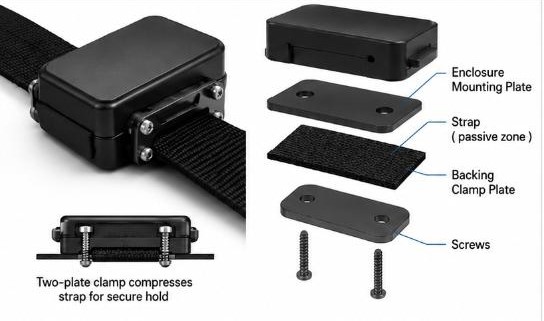
A two-plate assembly sandwiches the strap between an enclosure-mounted plate and a separate backing plate, with screws or snap-locks drawing the plates together to grip the strap through compressive friction. The inward-facing bracket surface must be smooth, fully chamfered, and low-profile to prevent skin irritation or animal discomfort.
The clamp zone must be positioned in the passive zone of the strap to avoid any embedded antenna conductors
Best Application: Heavier wearable devices where loop-through slots require impractically large apertures; industrial body-worn devices.
Pros: Distributes clamping load across wide strap area; adjustable along strap length; compatible with varying strap thickness.
Cons: Requires tools for installation; inner bracket must be smooth for wearer comfort; clamp zone must avoid active antenna conductors.
6. Screw Mount
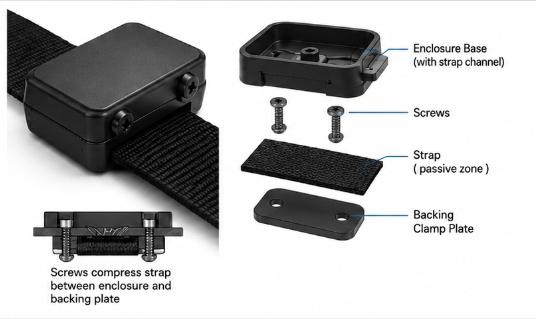
The enclosure base incorporates an internal strap channel plus one or more screws with backing plates compressing the strap between the enclosure body and the clamping surface. The screw mount is more compact and lower profile than a bracket clamp. For antenna-embedded straps, the rigid clamping plate must be positioned in the passive (non-antenna) zone of the strap.
Best Application: Secondary retention alongside a loop-through primary mount, preventing longitudinal sliding along the strap.
Pros: Adjustable and repositionable; extremely secure when torqued; resistant to vibration with thread-locking compound.
Cons: Requires tools; overtightening risks strap deformation or antenna conductor damage; strap reinforcement in clamp zone adds BOM complexity.
7. Clip-On (Pin) Strap Mount
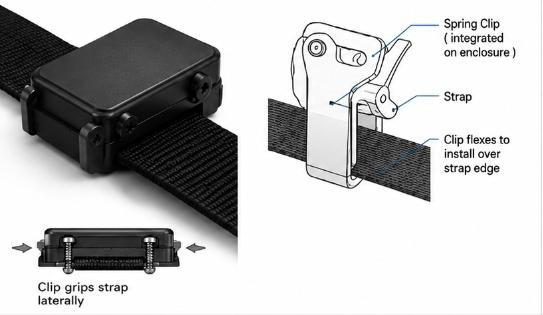
A spring-like plastic or metal clip integrated on the enclosure side edges flexes outward during installation over the strap edge and springs back to grip the strap laterally. Installation requires no tools and no strap removal. Retention force is limited — insufficient as a standalone primary mount for electronics-carrying devices.
Best Application: Anti-rotation secondary feature alongside a loop-through primary mount; lightweight accessory devices under 5g.
Pros: Tool-free installation; no strap removal required; lightweight; fast field installation.
Cons: Insufficient retention as standalone primary mount; clip fatigue over repeated installation cycles; metal pins risk fur snagging.
8. Cam Follower Mechanism
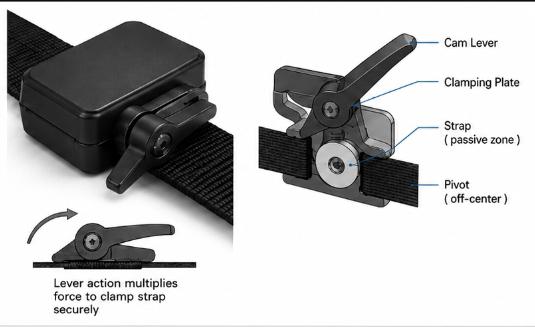
A rotating cam lever draws a clamping plate against the strap surface via mechanical advantage, a small input force at the lever generates a proportionally larger clamping force. The simplified linear eccentric lever variant, where a single lever with an off-center pivot directly clamps the strap, reduces failure modes significantly over the full rotary cam follower assembly.
Best Application: Specialised tool-free strap clamping applications in industrial body-worn devices, field-deployable monitoring equipment, or sports performance wearables where lever-actuated quick-release is specified.
Pros: High clamping force without tools; cam profile engineerable for gradual or sudden locking.
Cons: High mechanical complexity; multiple moving parts in wet/dirty environments; cam profilerequires high manufacturing accuracy.
Preferrable enclosure to strap locking mechanisms
Screw Mount is the most suitable mechanism for injection molded pet wearable devices because it provides the best balance between:
- manufacturability
- cost efficiency
- structural reliability
- pet comfort
- production scalability
- long-term durability
Why Screw Mount is Preferred
The screw mount mechanism is preferred for pet wearable devices because it offers the best balance between manufacturability, cost, reliability, and comfort.
From an injection molding DFM perspective, the design is comparatively simple since it mainly uses standard features like screw bosses, ribs, and strap channels, which are easy to mold without complex tooling such as sliders or moving cores. This reduces mold complexity, tooling cost, and production risk.
From a cost perspective, screw mounting is economical for mass production because the assembly process is straightforward and uses standard hardware. The design also reduces the number of separate mechanical parts compared to bracket clamps or cam-lock systems, which helps lower BOM cost and assembly time.
Structurally, screw mounts provide strong and stable retention, which is important in pet wearables where the device is exposed to constant movement, pulling, vibration, and outdoor usage. Unlike clip-on systems, the enclosure is less likely to detach accidentally during pet activity.
Another advantage is the compact and low-profile design possibility. Since the mounting structure can be integrated directly into the enclosure body, it improves pet comfort, reduces fur snagging, and gives a cleaner product appearance. The mechanism also supports better waterproof sealing and safer isolation of antenna zones in antenna-embedded straps.
Overall, the screw mount is considered the most practical and industry-friendly solution for injection molded pet wearable products because it combines simple manufacturing, lower production cost, good durability, and better long-term reliability.
Other Notable Attachment Approaches for Specialised Wearables
Hook and Loop (Velcro) Fastener Mount
Hook and loop fastening uses two mating fabric surfaces, a hook side and a loop side, that create a releasable bond when pressed together. Medical-grade variants are hypoallergenic, latex-free, and washable. Used in ECG monitors, ambulatory monitoring patches, physiotherapy sensor arrays, and rehabilitation devices.
Best Application: Medical monitoring devices worn during rest or low-activity clinical assessment; rapid-prototype strap attachment evaluation during early development.
Adhesive / Patch Mount
The electronics module bonds directly to the skin via a biocompatible adhesive pad — no strap involved. Used in continuous glucose monitors, cardiac event monitors, respiratory rate patches, and multi-parameter biosensor platforms. Wear duration ranges from 24 hours for single-use diagnostic patches to 14 days for long-duration CGM sensors.
Best Application: Disposable or semi-disposable medical biosensor modules designed for direct skin application.
Side-by-Side Comparison: Clamping & Supplementary Mechanisms
| Mechanism | Retention Strength | Tool-Free | Antenna-Safe | Repositionable | Best Role |
|---|---|---|---|---|---|
| Bracket Clamp | High | ❌ | ⚠️ | ✅ | Primary for heavy devices |
| Screw Mount | High | ❌ | ⚠️ | ✅ | Secondary anti-slide retention |
| Clip-On Pin | Low | ✅ | ✅ | ✅ | Secondary anti-rotation only |
| Cam Follower | Moderate | ✅ | ⚠️ | ✅ | Specialised clamping only |
| Hook & Loop | Hook & Loop | ✅ | ✅ | ✅ | Medical/low-activity devices |
| Adhesive Patch | Moderate* | N/A | ✅ | ❌ | Disposable medical biosensors |
Master Decision Framework: All 9 Mechanisms
- Smartwatch/fitness tracker, strap interchangeability → Spring Bar / Lug Mount
- Collar/band format, permanent primary retention → Loop-Through Mount
- Factory-permanent, highest retention → Rivet / Eyelet
- Production-intent unibody, highest IP integrity → Over-Mold
- Heavy device, primary clamping needed → Bracket Clamp
- Primary retention established, anti-slide needed → Screw Mount (passive zone)
- Primary retention established, anti-rotation needed → Clip-On Pin
- Medical monitor, low-activity clinical assessment → Hook & Loop
- Disposable biosensor, direct skin application → Adhesive Patch
Frequently Asked Questions
A bracket clamp mount uses a two-plate assembly to sandwich the strap between an enclosure-mounted surface and a separate backing plate, gripping through compressive friction. Best suited to heavier wearable devices. Clamp zone must be mapped against strap antenna layout to avoid compressing active conductor traces.