CASE STUDY SNAPSHOT
Customer : A pioneering Indian electric two-wheeler startupSize : 51-200
Project vertical : Automotive, Electric Vehicles, Mobile Applications
Challenge : Develop a feature-rich Android 14 HMI cluster application with seamless dual-core display handoff, real-time vehicle data integration, power optimization, and Delta FOTA on a heterogeneous hardware architecture.
Solution : Android 14 cluster application on Qualcomm SM6115 with custom Vehicle HAL, RH850 D1MV2 for vehicle communication, seamless display transfer on boot, MapMyIndia navigation, and Delta OTA.
Services & Products Availed : Android BSP & Application Development, Vehicle HAL Customization, Embedded Firmware Development, Mobile Application Development, UI/UX Design
Tools and Technologies :
- Application Processor: Qualcomm SM6115 (Quectel SC612A-EM module)
- OS: Android 14 AOSP
- Vehicle Comm MCU: Renesas RH850 D1MV2
- Navigation: MapMyIndia SDK
- Connectivity: CAN-FD, BLE, Cellular
- Cloud: Custom MQTT-based telematics backend
- Languages: Kotlin, Java, C
- Frameworks: Android AOSP, Vehicle HAL (VHAL), MQTT
- Protocols: CAN-FD, J1939, UDS, AVRCP+A2DP, HFP
Introduction
Electric two-wheelers are rapidly evolving from simple transport into connected, intelligent vehicles. A pioneering Indian electric two-wheeler startup needed an instrument cluster that matched this ambition, a fully Android-powered HMI capable of real-time vehicle monitoring, turn-by-turn navigation, telematics, and over-the-air updates, all within the constraints of a production two-wheeler cluster form factor.
Embien was engaged to develop the complete Android 14 HMI cluster application, running on a Qualcomm SM6115-based Quectel SC612A-EM module, tightly integrated with a Renesas RH850 D1MV2 vehicle communication MCU. The architecture presented unique challenges, particularly the seamless handoff of the display from the RH850 on boot to Android once the application processor was ready, along with demanding requirements for power optimisation, Vehicle HAL customisation, and a Delta FOTA mechanism for both the cluster and vehicle ECUs.
Challenge
The heterogeneous dual-processor architecture was the defining challenge. The Qualcomm SM6115 running Android 14 handles the rich HMI, navigation, telematics, and connectivity. The Renesas RH850 D1MV2 handles all real-time vehicle communication over CAN-FD. On power-on, Android takes several seconds to boot, during which the cluster display must remain functional, showing critical information driven by the RH850. The moment Android is ready, the display ownership must transfer from the RH850 to Android seamlessly, with no blank screen, flicker, or visual discontinuity visible to the rider.
On the Android side, the Vehicle HAL, the interface layer between Android applications and vehicle hardware, required deep customisation to correctly expose vehicle signals received from the RH850 over CAN-FD. Standard VHAL implementations do not account for the specific data models and signal mappings of a two-wheeler EV powertrain.
Additional challenges included achieving aggressive power optimisation in an always-connected vehicle context, building a robust Delta FOTA mechanism that minimises update payload sizes over cellular, and integrating the MapMyIndia SDK for navigation with seamless cluster display rendering.
Solution
Dual-Core Hardware Architecture
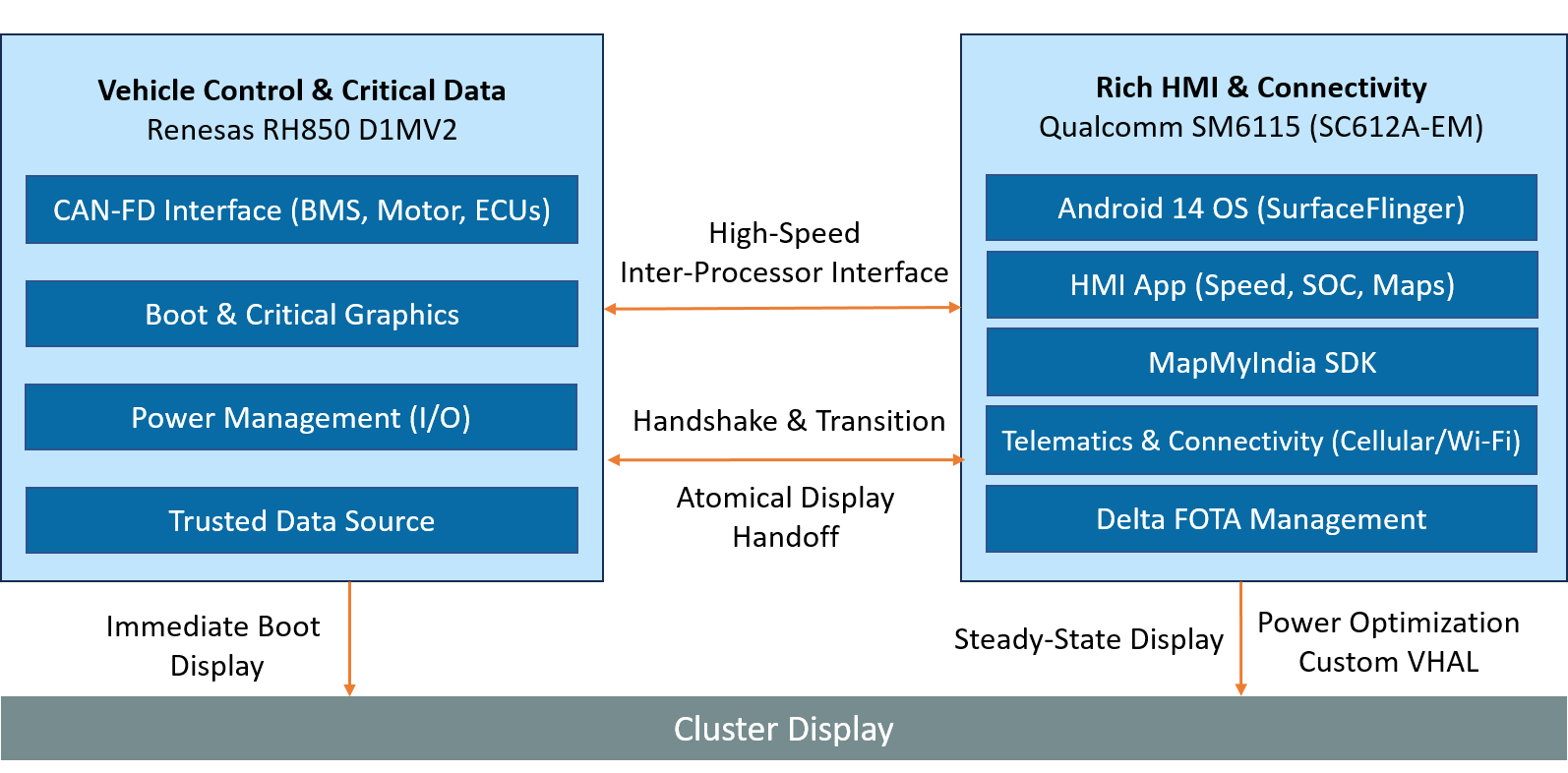
The system is built around two processors with clearly separated responsibilities. The Renesas RH850 D1MV2 owns all vehicle communication, interfacing with the BMS, motor controller, and other ECUs over CAN-FD, running core cluster algorithms, managing power sequencing, and controlling all digital and analog I/O. The Qualcomm SM6115, running Android 14 on the Quectel SC612A-EM module, owns the rich HMI layer, navigation, telematics, connectivity, and OTA management. The two processors communicate over a high-speed inter-processor interface, with the RH850 acting as the trusted source of all vehicle data.
Seamless Display Handoff on Boot
On ignition, the RH850 immediately drives the cluster display, rendering the boot logo, critical battery state, speed, and readiness indicators using its own graphics engine. This ensures the rider always sees a live, informative display from the moment of power-on, with zero dark screen time.
In parallel, Android boots on the Qualcomm processor. A handshake protocol was developed between the RH850 and the Android BSP layer to monitor Android's readiness state. The moment Android signals readiness, the display ownership is transferred atomically from the RH850 renderer to the Android SurfaceFlinger. This transition was engineered to be imperceptible, the last RH850-rendered frame and the first Android-rendered frame are matched in content and timing so the rider sees a continuous, flicker-free display experience.
Android Vehicle HAL Customisation
The Android Vehicle HAL was deeply customised to bridge the RH850's vehicle data domain with Android's property-based vehicle data model. Custom VHAL properties were defined and implemented for EV-specific signals, state of charge, estimated range, regenerative braking mode, motor temperature, fault states, and charging status. A dedicated HAL service handles the CAN-FD data received from the RH850, parses it according to the vehicle's DBC mapping, and updates the corresponding VHAL properties in real time. Android applications consume these properties through standard VHAL APIs, ensuring clean separation between the vehicle domain and the application layer.
HMI Application Development
The cluster application was developed natively in Kotlin, designed specifically for the always-on, distraction-minimised automotive context. Key screens include the main riding display, showing speed, battery state of charge, estimated range, power consumption, riding mode, and tell-tales, along with navigation overlay, charging status, trip summary, and settings. The UI was optimised for glanceable readability, with minimal interaction required while riding. Auto-brightness control using the ambient light sensor was implemented through a custom Android service.
Navigation with MapMyIndia SDK
MapMyIndia SDK was integrated for turn-by-turn navigation, chosen for its comprehensive coverage of Indian roads and offline map capabilities. Navigation instructions, route overlay, ETA, and distance-to-manoeuvre data are rendered directly within the cluster application. The navigation UI was designed to be non-distracting, large, high-contrast directional cues with minimal supporting text, optimised for a riding context.
Telematics and Connectivity
A telematics module was developed to continuously publish vehicle telemetry, location, speed, battery state, energy consumption, fault events, and riding patterns, to the customer's custom cloud backend over MQTT. The telematics service manages connectivity state transitions between cellular and Wi-Fi, implements store-and-forward buffering for periods of network unavailability, and handles secure authentication with the cloud. Bluetooth Hands-Free Profile (HFP) and AVRCP+A2DP profiles are supported for call management and music control from the cluster.
Power Optimisation
Power optimisation was a first-class concern given the EV context. The Android BSP was tuned to aggressively govern CPU and GPU DVFS states based on HMI activity level. Background services were profiled and scheduled to minimise wake-lock duration. The cellular modem, GPS, and Wi-Fi radios are duty-cycled based on vehicle state, reducing power draw significantly during parked or standby modes. The display backlight is managed dynamically using the ambient light sensor. Combined, these measures delivered a meaningful reduction in cluster system power consumption compared to the baseline Android configuration.
Delta FOTA
A Delta FOTA mechanism was implemented to minimise OTA update payload sizes, critical for a cellular-connected vehicle where data cost and download time directly impact user experience. Rather than transmitting full firmware images, the system generates binary diff patches on the server side. The cluster downloads and applies only the delta between the current and target firmware versions. The FOTA process covers both the Android system image on the Qualcomm processor and the RH850 firmware, with the latter updated securely over the inter-processor interface using UDS-based programming sequences. Rollback protection and integrity validation are enforced before any firmware activation.
Benefits
- Seamless display handoff - Imperceptible transition from RH850 boot display to Android HMI, ensuring zero dark-screen time from ignition
- Deep Vehicle HAL integration - Custom VHAL properties expose EV powertrain signals correctly to Android applications
- MapMyIndia navigation - India-optimised navigation with offline capability rendered natively in the cluster app
- Aggressive power optimisation - BSP-level CPU/GPU DVFS tuning and radio duty-cycling reduce cluster system power consumption significantly
- Delta FOTA - Binary diff-based OTA minimises cellular data usage and update download time for both Android and RH850 firmware
- Telematics with store-and-forward - No telemetry data loss even during intermittent connectivity
- Production-grade architecture - Clean separation between real-time vehicle domain (RH850) and rich HMI domain (Android) enables independent development and update cycles
Conclusion
This LoRa and BLE personal tracker technology demonstrator reflects Embien's capability to develop sophisticated multi-mode location and health monitoring wearables for healthcare applications. By combining LoRa, BLE, and GPS location technologies in a context-aware architecture, alongside PPG health monitoring and aggressive multi-subsystem power management, Embien demonstrated a personal tracker concept capable of providing reliable, continuous location and health awareness for autistic individuals across indoor, urban, and outdoor environments within a five-day battery life constraint. This project reflects Embien's experience in multi-radio embedded design, ultra-low power wearable firmware development, and healthcare IoT applications, a combination increasingly relevant as connected health monitoring technology addresses the safety and care challenges faced by individuals with complex needs.