CASE STUDY SNAPSHOT
Customer : A pioneering Indian electric two-wheeler startupSize : 51–200
Project vertical : Automotive, Electric Vehicles, Connected Vehicles
Challenge : Develop a production Android 10 HMI cluster application for an electric two-wheeler covering complete vehicle parameter display, MapMyIndia navigation, telematics with store-and-forward, cloud connectivity, Bluetooth smartphone integration, and over-the-air firmware update of vehicle ECUs, all on a Quectel SC200 based platform
Solution : Production Android 10 HMI cluster application on Quectel SC200 with CAN-based vehicle data acquisition, complete EV parameter display, MapMyIndia SDK navigation, telematics engine with store-and-forward, MQTT cloud connectivity, Bluetooth smartphone integration, and UDS-based ECU FOTA update
Services & Products Availed : Embedded Software Development, Android Application Development, Mobile Application Development, Cloud Integration
Tools and Technologies:
- Application Processor: Quectel SC200
- OS: Android 10 AOSP
- Vehicle Interface: CAN
- Navigation: MapMyIndia SDK
- Cloud: Custom backend over MQTT
- Connectivity: Bluetooth (HFP, AVRCP, A2DP)
- FOTA: UDS-based ECU firmware update
- Telematics: Store-and-forward over cellular
- Languages: Java, Kotlin, C
- FrameworksFrameworks: Android AOSP, CAN stack, UDS stack
Introduction
Electric two-wheelers in the Indian market are evolving rapidly from basic transportation into connected, data-driven vehicles. Riders expect a cluster experience that goes well beyond displaying speed and battery level, they want turn-by-turn navigation, smartphone integration for calls and music, real-time vehicle health visibility, and the assurance that their vehicle's software can be updated seamlessly over the air. For a fleet operator or OEM, the ability to track vehicles in real time, analyse usage patterns, and manage ECU software remotely is equally important.
A pioneering Indian electric two-wheeler startup approached Embien to develop the complete HMI cluster application for their production electric two-wheeler on a Quectel SC200 Android 10 platform. The application had to cover the full spectrum of cluster functionality, from real-time vehicle parameter display and navigation to telematics, cloud connectivity, smartphone integration, and ECU firmware update, in a single, production-ready Android application that would ship with their vehicle to customers across India.
Challenge
The breadth of the application's functional scope was the defining challenge. Developing any one of the required features, navigation, telematics, FOTA, or Bluetooth connectivity, to production standard is a substantial undertaking in its own right. Delivering all of them as a coherent, stable production application on Android 10, within the timeline of a startup's vehicle launch programme, required disciplined software architecture, a modular development approach, and deep expertise across Android application development, automotive CAN protocols, cloud integration, and embedded security.
The CAN vehicle data acquisition architecture had to be designed to reliably receive and process the full set of vehicle signals, battery state of charge, estimated range, motor temperature, vehicle speed, fault codes, charging state, and regenerative braking mode, from multiple ECUs on the vehicle's CAN network, across the full range of vehicle operating conditions. Signal mapping, scaling, and timeout handling had to be implemented correctly for every parameter to ensure the cluster always displayed accurate, current vehicle information.
The telematics store-and-forward requirement introduced resilience complexity. The vehicle operates across India, including areas with intermittent or no cellular connectivity. Telemetry data, location, speed, battery state, energy consumption, and fault events, had to be reliably captured and queued locally when connectivity was unavailable, and uploaded to the cloud backend when connectivity was restored, with no data loss and no duplication of records already successfully transmitted.
The ECU FOTA requirement, updating the firmware of vehicle ECUs over the air using UDS, introduced both technical complexity and a strong reliability requirement. A failed or partial ECU firmware update on a deployed vehicle could render the vehicle inoperable, making the update mechanism's robustness a direct product quality concern.
Solution
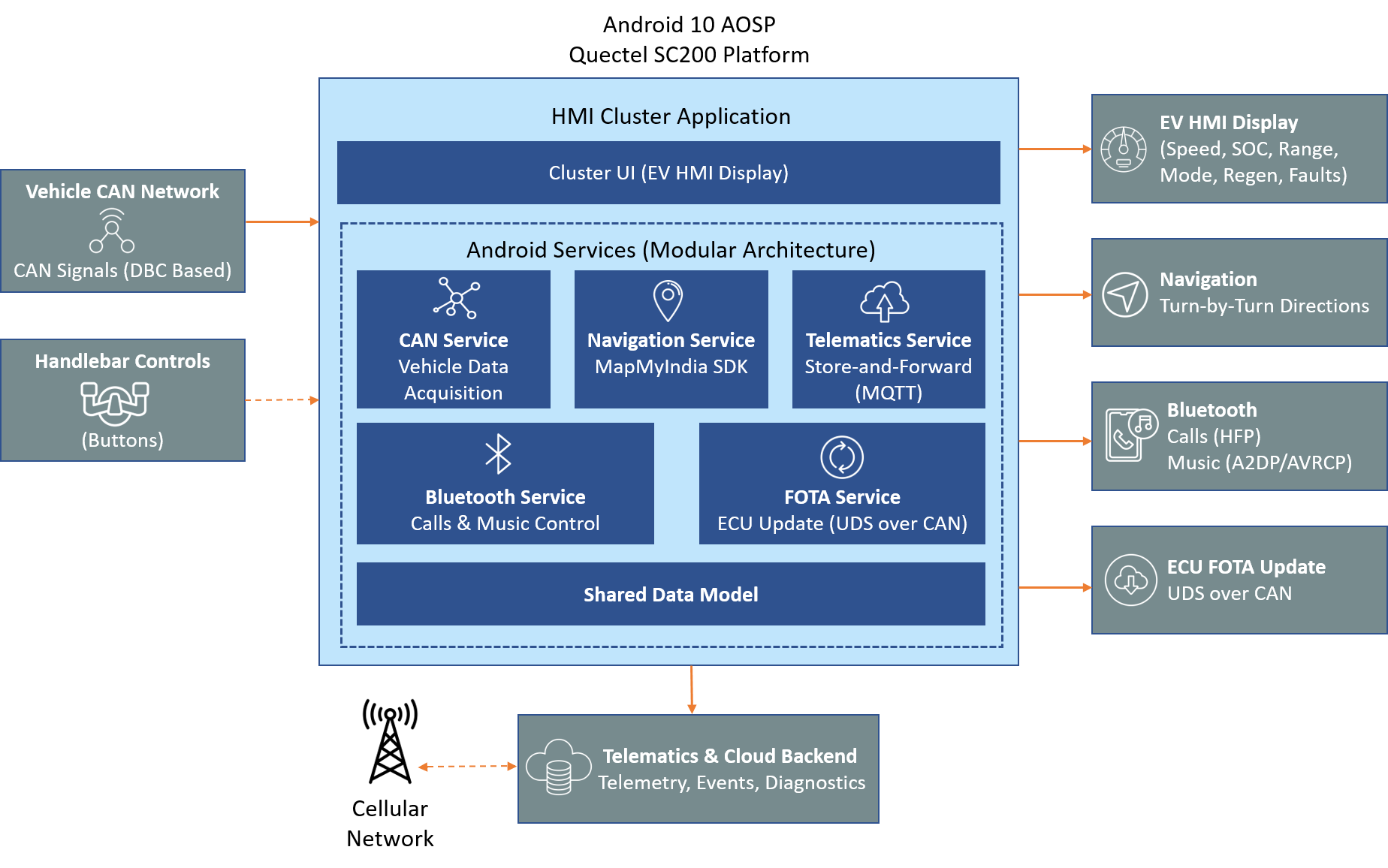
Android 10 Application Architecture
The HMI cluster application was developed on Android 10 AOSP for the Quectel SC200 platform. The application was architected as a set of loosely coupled Android services, each owning a specific functional domain, communicating through well-defined internal interfaces. This modular service architecture enabled parallel development of individual features by dedicated sub-teams and provided clear boundaries for testing and fault isolation. The main cluster UI consumed data from these services through a shared data model, updating the display in response to changes without tight coupling to the underlying data sources.
CAN-Based Vehicle Data Acquisition
All vehicle data is acquired from the vehicle's CAN network through a dedicated CAN service running as a persistent Android background service. The service manages the CAN interface, configuring baud rate, filter masks, and receive buffers, and processes incoming CAN frames against a signal mapping table derived from the vehicle's CAN DBC specification. Decoded signal values, vehicle speed, battery state of charge, estimated range, motor temperature, charging state, fault codes, and regenerative braking mode, are published to the shared data model, from which the cluster UI and telematics service consume them. Timeout monitors detect loss of any critical CAN message and substitute safe default display values, ensuring the cluster behaves correctly when a CAN signal is temporarily unavailable.
Complete EV HMI Display
The cluster application presents a comprehensive electric vehicle instrument display designed for the two-wheeler riding context. The main riding screen shows vehicle speed, battery state of charge with graphical indicator, estimated remaining range, riding mode, regenerative braking level, motor temperature status, and active tell-tales, all updated in real time from the CAN data model. The charging screen presents charging state, current charge level, estimated time to full charge, and charging power. A trip summary screen displays distance covered, energy consumed, average speed, and energy efficiency for the current trip. All screens were designed for glanceable readability, large, high-contrast primary indicators with supporting information in a clearly organised layout appropriate for a riding context.
MapMyIndia SDK Navigation
Turn-by-turn navigation was implemented using the MapMyIndia SDK, chosen for its comprehensive coverage of Indian roads, offline map capability, and optimised routing for Indian traffic conditions. Navigation instructions, directional cues, distance to next manoeuvre, and ETA are rendered as an overlay on the cluster display when an active navigation session is running. The navigation UI was designed specifically for the riding context, large directional arrows and distance callouts that are legible at a glance without requiring the rider to focus on the display.
Telematics with Store-and-Forward
A telematics service continuously captures vehicle telemetry, GPS location, vehicle speed, battery state, energy consumption, fault events, and riding session data, and publishes it to the customer's cloud backend over MQTT. The store-and-forward mechanism maintains a local telemetry queue on the device storage. When cellular connectivity is available, telemetry records are transmitted to the cloud and confirmed records removed from the local queue. When connectivity is unavailable, as commonly occurs in rural areas and urban dead zones, records continue to accumulate in the local queue without loss. On connectivity restoration, queued records are uploaded in chronological order, ensuring the cloud backend receives a complete, uninterrupted telemetry history regardless of connectivity interruptions during the journey.
The telematics service also handles event-based reporting, transmitting critical events such as fault detection, geofence entry or exit, and charging start/stop immediately on occurrence rather than waiting for the next scheduled telemetry upload interval, ensuring time-sensitive fleet management events reach the cloud backend promptly.
Bluetooth Smartphone Integration
Bluetooth connectivity was implemented supporting Hands-Free Profile (HFP) for call management and AVRCP + A2DP for music playback control. Incoming calls are displayed on the cluster with answer and reject options accessible through handlebar controls, keeping the rider's hands on the bars and eyes on the road. Music playback, play, pause, skip, and volume, is controllable from the cluster, with track information displayed on screen. The Bluetooth service manages connection lifecycle, handling reconnection automatically when the rider's paired smartphone comes within range.
ECU FOTA Update
Over-the-air firmware update for vehicle ECUs was implemented using the UDS (Unified Diagnostic Services) protocol over CAN, the standard automotive mechanism for ECU reprogramming. The FOTA service monitors the cloud backend for available firmware updates for each ECU on the vehicle. When an update is available, the firmware image is downloaded securely over HTTPS, validated for integrity and authenticity, and then programmed to the target ECU using the UDS RequestDownload, TransferData, and RequestTransferExit service sequence over CAN.
The update process includes pre-conditions checking, verifying that the vehicle is stationary, the battery state of charge is sufficient, and no active faults are present before initiating programming, to minimise the risk of an interrupted update. Progress is displayed on the cluster display throughout the update process. Rollback protection is enforced, if the ECU fails to boot successfully after update, the cluster detects the failure and reports it to the cloud backend for remote diagnosis.
Benefits
- Production-complete EV HMI Full electric two-wheeler cluster application covering real-time CAN vehicle data display, riding mode management, charging state, trip summary, and tell-tales, production-validated for field deployment across the customer's vehicle fleet
- MapMyIndia navigation India-optimised turn-by-turn navigation with offline map capability rendered natively in the cluster application, providing riders with reliable routing across Indian roads including areas with limited connectivity
- Telematics store-and-forward Local telemetry queuing with cloud synchronisation on connectivity restoration ensures complete, uninterrupted vehicle usage and location history reaches the fleet management backend regardless of cellular coverage gaps
- UDS-based ECU FOTA Pre-conditions validated, integrity-checked over-the-air ECU firmware update over CAN delivers vehicle software updates safely to deployed vehicles without requiring service centre visits
- Integrated smartphone connectivity HFP call management and AVRCP+A2DP music control via Bluetooth keep riders connected to their smartphone through the cluster without requiring phone handling while riding
Conclusion
This production HMI cluster application demonstrates Embien's capability to deliver comprehensive, multi-feature Android automotive software for electric two-wheelers within the demanding timelines of a startup vehicle launch programme. By developing a modular Android 10 application architecture on the Quectel SC200 platform, integrating CAN vehicle data acquisition, MapMyIndia navigation, telematics with store-and-forward, Bluetooth connectivity, and UDS-based ECU FOTA into a coherent, production-ready cluster experience, Embien provided its electric two-wheeler customer with a software foundation that matches the connectivity and feature expectations of the modern Indian EV rider. This project, alongside other Android cluster developments in Embien's automotive portfolio, reflects our growing depth in connected electric vehicle software across the full stack from CAN firmware to cloud telematics.