CASE STUDY SNAPSHOT
Customer : A global leader in medical devices and healthcare solutions, engaged through a specialised engineering services partnerSize : > 10,000
Project vertical : Medical Devices, Cybersecurity, Validation and Verification
Challenge : Perform comprehensive cybersecurity validation and verification of an iMX8-based medical equipment platform, covering OS hardening, network hardening, and code inspection, to ensure the device met the stringent security requirements of the medical device regulatory landscape
Solution : End-to-end cybersecurity V&V engagement covering OS hardening validation, network attack surface testing, code inspection and vulnerability analysis, with structured test reports meeting medical device regulatory submission standards
Services & Products Availed : Embedded Systems Testing, Cybersecurity Validation and Verification, Medical Device Software Testing
Tools and Technologies:
- Platform: NXP iMX8 based medical equipment
- OS: Embedded Linux
- Security Testing: OS hardening validation, network hardening, code inspection
- Standards: Medical device cybersecurity guidelines
- Languages: C, C++
- Tools: Static analysis tools, network testing tools, vulnerability scanners
Introduction
Cybersecurity has become a first-class requirement in medical device development. Regulatory bodies worldwide, including the FDA and equivalent authorities in other geographies, now require medical device manufacturers to demonstrate that their products have been systematically evaluated for cybersecurity vulnerabilities and that identified risks have been mitigated to an acceptable level before market authorisation is granted. For connected medical devices running embedded Linux on modern application processors, this cybersecurity evaluation spans the operating system configuration, the network interfaces, and the application software itself, each representing a distinct attack surface that must be rigorously assessed.
A global leader in medical devices and healthcare solutions, engaged through a specialised engineering services partner, required a comprehensive cybersecurity validation and verification engagement for their iMX8-based medical equipment platform. The device had undergone security hardening across its OS configuration, network stack, and application software, and needed an independent, structured V&V assessment to validate that the hardening measures were effective, comprehensive, and correctly implemented, producing the test evidence required for regulatory submission.
Embien was engaged to plan and execute this V&V programme, defining the test approach for each security domain, developing and executing the test cases, documenting the findings, and producing the structured test reports required by the customer's regulatory submission process.
Challenge
Medical device cybersecurity V&V is a discipline that sits at the intersection of embedded systems expertise, security testing capability, and regulatory process knowledge. Generic IT security testing approaches, while valuable, do not directly translate to the embedded medical device context, where the test approach must account for the resource constraints of the embedded platform, the specific regulatory requirements applicable to medical device software, and the need to produce structured, auditable test evidence rather than simply identifying vulnerabilities.
The OS hardening scope required validating a broad range of system-level security controls, secure boot configuration, filesystem permissions, unnecessary service removal, debug interface restrictions, and kernel hardening parameters, each of which had to be tested against a defined expected state and the result documented with sufficient detail for regulatory review.
Network hardening validation required assessing the device's exposure across all its network interfaces, evaluating port configurations, protocol behaviour, authentication mechanisms, and resilience against common network-based attack patterns. Testing had to be conducted in a way that was representative of real-world attack scenarios while remaining safe to execute on medical equipment hardware.
Code inspection required a systematic review of the application software for security-relevant weaknesses, including memory safety issues, input validation gaps, use of deprecated or insecure APIs, dependency vulnerabilities, and process permission configurations, producing findings with sufficient technical detail for the development team to act on and for the regulatory submission to reference.
Across all three domains, the test documentation had to meet the customer's regulatory submission standards, with each test case capturing the brief introduction about the necessity of the test, the test approach, the required hardware and software components with version information, detailed step-by-step test procedures, expected and observed results, and the testing engineer's assessment with pass/fail determination, notes, and signature.
Solution
V&V Programme Planning
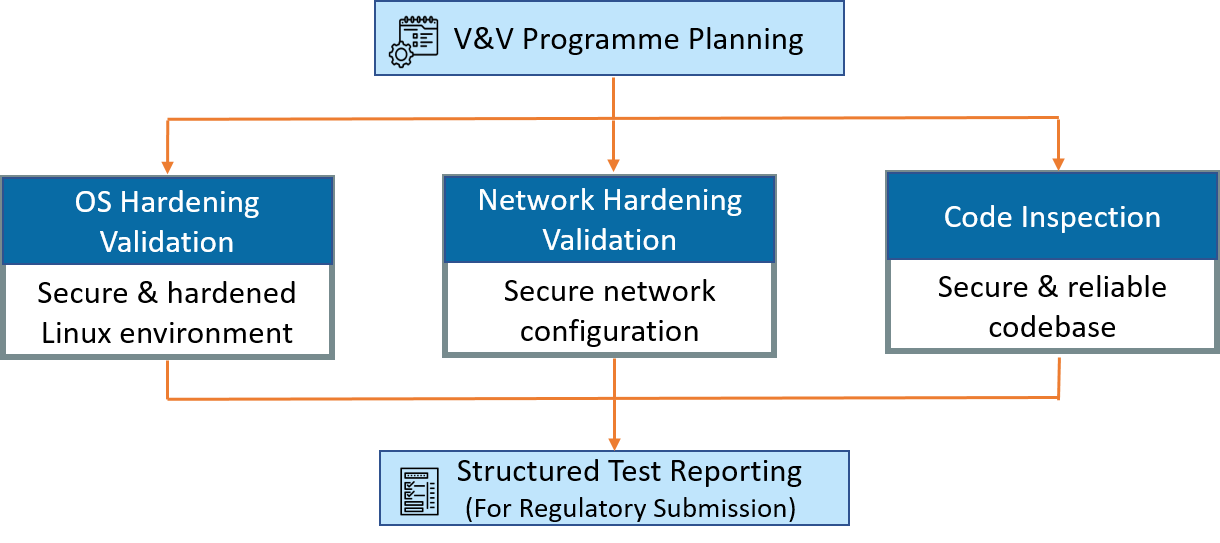
Embien began the engagement by working with the customer's development and quality teams to understand the security architecture of the iMX8-based medical equipment, the hardening measures that had been applied, and the regulatory submission requirements the V&V output had to satisfy. A structured V&V programme was defined, covering the three security domains of OS hardening, network hardening, and code inspection, with a test plan documenting the scope, approach, test environment requirements, and documentation standards for each domain.
OS Hardening Validation
The OS hardening validation covered the full scope of system-level security controls applied to the embedded Linux platform. Test cases were developed and executed for secure boot chain validation, filesystem mount options and permission configurations, identification and verification of removed or disabled unnecessary services and daemons, debug interface access restrictions including JTAG and serial console controls, kernel hardening parameter verification, and user account and privilege configuration. Each test case was executed against the target hardware and the observed system state compared to the expected hardened configuration. Deviations, where the observed state did not match the expected hardened state, were documented as findings with sufficient technical detail for the development team to assess and remediate.
Network Hardening Validation
Network hardening validation assessed the device's attack surface across all active network interfaces. Test cases covered network port enumeration and verification against the expected open port set, protocol behaviour testing for each exposed service, authentication mechanism validation, Wi-Fi security configuration assessment, and evaluation of the device's resilience against common network-based attack patterns including denial of service attempts and protocol fuzzing. Testing was conducted using industry-standard network testing tools in a controlled test environment, with all findings documented with the test approach, tools used, observed results, and pass/fail determination.
Code Inspection
The code inspection domain covered a systematic review of the medical equipment's application software for security-relevant weaknesses. Static analysis tools were applied to the codebase to identify memory safety issues, buffer overflows, use-after-free conditions, and integer overflow vulnerabilities, alongside use of deprecated or insecure library functions and API calls. Input validation coverage was reviewed for all external data ingestion points, network interfaces, file inputs, and inter-process communication channels. Third-party dependency versions were checked against known vulnerability databases. Process permission configurations, ensuring application processes ran with the minimum privilege level required for their function, were verified. Findings were documented with sufficient technical context for the development team to understand the nature of each issue, assess its risk in the medical device context, and implement appropriate remediation.
Structured Test Reporting
All test results, across OS hardening, network hardening, and code inspection, were documented in structured test reports meeting the customer's regulatory submission standards. Each test case report captured the rationale for the test, the test approach and methodology, the hardware and software environment including component versions, step-by-step test procedures, expected and observed results, and the testing engineer's pass/fail determination with supporting notes and signature. The structured format ensured that the V&V evidence was directly usable in the regulatory submission package without requiring reformatting or supplementation.
Benefits
- Regulatory-ready V&V evidence Structured test reports covering OS hardening, network hardening, and code inspection produced to the customer's regulatory submission standards, directly usable in the medical device market authorisation package
- Comprehensive three-domain coverage Systematic validation across OS configuration, network attack surface, and application code provides a complete cybersecurity assurance picture for the iMX8-based medical platform
- Independent assessment value Third-party V&V execution by Embien provides the independence and objectivity that regulators and quality auditors expect from a medical device cybersecurity evaluation
- Actionable findings All deviations and vulnerabilities documented with sufficient technical detail for the development team to understand, prioritise, and remediate each finding effectively
- Embedded medical device expertise V&V approach tailored to the specific constraints and regulatory context of embedded medical equipment, going beyond generic IT security testing to address the unique characteristics of the medical device platform
Conclusion
This medical device cybersecurity V&V engagement demonstrates Embien's capability to deliver structured, regulatory-grade security validation and verification for embedded medical equipment. By executing a comprehensive V&V programme across OS hardening, network hardening, and code inspection, and producing structured test reports meeting regulatory submission standards, Embien provided its customer with the cybersecurity assurance evidence required to support their market authorisation process. This project reflects Embien's growing depth in medical device software testing and cybersecurity validation, a combination of embedded systems expertise, security testing capability, and regulatory process knowledge that is increasingly essential as medical device cybersecurity requirements continue to strengthen globally.