CASE STUDY SNAPSHOT
Customer : An Indian Smart energy meter system integratorSize : >51-200
Project vertical : Industrial
Challenge : Retrofit mechanism to acquire data from energy meters over wireless.
Solution : Leverage eStorm-B1 wireless module to acquire data from IEC 62056 port.
Services & Products Availed : Product engineering services, Rapid prototyping, NXP Partner
Tools and Technologies :
- Key Hardware: NXP KW36A based eStorm-B1
- Software Development: C
- Frameworks: MCUXpresso IDE
- Peripherals: IEC 62056, BLE etc
INTRODUCTION
A leading Indian smart energy metering company faced the challenge of modernizing data collection from millions of deployed digital meters. They needed a cost-effective, non-invasive solution to replace manual, wired readings with a faster, wireless process, leveraging the power of modern smartphones for improved efficiency and data management.
CHALLENGE
The primary obstacle was the immense cost and logistical complexity of replacing millions of functional energy meters across India. A full-scale upgrade was not feasible. The existing meters used a standard IEC 62056 optical port for data acquisition via proprietary, wired handheld devices. This process was slow, cumbersome for field engineers, and lacked a direct path to the cloud. The challenge was to create a secure, tamper-proof, and ultra-low-power wireless solution that could retrofit onto these existing meters, communicate with a standard smartphone, and drastically reduce the time and cost of energy billing cycles.
SOLUTION
The eStorm-B1 Powered Optical-to-BLE Bridge
Embien was approached to engineer an innovative solution that could wirelessly bridge the gap between the meter's optical port and a smartphone. While the client was developing their own Android application for data collection, they needed a hardware and embedded firmware specialist to create the physical interface—a compact, battery-powered module that could read meter data and transmit it seamlessly.
Understanding the Existing Infrastructure
Our engineering team began by analyzing the existing setup. The energy meters featured a standard optical port, a non-invasive interface using an infrared LED and a photodiode, compliant with the IEC 62056 standard for utility meter data exchange. This port allowed for secure, two-way communication without opening the meter's enclosure. A handheld device with a matching magnetic connector would be physically attached to the meter for each reading. Our goal was to replace this physical connection with a wireless link.
Proposing the eStorm-B1 Platform
After a detailed requirement analysis, Embien proposed a solution centered around our production-ready eStorm-B1 BLE module. This module was the ideal choice for several key reasons:
- Ultra-Low Power Consumption: The device needed to be battery-operated and last for thousands of readings. The eStorm-B1 is specifically designed for low-energy IoT applications, making it perfect for this use case.
- Compact Form Factor: The entire converter module had to be small enough to fit neatly onto the meter's existing optical port socket. The compact dimensions of eStorm-B1 made this integration straightforward.
- Rapid Development: As a pre-certified and proven platform, eStorm-B1 allowed us to significantly accelerate the development timeline, moving from concept to prototype in record time.
Hardware and Firmware Development
With the customer's approval, our team designed a compact hardware prototype. This board integrated the eStorm-B1 module with the necessary infrared LED and photodiode components to communicate optically with the energy meter. The entire unit was designed to be powered by a small, non-rechargeable battery.
The core of the solution lay in the embedded firmware developed by Embien. We programmed the eStorm-B1 to function as a transparent data bridge. The workflow was as follows:
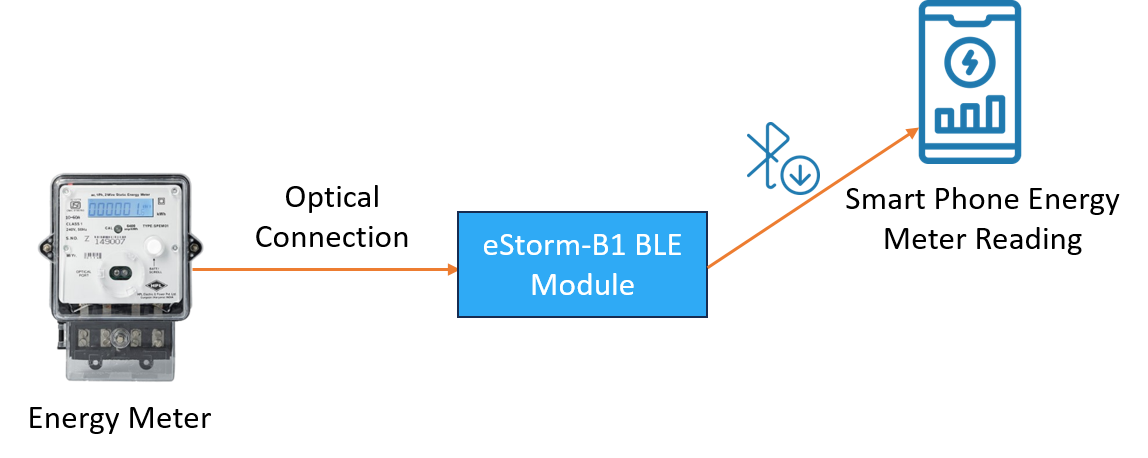
Energy Meter Reading using eStorm-B1 BLE Module
- The field engineer's smartphone, running the data acquisition app, sends a command request (e.g., "Read Current Meter Value") via BLE.
- The eStorm-B1 module receives this wireless command.
- The firmware instantly translates and transmits the command to the energy meter through the optical port using modulated infrared light.
- The energy meter processes the command and sends its response back through the optical port.
- The eStorm-B1's photodiode captures the response, and the firmware transmits this data packet back to the smartphone app via BLE.
A critical part of the firmware was an intelligent power management system. The module remained in a deep sleep state, consuming minimal power, and only woke up when a BLE connection was initiated. This efficiency was key to achieving a battery life capable of lasting for more than 6,000 meter readings on a single battery.
Testing and Delivery
To ensure flawless operation and de-risk the project for our client, Embien also developed a dedicated test Android application. This allowed us to rigorously test every command set and validate the end-to-end communication flow before delivering the hardware.
The entire project, from initial design to delivery of the final, tested prototypes, was completed within an exceptionally short timeline of two weeks. This rapid deployment was a direct result of leveraging our versatile eStorm platform.
Benefits
By partnering with Embien, the customer gained significant competitive advantages:
- Modernized Legacy Systems: They successfully upgraded their data acquisition process without the prohibitive cost of replacing millions of meters.
- Eliminated Proprietary Hardware: The solution replaced expensive, custom handheld readers with ubiquitous smartphones, drastically reducing capital expenditure.
- Increased Operational Efficiency: The meter reading process was significantly accelerated, allowing field engineers to complete their routes faster and reduce billing cycle times.
- Enabled Cloud Connectivity: Data could now be pushed directly from the smartphone app to a central cloud server, enabling real-time data analysis and management.
- Rapid Time-to-Market: Embien's platform-based approach delivered a custom-engineered solution in just two weeks, allowing the customer to launch their new service far ahead of schedule.
Conclusion
This project is a prime example of how Embien's expertise in embedded systems and IoT solutions can solve complex industrial challenges. By creating a custom BLE-to-Optical bridge using our eStorm-B1 platform, we provided a solution that was not only technologically elegant but also immensely practical and commercially viable. Our rapid, platform-driven development model empowers our clients to innovate quickly and stay ahead in a competitive market.
If your business faces challenges in data acquisition, legacy system modernization, or requires a custom IoT solution, contact Embien today. Let us help you turn your concept into a market-ready reality.