CASE STUDY SNAPSHOT
Customer : Global Automotive Tier 1 SupplierSize : 1000 – 10000
Project vertical : Automotive Infotainment & Digital Cockpit
Challenge : Developing a dual-processor, high-speed Android-based smart cluster with complex vehicle networking and stringent security requirements.
Solution : A heterogeneous architecture featuring i.MX8 and RH850, running Android Automotive 10 with custom Vehicle HAL and a secure OTA framework.
Services & Products Availed : Hardware Design, Android Porting, Firmware Development, Signal Integrity Analysis, Security Integration
Tools and Technologies :
- Key Hardware: NXP i.MX8 QuadPlus, Renesas RH850-F1KM, Quectel LTE/GNSS, Murata WiFi/BT.
- Software/OS: Android Automotive 10, FreeRTOS (MCU), C/C++, Java.
- Frameworks: Android Vehicle HAL (VHAL), Google Security Patch Integration.
- Tools: Hyperlynx (SI Analysis), Altium Designer, Android Studio, Green Hills/IAR for MCU.
Introduction
A leading global Automotive Tier 1 supplier sought to redefine the digital cockpit experience by developing a high-performance, Android-based Smart Cluster. They required a partner capable of merging high-end infotainment features with critical vehicle-grade reliability. Embien was chosen to design the complete hardware and software stack for this sophisticated dual-processor system.
Challenge
The project presented significant engineering hurdles, primarily the integration of a rich Android Automotive 10 environment with real-time vehicle diagnostics. The system had to handle high-speed signal integrity for a 12-layer PCB while managing complex power states between an application processor (i.MX8) and a safety-critical MCU (RH850). Additionally, the customer required a seamless, secure Over-the-Air (OTA) update mechanism and a comprehensive suite of wireless connectivities (LTE, GNSS, WiFi, BT) that met automotive EMI/EMC standards. Ensuring low-latency boot-up times and reliable "Wake-up CAN" support was essential for a production-grade automotive environment.
Solution
Embien’s solution was built on a sophisticated heterogeneous computing architecture designed to balance rich user interface requirements with the rigorous safety standards of the automotive industry.
Core Hardware Architecture
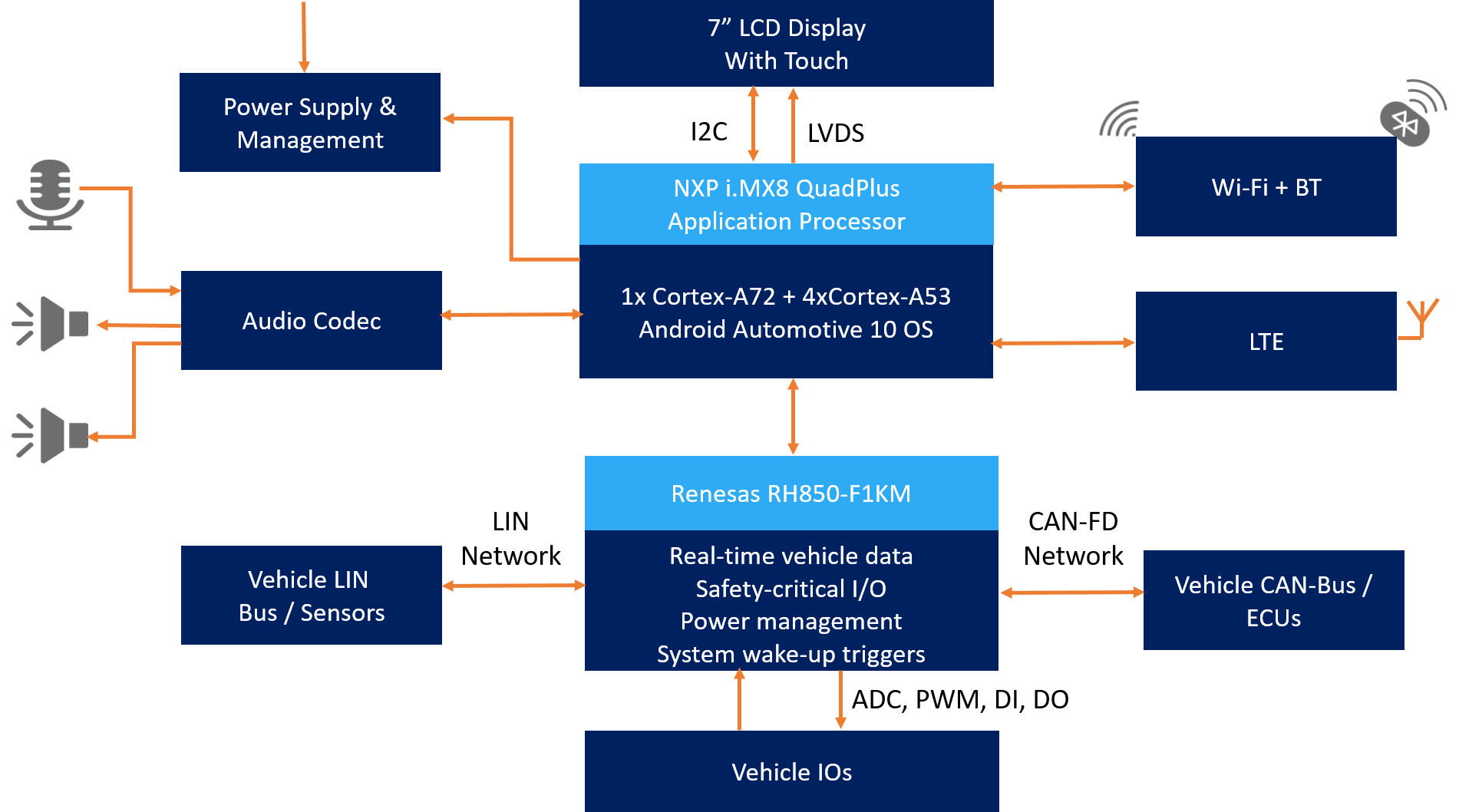
At the heart of the system, Embien integrated the NXP i.MX8 QuadPlus as the primary Application Processor. Utilizing a combination of one Cortex-A72 and four Cortex-A53 cores, this processor handled the heavy lifting for the Android Automotive 10 OS, rendering high-definition graphics for the 7” LCD display. To ensure a fluid user experience, the display was interfaced via LVDS with an I2C-based capacitive touch controller.
To manage real-time vehicle data and safety-critical I/O, Embien utilized the Renesas RH850-F1KM MCU. This secondary processor acted as the "gatekeeper" for the vehicle’s CAN-FD and LIN networks, handling power management and system wake-up triggers independently of the main OS.
Connectivity and Sensor Integration
The cluster was designed to be a fully connected hub. Embien integrated:
- Wireless: A Quectel AG35-E module provided robust LTE and GNSS capabilities, while a Murata LBEE6XX1UR module enabled high-speed WiFi and Bluetooth 5.0.
- Audio/Video: The system supported an analog camera input via an onboard decoder for rearview or cabin monitoring. The audio subsystem featured a dedicated codec with Class-D amplifiers for dual speaker output and dual microphone inputs for Bluetooth hands-free communication.
- Sensing: An onboard ambient light sensor enabled automatic brightness adjustments, while a 6-axis MEMS sensor (accelerometer and gyroscope) provided critical motion data for vehicle dynamics and navigation assistance.
Advanced Vehicle Networking & I/O
The RH850 MCU was configured to handle a massive array of physical inputs, ensuring compatibility with various vehicle sensors and switches:
- Digital I/O: 10 active-low and 17 active-high inputs.
- Analog/Pulse: 4 resistive inputs and 3 pulse inputs for frequency-based sensor data.
- Networking: Full support for CAN-FD with wake-up functionality and LIN for peripheral control.
Software Engineering & Android Automotive 10
Embien ported Android Automotive 10 to the i.MX8 platform, developing custom Vehicle HAL (VHAL) layers to bridge the communication between the Android properties and the MCU-side vehicle data. This allowed the Android UI to display real-time speed, RPM, fuel levels, and diagnostic alerts with minimal latency.
High-Speed PCB Design & Signal Integrity
A 12-layer PCB was necessitated by the high density of components and the speed of the DDR and LVDS signals. Embien’s hardware team performed rigorous post-layout verification using Hyperlynx to validate signal integrity (SI) and power integrity (PI), ensuring that high-speed traces were free from crosstalk and EMI issues, a critical step for automotive certification.
Security and OTA Updates
To protect the system from cyber threats, Embien implemented a Secure Boot chain, ensuring only signed code could execute. The OTA (Over-the-Air) update framework was designed for maximum flexibility and reliability over WiFi. It supported:
- Differential updates (Application only or File system only).
- Full Image flashing for critical system-wide changes.
- Encrypted and Signed Update Images to prevent unauthorized firmware tampering.
Benefits
Seamless Integration:Successfully bridged the gap between high-performance Android infotainment and safety-critical vehicle I/O via a dual-processor architecture.
Enhanced Reliability:Achieved superior signal integrity on a complex 13-layer PCB through advanced simulation and validation tools.
Future-Proof Connectivity:Integrated LTE, GNSS, and WiFi/BT 5.0 to support modern connected-car features and driver assistance.
High Security:Guaranteed system integrity through Secure Boot and an encrypted, multi-tier OTA update mechanism.
Optimized Power Management:Reduced battery drain through dedicated MCU-controlled power states and "Wake-up CAN" functionality.
Conclusion
Through this project, Embien demonstrated its ability to deliver a robust, production-ready Smart Cluster that meets the high standards of the global automotive Tier 1 industry. By combining deep expertise in Android Automotive porting with rigorous hardware engineering and secure firmware practices, we provided a solution that is both technologically advanced and inherently secure.