CASE STUDY SNAPSHOT
Customer : A specialist industrial automation OEM delivering IoT gateway solutions for manufacturing environmentsSize : 51–200
Project vertical : Industrial Automation, Industrial IoT
Challenge : Develop a cross-platform mobile application for real-time monitoring, remote control, and field commissioning of industrial IoT gateways, with a particular emphasis on simplifying gateway onboarding through augmented reality
Solution : An Android and iOS IoT monitor application featuring AR-guided gateway onboarding, real-time WebSocket telemetry, remote Modbus write, voice control, FCM push notifications, and custom dashboard widgets
Services & Products Availed : Mobile Application Development, UI/UX Design
Tools and Technologies :
- Platforms: Android, iOS
- Languages: Kotlin, Swift
- AR Frameworks: ARCore (Android), ARKit (iOS)
- Protocols: WebSocket (real-time telemetry), Modbus TCP (remote write via gateway), MQTT
- Notifications: Firebase Cloud Messaging (FCM)
- Maps: Google Maps SDK
- Voice: Android native Speech Recognition
- Backend: REST API (Retrofit, OkHttp)
Introduction
Industrial IoT gateways aggregate data from field devices, PLCs, sensors, meters, and actuators, and make that data available to plant operators, maintenance engineers, and remote supervisors. However, even the most capable gateway hardware is only as useful as the tools available to configure, commission, and monitor it. Manual commissioning processes are time-consuming and error-prone in busy plant environments, and traditional dashboard interfaces offer little contextual guidance to field technicians unfamiliar with a specific gateway installation.
A specialist industrial automation OEM approached Embien to develop a cross-platform mobile application for Android and iOS that would serve as the primary interface for their IoT gateway product line. The application had to cover the full operational lifecycle of a gateway deployment, from initial commissioning in the field through day-to-day monitoring, remote control, and event response. A key mandate from the customer was to make gateway onboarding dramatically simpler using augmented reality, transforming what was previously a manual, documentation-heavy process into an intuitive, guided experience directly on the technician's smartphone.
Challenge
Industrial environments present unique constraints for mobile applications. Plant floors are noisy, physically demanding, and often have intermittent connectivity. Technicians may be commissioning gateways in locations with poor lighting, limited space, and no access to documentation. The onboarding process had to be reliable and intuitive enough to be completed by a field technician with minimal training.
Beyond onboarding, the application had to maintain real-time telemetry from multiple gateways simultaneously using WebSocket connections, displaying live sensor data, device states, and event streams without latency. Remote Modbus write capability, allowing operators to send control commands to field devices through the gateway, introduced strict requirements around command confirmation, error handling, and audit visibility. The voice control interface needed to function reliably in a noisy industrial environment where typed input is impractical. Finally, the application had to deliver immediate push notifications for critical gateway events, alarms, threshold breaches, and connectivity failures, even when the application was not in the foreground.
Solution
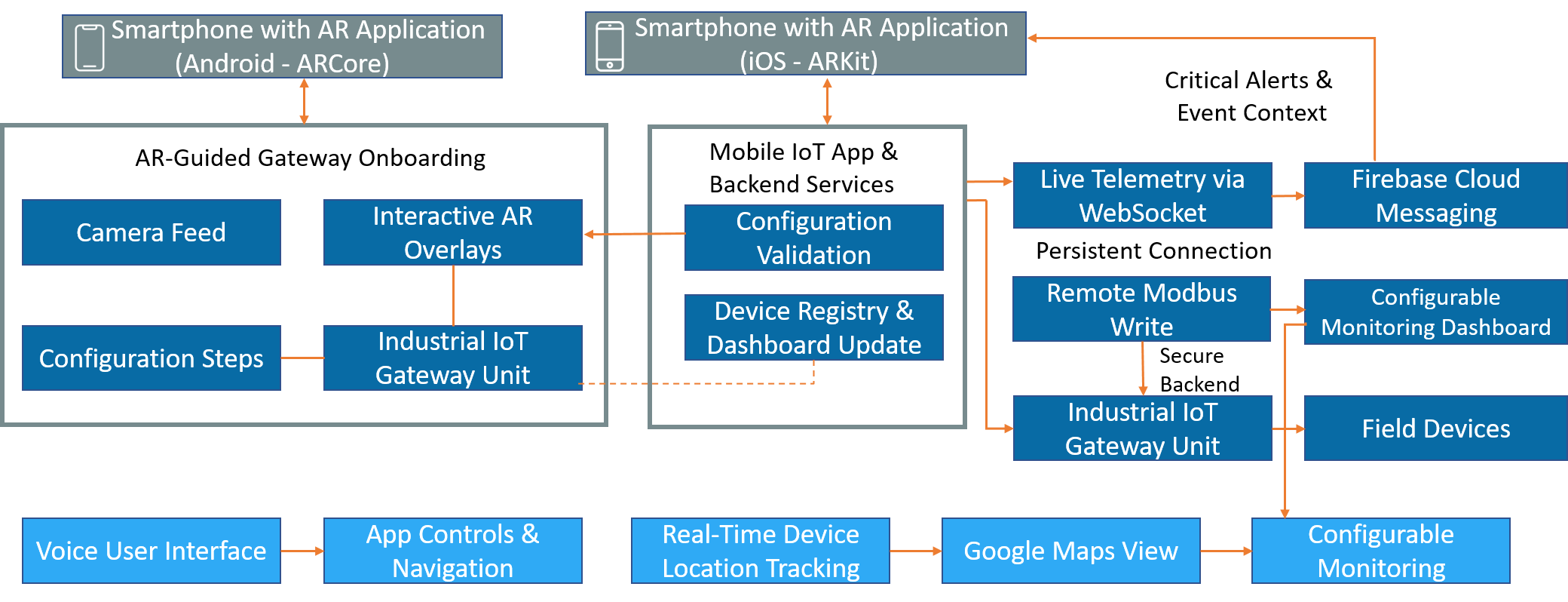
AR-Guided Gateway Onboarding
The standout feature of the application is its augmented reality onboarding experience, the capability that most significantly differentiates it in the industrial IoT space. Built using ARCore on Android and ARKit on iOS, the AR onboarding system guides field technicians through the complete gateway installation and commissioning process using interactive visual overlays rendered directly on the live camera feed of their smartphone.
When a technician arrives at a new gateway installation, they launch the AR onboarding flow and point their phone at the gateway unit. The application uses the device's camera and the AR framework's plane detection and object recognition capabilities to identify the gateway and its physical interfaces. Once recognised, interactive AR annotations appear overlaid on the gateway, highlighting specific ports, indicating correct cable connections, showing status LED meanings, and stepping the technician through the configuration sequence in order.
Configuration parameters such as network settings, Modbus slave addresses, polling intervals, and cloud connectivity credentials are entered directly within the AR interface as the technician works through each step. The AR system validates each configuration action before advancing, preventing common commissioning errors. On completion, the gateway is automatically registered to the technician's account and appears in the monitoring dashboard, ready for live data. The entire onboarding process, from physical inspection to live dashboard appearance, is completed without the technician consulting any external documentation.
This AR-first onboarding approach reduced gateway commissioning time significantly and virtually eliminated configuration errors that previously required return site visits to resolve.
Real-Time Telemetry via WebSocket
Once a gateway is commissioned, the application maintains a persistent WebSocket connection to each registered gateway through the customer's IoT backend. Live telemetry including sensor readings, device states, I/O values, protocol-level data from Modbus-connected field devices, and gateway health metrics, streams continuously to the application and is presented through a configurable dashboard.
The dashboard supports a rich widget library tailored for industrial monitoring: line and bar charts for trend visualisation, real-time meters and gauges, status lights, tank level indicators, and data tables. Users configure their dashboard layout per gateway, selecting the data points and widget types most relevant to their role and application. Multiple gateways can be monitored simultaneously, with the application managing independent WebSocket sessions per device and aggregating status across the fleet in a unified view.
Remote Modbus Write
The application supports remote Modbus write operations, allowing operators to send control commands to field devices connected to the gateway, directly from their smartphone. Commands are transmitted to the gateway over the secure backend connection, and the gateway issues the corresponding Modbus write request to the target field device. Each write operation is confirmed with a response indicating success or failure, with detailed error information surfaced to the operator. All write operations are timestamped and logged within the application for audit purposes, meeting the traceability requirements of industrial control environments.
Voice User Interface
A voice control interface was implemented using Android's native Speech Recognition framework, enabling operators to interact with the application hands-free, particularly valuable in plant environments where wearing gloves or carrying tools makes touchscreen interaction impractical. Voice commands support navigation between gateway dashboards, querying current sensor values, acknowledging alarms, and triggering specific monitoring views. The voice interface was tuned for industrial terminology and short-form command structures that work reliably even in moderate background noise.
Real-Time Device Location Tracking
Gateway locations are tracked on an interactive Google Maps view, providing a geospatial overview of the entire deployed fleet. This is particularly useful for organisations managing gateways across multiple sites or across a large plant facility. Tapping a gateway marker on the map opens its live dashboard directly, enabling rapid navigation between the fleet view and individual device monitoring.
FCM Push Notifications
Firebase Cloud Messaging was integrated to deliver immediate push notifications for critical gateway events, threshold breaches, device communication failures, power events, and custom alarm conditions configured per gateway. Notifications are delivered even when the application is in the background or the device screen is off, ensuring operators are alerted to critical conditions without needing to keep the application open. Notification payloads carry sufficient context, gateway ID, event type, severity, and timestamp, that operators can assess urgency without opening the application.
Benefits
- AR onboarding - ARCore and ARKit-powered guided commissioning eliminates documentation dependency, dramatically reduces installation time, and virtually eliminates configuration errors in the field
- Real-time multi-gateway telemetry - Persistent WebSocket connections deliver live data from multiple gateways simultaneously with no perceptible latency
- Remote Modbus write - Secure, confirmed remote control of field devices through the gateway with full audit logging
- Voice control - Hands-free operation using Android native Speech Recognition enables practical use in active plant environments
- Configurable dashboards - Industrial widget library allows operators to build monitoring views tailored to their specific process and role
- Geospatial fleet view - Google Maps integration provides instant situational awareness across distributed gateway deployments
- Immediate push alerts - FCM-powered notifications ensure critical events are never missed regardless of application state
Conclusion
This project demonstrates Embien's ability to build sophisticated industrial mobile applications that go well beyond conventional monitoring dashboards. The AR-guided onboarding experience, built on ARCore and ARKit, represents a meaningful advance in how field technicians interact with industrial IoT hardware, replacing error-prone manual processes with an intuitive, validated, step-by-step guided flow. Combined with real-time telemetry, remote Modbus control, voice interaction, and push alerting, the application delivers a complete operational tool for the full gateway deployment lifecycle. This project reflects Embien's depth in both mobile application development and industrial IoT protocols, a combination that is increasingly essential as the boundary between the plant floor and the smartphone continues to dissolve.