CASE STUDY SNAPSHOT
Customer : Leading International Aircraft OEMSize : >1000 – 10000
Project vertical : Aerospace & Avionics
Challenge : Developing a secure, safety-critical multi-node battery monitoring system meeting stringent aircraft subsystem demands within a tight 6-month window.
Solution : A distributed Hub-and-Node architecture using STM32H7, featuring proprietary CAN protocols, secure boot (SBSFU), and MQTT over TLS for server connectivity.
Services & Products Availed : Embedded Hardware Design, Firmware Development, TARA (Threat and Risk Analysis), Cyber-security Auditing, System Integration
Tools and Technologies :
- Key Hardware: STM32H753ZITx (ARM Cortex-M7)
- Interface: CAN (Proprietary Protocol), Ethernet
- Communication: MQTT over Secure TLS
- Security: STM32 SBSFU (Secure Boot Secure Firmware Update), TARA, Black Duck (Software Composition Analysis)
- Programming: Embedded C/C++
- Frameworks: FreeRTOS, LwIP
Introduction
Our customer, a prominent international leader in aircraft systems, required a sophisticated monitoring solution for their next-generation Lithium-Ion battery arrays. Facing the rigorous safety standards of the aviation industry, they needed a partner capable of delivering a high-performance, secure, and distributed electronic monitoring architecture to ensure optimal power management and flight safety.
Challenge
The primary challenge for the Li-Ion Battery Monitoring System lay in the extreme reliability and security requirements inherent to aerospace applications. The system needed to monitor multiple battery units simultaneously with high precision, requiring a distributed architecture that could operate in harsh environments. Communication between units had to be immune to interference and unauthorized access, necessitating a custom, proprietary protocol over CAN. Furthermore, the integration of server-based monitoring via MQTT required a robust cybersecurity framework, including secure boot and encrypted channels. Completing the hardware design, firmware development, and rigorous safety audits including a full Threat and Risk Analysis (TARA), Software Composition Analysis within a strict six-month timeline added immense pressure to the engineering cycle.
Solution
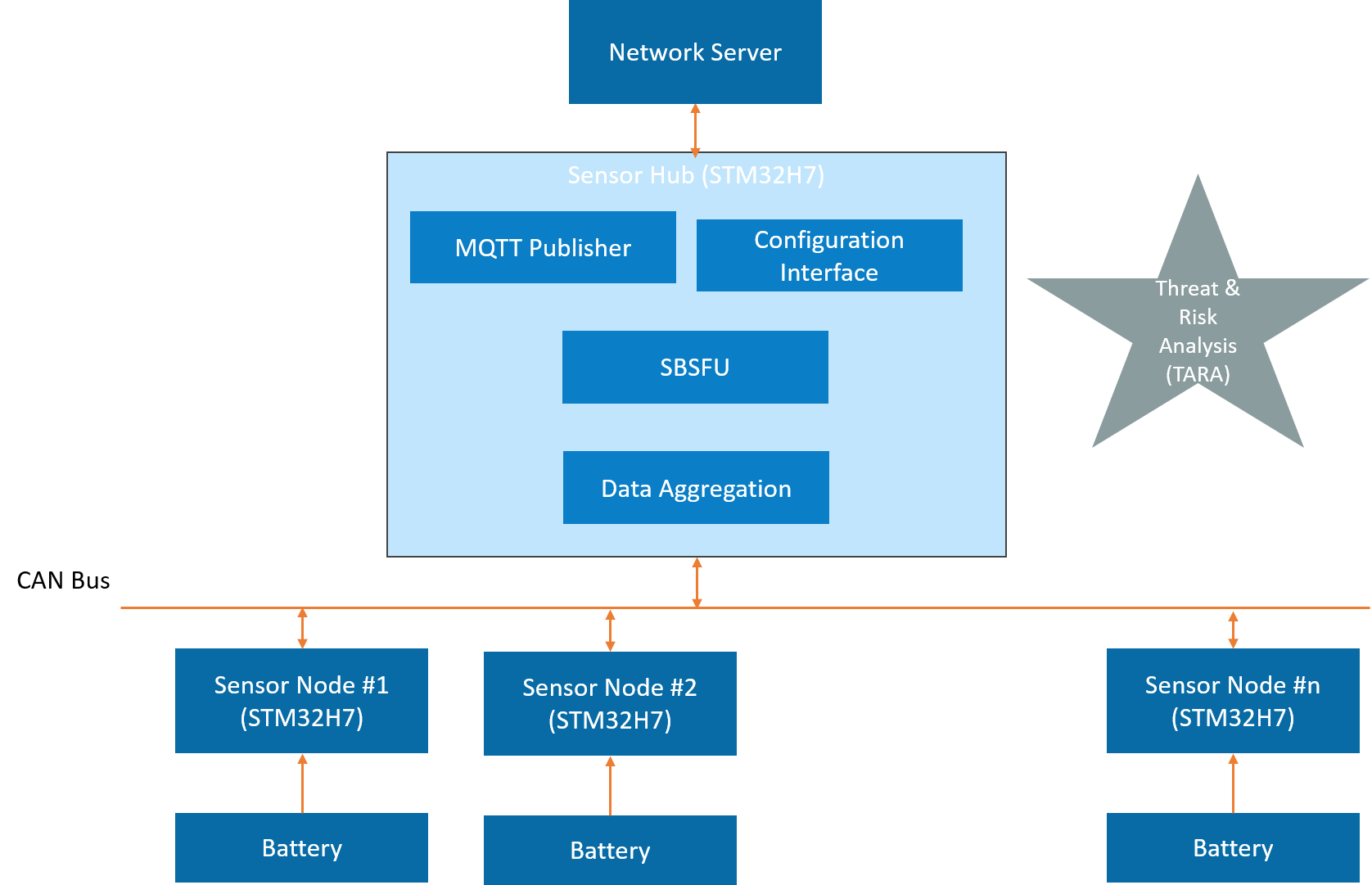
Embien addressed this complex requirement by designing a high-speed, distributed architecture consisting of a centralized Hub and multiple Nodes. This modular approach allowed for scalable Li-Ion Battery Monitoring System tailored to various aircraft configurations.
Hardware & Core Architecture
Both the Hub and the Nodes were built upon the powerful STM32H753ZITx microcontroller. This high-performance ARM Cortex-M7 core was selected for its high clock speeds, advanced security features, and the reliability required for safety-critical avionics. Each Node was dedicated to monitoring individual battery cells, collecting real-time data on voltage, temperature, and current. These Nodes then communicated this data to the Hub through a proprietary CAN-based protocol, ensuring low latency and high noise immunity within the aircraft's electrical environment.
Secure Communication & Connectivity
The Hub served as the primary gateway for the system. Beyond managing the internal CAN network, it provided external connectivity via a secure web-server-based configuration interface. For remote data logging and fleet-wide monitoring, the Hub implemented MQTT over a secure TLS channel. This ensured that all telemetry data transmitted from the aircraft to ground stations remained encrypted and protected against interception.
Cybersecurity & Safety Compliance
Security was baked into the design of the Li-Ion Battery Monitoring System from the initial phase. Embien performed an elaborate Threat and Risk Analysis (TARA) to identify potential attack vectors in the aircraft subsystem. To mitigate these risks, we implemented STM32 SBSFU (Secure Boot and Secure Firmware Update). This ensures that only authenticated, encrypted firmware can run on the hardware, preventing malicious code injection or unauthorized modifications.
Quality Assurance & Validation
To meet the "zero-failure" tolerance of the aerospace industry, all firmware underwent a rigorous review process. We utilized Black Duck for Software Composition Analysis (SCA) to verify that no vulnerable open-source components were present in the codebase. This thorough vetting process ensured that the final delivery was not only functional but also resilient against modern cyber threats.
Agile Execution
Despite the multidisciplinary nature of the project spanning hardware layout, proprietary protocol development, and cloud security, Embien leveraged its deep expertise in STM32 platforms to fast-track development. By utilizing parallel workstreams for hardware prototyping and firmware simulation, we successfully delivered the complete, verified system in just six months, enabling the customer to meet their production milestones and successful deployment in the Aerospace Applications.
Benefits
Distributed Scalability: The Hub-and-Node architecture allows the system to scale effortlessly based on the number of battery cells in different aircraft models.
Industrial-Grade Security: With SBSFU and TARA-based design, the system provides a hardware-rooted "Chain of Trust" essential for aerospace cybersecurity.
Real-Time Telemetry: Secure MQTT integration provides stakeholders with real-time health data, enabling predictive maintenance and enhanced safety.
Proprietary Protocol Efficiency: The custom CAN protocol optimizes bandwidth and ensures deterministic communication between safety-critical nodes.
Rapid Time-to-Market:Embien’s ability to navigate aerospace complexities in 6 months significantly reduced the customer’s R&D cycle and overhead costs.
Conclusion
Embien’s development of the Lithium-Ion battery monitoring system demonstrates our ability to merge high-performance embedded engineering with the uncompromising security standards of the aerospace industry. By combining the power of the STM32H7 with robust cybersecurity protocols like SBSFU and TLS, we delivered a solution that is both innovative and reliable. Our commitment to processes like Software Composition Analysis, rigorous auditing and rapid execution allowed our customer to deploy a cutting-edge energy management system on schedule.
Are you looking to develop safety-critical embedded systems for aerospace or defense? Contact Embien to leverage our expertise in secure firmware and high-reliability hardware design.