CASE STUDY SNAPSHOT
Customer : Global Semiconductor VendorSize : 1000 – 10000
Project vertical : Semiconductor - Silicon Enablement & Reference Design Development
Challenge : Developing a high-performance, low-cost EVK for the GERDA ZWEI KM2KSZ260UA to capture the Indian two-wheeler market.
Solution : A comprehensive hardware-software reference design featuring the Sparklet GUI library, map mirroring, and optimized GPU utilization.
Services & Products Availed : Hardware Design, Embedded Software, Sparklet Graphics Library, Flint UI Designer, Enclosure Design
Tools and Technologies :
- Key Hardware: GERDA ZWEI KM2KSZ260UA
- Software Development: C, Assembly
- Frameworks: RTOS, JPEG Software optimization.
- Peripherals: CAN-FD, Wi-Fi/BT etc.
Introduction
Nuvoton sought to establish its new GERDA ZWEI KM2KSZ260UA chipset as the leading choice for the Indian automotive market. To do this, they needed more than just a datasheet; they required a robust, high-performance evaluation kit (EVK) that demonstrated the chip's ability to handle rich graphics and smart connectivity at a disruptive price point.
Challenge
The primary hurdle was the "Cost vs. Performance" paradox prevalent in the Indian automotive landscape. Nuvoton’s GERDA ZWEI, while powerful, is an MCU-based platform. Delivering a 7-inch TFT display experience with smooth animations, smartphone-like map mirroring, and seamless OTA updates—all while maintaining a low BOM (Bill of Materials), was a tall order.
The challenge was twofold: first, the software had to be lightweight enough to run on an RTOS without the overhead of Linux; second, it had to fully leverage the silicon’s internal GPU and peripherals to prevent CPU bottlenecking, ensuring the chip’s performance metrics looked stellar to prospective OEMs.
Solution: Empowering Silicon with Turnkey Enablement
Embien’s approach was to treat the GERDA ZWEI KM2KSZ260UA not just as a component, but as the heart of an ecosystem. Our solution focused on maximizing the silicon’s "Performance-per-Watt" and "Performance-per-Dollar" through deep hardware-software synergy.
Hardware Design & Peripheral Integration
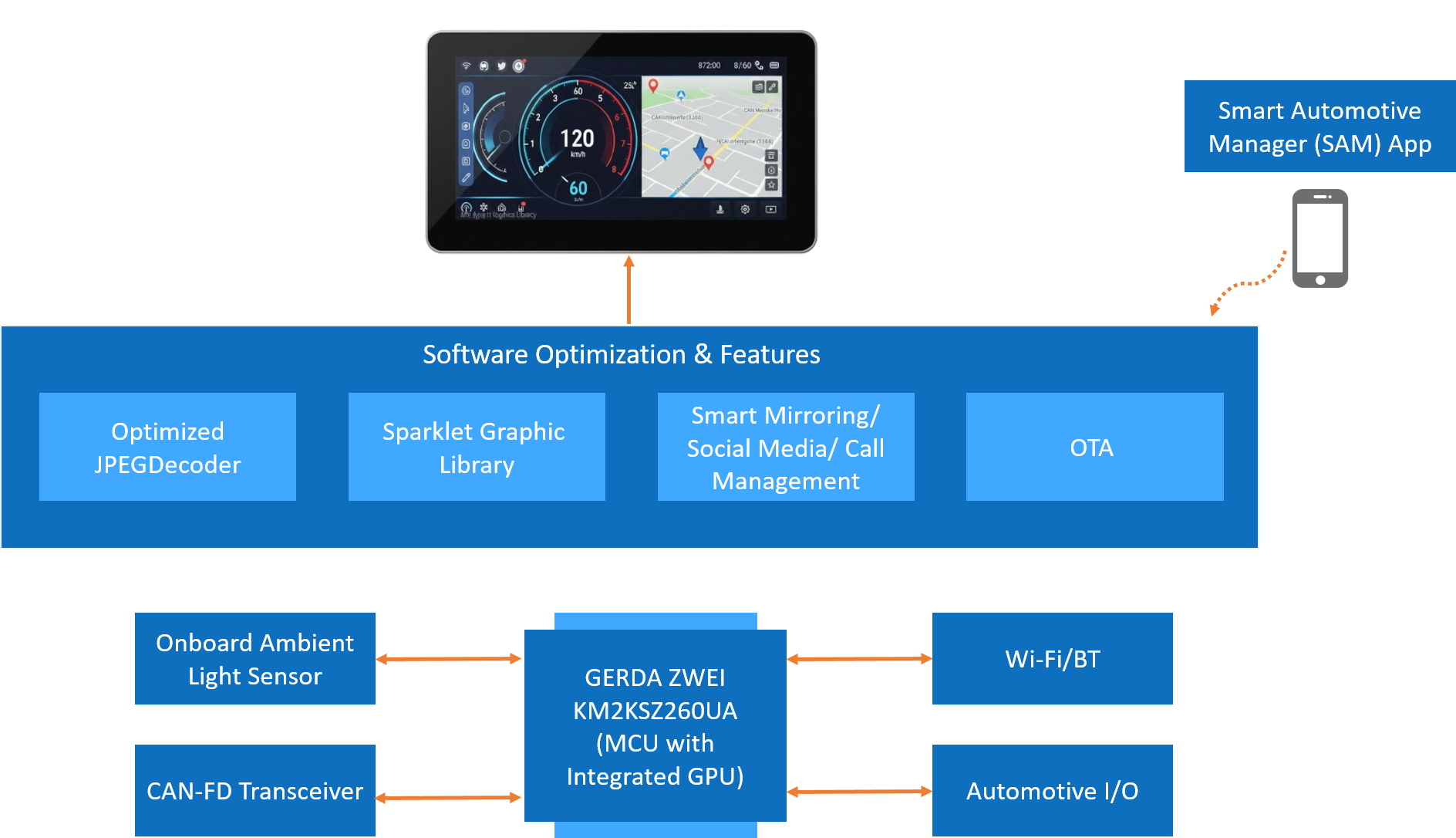
To demonstrate the versatility of the GERDA ZWEI, Embien engineered a highly integrated PCB that served as a blueprint for automotive instrument clusters.
The hardware was designed to support a wide array of automotive-grade inputs, ensuring that silicon evaluators could test every possible real-world scenario:
- Visual Interface: A 7” LCD display with capacitive touch served as the primary interaction point.
- Connectivity: Integrated Wi-Fi and Bluetooth modules to showcase the chip's smart-city capabilities.
- Sensor Fusion: Onboard ambient light sensors for auto-brightness, proving the chip’s ability to handle ADC tasks efficiently.
- Automotive I/O: Comprehensive support for CAN-FD (with Wake-up support), pulse inputs for speed sensing, and multiple active-high/low resistive inputs.
Advanced Graphics with Sparklet & Flint
The "wow factor" for any semiconductor EVK is the display. To ensure the GERDA ZWEI's graphics capabilities were front and centre, Embien deployed its proprietary Sparklet Graphics Library.
Unlike generic libraries, Sparklet was specifically tuned to leverage the GERDA ZWEI’s internal GPU. By offloading pixel-pushing tasks from the CPU to the GPU, we achieved 60FPS fluid animations without taxing the primary processor. This allowed the MCU to remain responsive for critical tasks like CAN message processing and sensor monitoring. Using the Flint UI Designer, we rapidly prototyped a sleek, modern dashboard that looked as though it were running on a much more expensive MPU.
Software Optimization: The JPEG Decoder & Mirroring
In the semiconductor world, "optimizing for silicon" is key. Embien worked closely with Nuvoton to integrate a highly optimized software JPEG decoder. This allowed the system to render complex animations and high-resolution icons with minimal memory footprint—a critical selling point for an MCU-based design.
Furthermore, we integrated the Smart Automotive Manager (SAM) App. This enabled Map Mirroring, bringing turn-by-turn navigation, social media notifications, and call management to the cluster. By handling the heavy lifting on the smartphone and "mirroring" the essential data, we proved that Nuvoton’s silicon could power "Smart" clusters without the need for high-end application processors.
Lifecycle & Connectivity (OTA over Wi-Fi)
To make the EVK production-ready, Embien implemented a robust Over-the-Air (OTA) update mechanism via Wi-Fi. This demonstrated the chip’s security and memory management capabilities, showing OEMs how they could maintain vehicles in the field. Finally, we developed a sleek, automotive-grade enclosure, transforming a bare PCB into a professional-grade product demonstration tool.
Benefits
Maximized Silicon Utility: Demonstrated the ability to run high-end features (Navigation/UI) on a cost-effective MCU.
Reduced R&D for OEMs: Provided a "golden reference" design that Tier-1 suppliers could take to production with minimal changes.
Superior Graphics Performance: Leveraged the GPU via Sparklet to provide a premium user experience without increasing CPU load.
Turnkey Connectivity: Immediate support for smartphone integration (iOS/Android) and cloud updates.
Market-Specific Optimization: Tailored specifically for the Indian two-wheeler market's unique cost and environmental requirements.
Conclusion
By partnering with Embien, Nuvoton successfully launched an evaluation kit that perfectly balanced cost and performance, significantly lowering the barrier to entry for OEMs. This project proved that with the right software enablement and hardware design, the GERDA ZWEI KM2KSZ260UA could outperform competitors in its class. Embien’s ability to provide a complete "Silicon-to-System" solution ensures that semiconductor vendors can focus on their core chip design while we handle the complexities of market-ready enablement.