CASE STUDY SNAPSHOT
Customer : A technology solutions provider specialising in automotive connectivity and telematicsSize : 200–1000
Project vertical : Automotive, Infotainment
Challenge : Demonstrate MirrorLink 1.1 smartphone screen mirroring on an automotive-grade Linux platform, enabling bidirectional audio and video between Android and iOS smartphones and an in-vehicle infotainment system
Solution : MirrorLink 1.1 technology demonstrator on NXP iMX6 Linux platform with USB NCM/Audio/HID interfaces, GStreamer-based video pipeline, audio routing, and Apple CarPlay and Android Auto provisioning
Services & Products Availed : Embedded Software Development, OS Porting and BSP Development, Embedded Multimedia
Tools and Technologies:
- Target Platform: NXP iMX6 (ARM Cortex-A9)
- OS: Embedded Linux
- Protocol Stack: MirrorLink 1.1, Car Connectivity Consortium
- USB Interfaces: USB NCM, USB Audio Class, USB HID
- Audio: AVRCP+A2DP Bluetooth Profiles, ALSA
- Languages: C
- Frameworks: Linux USB gadget stack, GStreamer
Introduction
Smartphone screen mirroring in the vehicle, enabling drivers and passengers to interact with smartphone applications through the vehicle's infotainment display and controls, was an emerging and technically complex capability in the automotive connectivity landscape. Multiple competing standards existed, each with distinct protocol stacks, device compatibility profiles, and integration requirements. MirrorLink, developed by the Car Connectivity Consortium, was one of the leading open standards addressing this need, offering a vendor-neutral approach to smartphone-to-IVI connectivity for both Android and iOS devices.
A technology solutions provider specialising in automotive connectivity approached Embien to develop a technology demonstrator showcasing MirrorLink 1.1 screen mirroring on an NXP iMX6-based automotive Linux platform. The objective was to demonstrate the full MirrorLink connectivity stack along with audio routing, USB interface management, and provisioning for Apple CarPlay and Android Auto, on a platform representative of production automotive infotainment hardware.
Challenge
MirrorLink 1.1 is a technically demanding standard that spans multiple protocol layers, USB transport, RTP-based video streaming, VNC-based display mirroring, and UPnP-based device discovery, all of which must interoperate correctly and within tight latency bounds on a resource-constrained embedded Linux platform. Implementing the stack from scratch and validating it against both Android and iOS devices required deep protocol expertise and careful integration with the Linux USB gadget subsystem.
Managing multiple simultaneous USB interface classes, USB NCM for network connectivity, USB Audio Class for audio transport, and USB HID for input event delivery from the IVI to the smartphone, within the Linux USB gadget composite device framework required careful configuration to ensure all interfaces enumerated correctly on both Android and iOS hosts. Audio routing, directing smartphone audio to vehicle speakers while maintaining call audio through the hands-free path, added a further integration dimension involving the platform's ALSA audio subsystem and Bluetooth HFP/A2DP profiles.
Solution
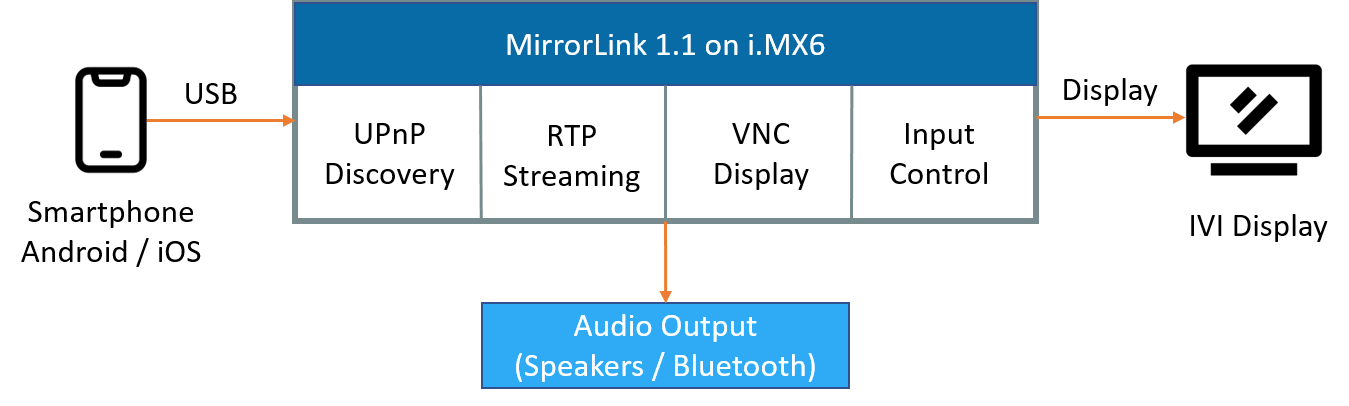
MirrorLink 1.1 Protocol Stack
Embien implemented the complete MirrorLink 1.1 protocol stack on the NXP iMX6 Linux platform. The stack covers UPnP-based MirrorLink device discovery and service advertisement, RTP video streaming of the smartphone display to the IVI screen, VNC-based remote framebuffer access enabling the IVI to render the mirrored smartphone UI, and the bidirectional input event channel that allows the driver to interact with smartphone applications through the IVI touchscreen or physical controls.
The video pipeline was implemented using GStreamer, leveraging the iMX6's hardware video decoding capability to handle the RTP stream with minimal CPU overhead. Display rendering was integrated with the IVI's Linux framebuffer, enabling the mirrored smartphone content to be composited with native IVI UI elements at the display driver level.
USB Composite Device Configuration
The iMX6 platform was configured as a USB composite gadget device presenting three simultaneous interface classes to the connected smartphone. USB NCM provides the network transport layer over which MirrorLink's UPnP discovery and RTP streaming operate. USB Audio Class transports smartphone audio to the IVI audio subsystem. USB HID delivers input events, touch coordinates, key presses, and scroll gestures, from the IVI back to the smartphone, enabling the driver to control smartphone applications without touching the phone. All three interfaces enumerate correctly on both Android and iOS hosts, with the composite device configuration validated across multiple device generations.
Audio Routing
Audio routing was implemented to correctly direct smartphone audio across the available output paths based on context. Media audio, music, navigation prompts, and application sounds, is routed to the vehicle speaker system through the USB Audio Class interface and the platform's ALSA audio subsystem. Call audio is routed through the Bluetooth Hands-Free Profile path, maintaining the regulatory and safety separation between media and communication audio in the vehicle. AVRCP and A2DP Bluetooth profiles are supported for media playback control from the IVI, enabling the driver to control music playback on the mirrored smartphone application through IVI controls or steering wheel buttons.
Mirrored Application Integration
The MirrorLink implementation enables smartphone applications, navigation, media, communication, and third-party MirrorLink-certified apps, to be mirrored onto the IVI display and controlled through the vehicle's touchscreen or physical input controls. The mirrored application UI is rendered at the IVI display resolution, with touch input events from the IVI translated and delivered back to the smartphone over the USB HID channel. This bidirectional interaction model gives the driver a seamless experience of controlling smartphone applications through the vehicle interface without needing to handle the phone.
Apple CarPlay and Android Auto Provisioning
The demonstrator platform was provisioned for Apple CarPlay and Android Auto integration, with the necessary USB interface infrastructure and software hooks in place to enable full CarPlay and Android Auto implementations to be built on top of the demonstrated foundation. This provisioning was explicitly scoped as infrastructure groundwork rather than full protocol implementation, giving the customer a clear technical pathway to CarPlay and Android Auto enablement on the same platform.
Benefits
- Complete MirrorLink 1.1 stack Full protocol implementation covering UPnP discovery, RTP video streaming, VNC display mirroring, and bidirectional HID input on a production-representative iMX6 Linux platform
- USB composite device expertise Simultaneous NCM, Audio Class, and HID interfaces correctly enumerated on both Android and iOS hosts within the Linux USB gadget framework
- GStreamer-accelerated video pipeline Hardware-assisted RTP stream decoding on iMX6 delivers smooth mirrored video with minimal CPU overhead
- Context-aware audio routing Media and call audio correctly separated and routed to vehicle speakers and hands-free path respectively, with AVRCP+A2DP media control from IVI
- CarPlay and Android Auto ready Platform provisioned with the infrastructure groundwork necessary for full CarPlay and Android Auto implementation as a natural next step
Conclusion
This MirrorLink technology demonstrator reflects Embien's deep capability in automotive connectivity protocols and embedded Linux multimedia integration. By implementing the complete MirrorLink 1.1 stack on an NXP iMX6 Linux platform and validating it across Android and iOS device connectivity, Embien provided its customer with a technically comprehensive demonstrator that validated the platform's capability across smartphone mirroring, audio routing, and USB interface management. The provisioning for CarPlay and Android Auto further positioned the platform as a credible foundation for production automotive infotainment development. This project is representative of Embien's ability to navigate complex, multi-standard automotive connectivity landscapes and deliver working demonstrations that accelerate customer product development decisions.