CASE STUDY SNAPSHOT
Customer : A global leader in building technologies, fire, and life safety solutionsSize : > 10,000
Project vertical : Healthcare, Enterprise Mobility
Challenge : Develop a reliable, real-time nurse call Android application that handles patient distress alerts, enables voice communication with patients, and integrates with multiple hospital backend systems
Solution : Android nurse call application on COTS tablet with WebSocket-based real-time alerts, SIP voice calls, SignalR integration, QR/SSO authentication, and configurable hospital workflows
Services & Products Availed : Mobile Application Development, UI/UX Design Services
Tools and Technologies:
- Platform: COTS Android Tablet
- Language: Kotlin
- Frameworks: Android AOSP, WebSocket, SignalR, SIP Stack
- Authentication: QR Code, SSO, Keycloak
- Protocols: SIP (voice), WebSocket (alerts), SignalR (event streaming)
Introduction
In a hospital environment, the speed and reliability of nurse-patient communication directly impacts patient safety and care quality. Traditional nurse call systems, fixed panels, call lights, and wired intercoms, are increasingly being replaced by software-driven mobile solutions that give caregivers real-time awareness, voice connectivity, and the ability to manage calls intelligently across an entire ward.
A global leader in building technologies and life safety solutions approached Embien to develop the Android application for their nurse call platform. The application runs on COTS Android tablets deployed across nursing stations and enables nurses to receive patient distress calls instantly, communicate over voice, manage priorities intelligently, and operate within the hospital's existing IT infrastructure through multiple authentication and backend integration mechanisms.
Challenge
The core challenge was reliability and real-time responsiveness. A nurse call application cannot miss an alert or delay a notification, even briefly. The application had to maintain a persistent, low-latency connection to the hospital backend at all times, survive network interruptions gracefully, and surface patient calls instantly regardless of what else the nurse was doing on the tablet.
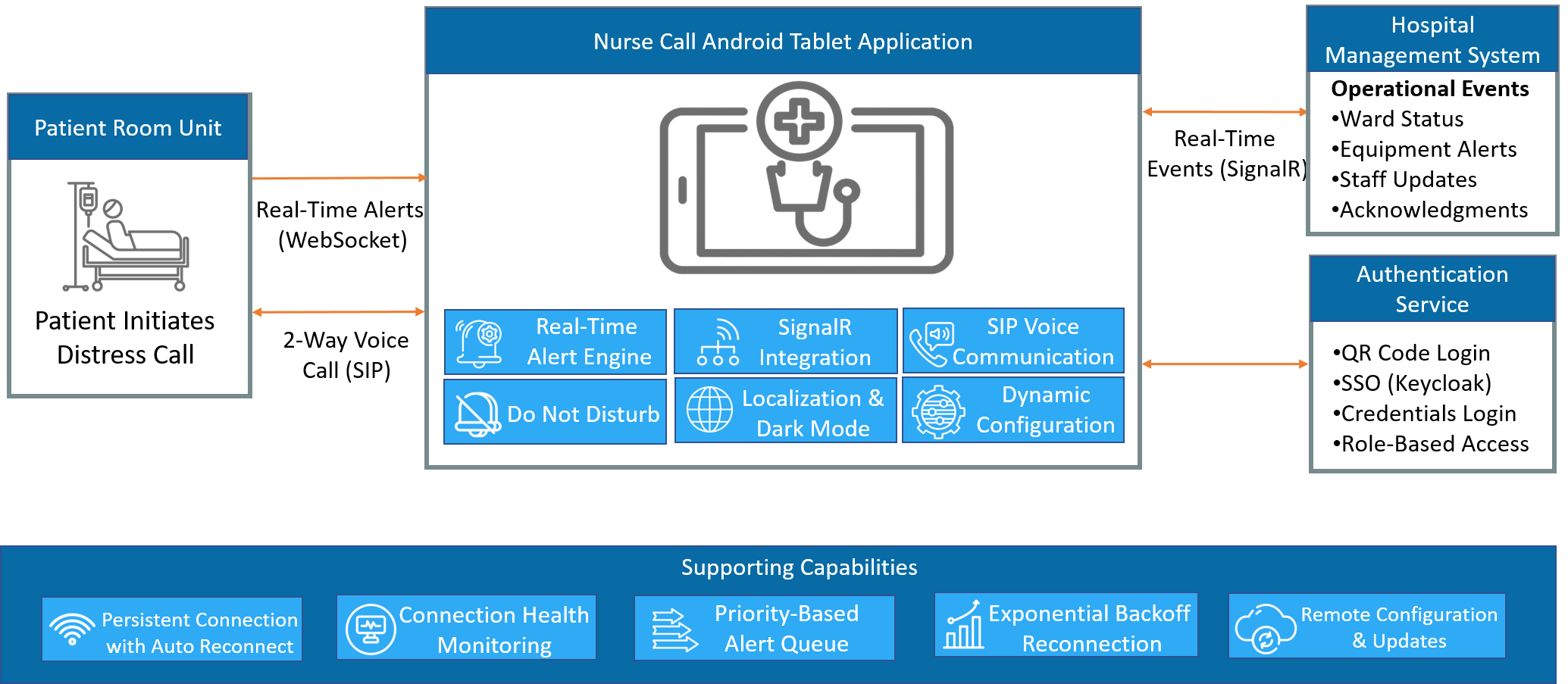
The multi-backend integration requirement added significant complexity. The application needed to interface with three distinct communication systems simultaneously, WebSocket for real-time event streaming, SignalR for server-push notifications from the hospital management system, and a SIP stack for two-way voice calls between the nurse's tablet and the patient room unit. Each protocol behaves differently in terms of connection lifecycle, error recovery, and concurrency, making concurrent management of all three a non-trivial architectural challenge.
The application also needed to be configurable for diverse hospital environments. Ward layouts, escalation rules, alarm priorities, role-based access, and localisation requirements vary significantly between deployments. The customer required an application that hospital administrators could tailor to their specific workflows without code changes.
Solution
Real-Time Alert Engine
The foundation of the application is a persistent WebSocket connection to the nurse call backend server. Patient-initiated distress calls arrive as structured event messages over this channel and are surfaced to the nurse immediately, regardless of whether the application is in the foreground, background, or screen-off state. A custom foreground service maintains the WebSocket connection with automatic reconnection logic, exponential backoff, and connection health monitoring, ensuring the alert pipeline remains live even during brief network fluctuations. Alert messages carry full context, patient room, call type, priority level, and timestamp, giving the nurse all the information needed before responding.
SignalR Integration
The hospital management system publishes operational events, ward status changes, equipment alerts, staff assignment updates, and acknowledgement confirmations, over a SignalR hub. Embien integrated the SignalR client into the application alongside the WebSocket alert engine, with both channels managed concurrently. The SignalR integration keeps the nurse's operational view synchronised with the hospital system in real time, ensuring that acknowledged calls, reassigned tasks, and escalated alarms are reflected immediately across all tablets in the ward.
SIP Voice Communication
Once a nurse responds to a patient call, the application initiates a two-way SIP voice session with the patient room unit. The SIP stack was integrated to handle call setup, in-call audio management, and teardown within the Android audio framework. Nurses can communicate directly with the patient through the tablet to understand the nature of the distress before physically attending, enabling faster triage and more efficient ward management. Call UI elements, answer, reject, mute, end, were designed for one-handed operation on a tablet, accounting for the clinical environment where nurses are frequently multitasking.
Secure Authentication
The application supports three authentication modes to accommodate different hospital IT environments. QR code login allows nurses to authenticate quickly by scanning a ward-specific cod, eliminating password entry in a time-sensitive care environment. SSO integration via Keycloak supports hospitals that manage identity centrally through their enterprise directory. Standard credential-based login is also supported as a fallback. Role-based access control ensures that nurses, supervisors, and administrators see only the functions and data appropriate to their role.
Do Not Disturb and Priority Management
A configurable Do Not Disturb mode allows nurses to suppress lower-priority notifications during critical care activities without missing emergency-level calls. Priority thresholds are defined by the hospital administrator and enforced in the application, ensuring that life-safety alerts always break through regardless of DND state. Call queuing logic presents multiple simultaneous patient calls in priority order, helping nurses triage efficiently during high-demand periods.
Localisation and Dark Mode
The application supports multiple languages to serve diverse nursing teams. A dark mode was implemented to reduce eye strain during night shifts and in low-light clinical environments, a frequently requested feature in healthcare applications deployed across 24-hour wards.
Dynamic Configuration
Hospital administrators can configure the application remotely, defining ward layouts, alarm categories, escalation timeouts, notification sounds, and role permissions, through the management console. Configuration changes are pushed to the application without requiring a reinstall or manual update on each tablet, enabling rapid adaptation to changing ward structures or operational policies.
Benefits
- Zero-miss alert delivery Persistent WebSocket connection with foreground service and automatic reconnection ensures no patient call is ever dropped
- Unified multi-protocol architecture WebSocket, SignalR, and SIP managed concurrently within a single application without interference
- SIP voice triage Direct voice communication with patient rooms before physical attendance improves response efficiency and care quality
- Flexible authentication QR code, SSO via Keycloak, and credential login support diverse hospital IT environments without compromise
- Intelligent priority management DND with emergency override and priority-ordered call queuing help nurses manage high-demand ward situations effectively
- Zero-touch configuration Remote administrator-driven configuration eliminates manual setup on every tablet deployment
- Clinical UX Dark mode, one-handed call controls, and multi-language support designed specifically for the hospital environment
Conclusion
The Nurse Call System application demonstrates Embien's capability to develop highly reliable, real-time mobile applications for life-safety environments. By architecting a concurrent multi-protocol communication engine, WebSocket for alerts, SignalR for operational events, and SIP for voice, within a single, robust Android application, Embien delivered a system that meets the uncompromising reliability and responsiveness demands of a clinical setting. This project reflects our experience in enterprise mobile development where failure is simply not an option.