CASE STUDY SNAPSHOT
Customer : A global leader in building technologies, fire, and life safety solutionsSize : > 10,000
Project vertical : Healthcare, Enterprise Mobility
Challenge : Develop an Android application that consolidates patient vital signs from multiple heterogeneous medical devices into a single interface, with cloud-based Early Warning Score computation, caregiver alerting, historic data review, and scheduled manual reading reminders
Solution : Android patient vitals Device Hub application on COTS tablet connecting to pulse oximeters, blood pressure monitors, and glucometers, with cloud EWS monitoring, deviation alerts, historic patient data visualisation, and inbuilt reading scheduler
Services & Products Availed : Mobile Application Development, UI/UX Design Services, Cloud Integration
Tools and Technologies:
- Platform: COTS Android Tablet
- Language: Kotlin
- Medical Devices: Pulse oximeters, BP monitors, glucometers
- Connectivity: Bluetooth, BLE
- Backend: Cloud EWS analytics engine
- Notifications: FCM
- Local Storage: Room Database
- Frameworks: Android AOSP, Bluetooth GATT
Introduction
Effective patient monitoring in a clinical ward requires caregivers to have a timely, accurate, and consolidated view of each patient's vital signs, drawn from multiple medical devices that are typically discrete, standalone instruments with no unified data pathway. A pulse oximeter, a blood pressure monitor, and a glucometer each capture critical parameters independently, leaving caregivers to manually collate readings, calculate early warning scores, and identify deteriorating patients from fragmented data sources. This manual process is time-consuming, error-prone, and poorly suited to the pace of a busy ward.
A global leader in building technologies and life safety solutions approached Embien to develop a Device Hub Android application, a single tablet-based interface through which caregivers could connect to multiple medical devices simultaneously, consolidate patient vital signs in real time, and rely on a cloud-based Early Warning Score engine to detect and alert on patient deterioration automatically. The application had to integrate with pulse oximeters, blood pressure monitors, and glucometers, support historic patient data review, and provide an inbuilt scheduler to remind caregivers of manual reading intervals, all within a user interface designed for the clinical environment.
Challenge
The fundamental challenge was device heterogeneity. Pulse oximeters, blood pressure monitors, and glucometers come from different manufacturers, use different Bluetooth and BLE communication protocols, and expose their measurement data in different formats and at different update frequencies. Building a single application that reliably connects to, communicates with, and correctly interprets data from this range of devices required developing and validating a distinct integration layer for each device category, while presenting a unified, consistent data model to the application layer above.
Bluetooth connectivity in a clinical ward environment introduces its own reliability challenges. Multiple devices competing for radio spectrum, physical obstructions between the tablet and bedside instruments, and the need to maintain stable connections during the full duration of a patient monitoring session all had to be addressed robustly. Connection loss, data gaps, and reconnection events had to be handled gracefully, without presenting incomplete or stale data to the caregiver as current.
The cloud-based Early Warning Score computation introduced a real-time alerting requirement. EWS is a clinical scoring system that aggregates multiple vital sign parameters, respiratory rate, oxygen saturation, blood pressure, heart rate, level of consciousness, and temperature, into a composite score that indicates patient deterioration risk. The cloud engine computing this score had to receive vital sign updates from the application promptly and return alert notifications to the caregiver without meaningful delay, as a delayed alert in a deteriorating patient scenario has direct clinical consequences.
The inbuilt reading scheduler, reminding caregivers to take manual readings such as blood pressure at configured intervals, had to be reliable even when the application was in the background, accounting for Android's aggressive background process management on clinical tablet deployments.
Solution
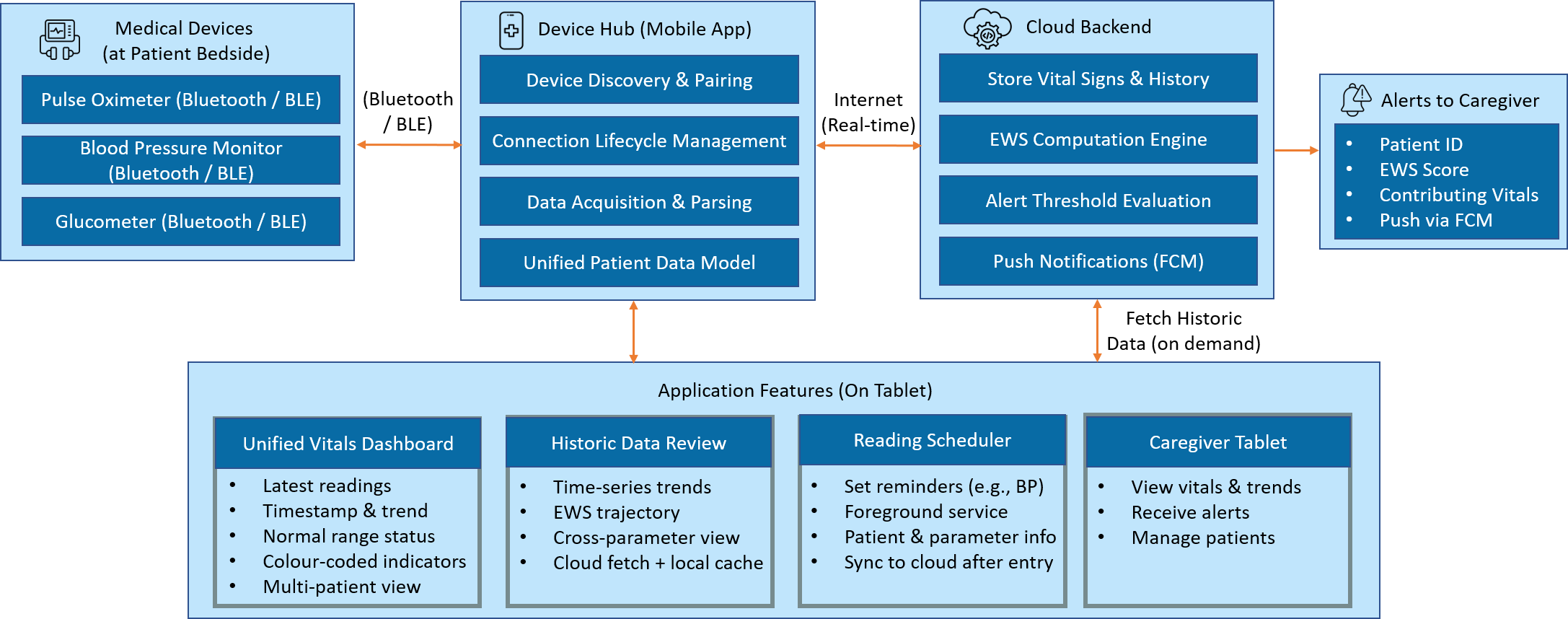
Multi-Device Connectivity Architecture
The Device Hub application manages simultaneous Bluetooth and BLE connections to multiple medical devices at the patient bedside. A modular device integration architecture was developed with a dedicated connectivity and data parsing module for each supported device category, pulse oximeters, blood pressure monitors, and glucometers. Each module handles device discovery, pairing, connection lifecycle management, measurement data acquisition, and protocol-specific data decoding for its device class, presenting decoded vital sign values to a unified patient data model used by the application layer.
Connection state is monitored continuously for each connected device, with automatic reconnection logic triggered on unexpected disconnection. Data freshness indicators in the UI make it immediately visible to the caregiver when a reading is live versus when it was last successfully acquired, preventing stale data from being mistaken for current values in a clinical decision context.
Unified Patient Vitals Dashboard
The main application screen presents a unified vitals dashboard for each patient, displaying the most recent reading from each connected device alongside its acquisition timestamp, trend indicator, and normal range status. The dashboard is designed for rapid clinical assessment, colour-coded status indicators provide immediate visual feedback on which parameters are within normal limits and which are approaching or exceeding threshold boundaries. Multiple patients can be managed within the application, with the caregiver switching between patient views as they move through the ward.
Cloud-Based Early Warning Score Monitoring
Vital sign readings acquired from connected devices are transmitted to the cloud analytics backend in real time. The cloud EWS engine aggregates the incoming vital sign parameters for each patient, computes the Early Warning Score using the configured clinical scoring algorithm, and evaluates the result against the defined alert thresholds. When the EWS exceeds a threshold, indicating a patient whose condition may be deteriorating, the cloud engine generates an alert that is pushed to the caregiver's tablet immediately via FCM. The alert carries the patient identifier, the computed EWS, and the contributing vital sign values, giving the caregiver the clinical context needed to assess the situation before attending.
The cloud backend maintains the full vital sign history for each patient, enabling retrospective review of parameter trends and EWS trajectory over the monitoring period. This longitudinal data view supports clinical decision-making beyond the immediate alert context, allowing caregivers and clinicians to assess whether a patient's condition is improving, stable, or progressively worsening over hours or days.
Historic Patient Data Review
The application provides a historic data view for each patient, presenting vital sign trends as time-series charts for each parameter over configurable review periods. Caregivers can quickly identify when a parameter first began deviating from normal, correlate changes across multiple vital signs, and review the EWS trajectory alongside the individual parameter data. Historic data is retrieved from the cloud backend on demand, with local Room database caching ensuring that recently viewed data remains accessible even during periods of intermittent network connectivity.
Inbuilt Reading Scheduler
A scheduler module enables caregivers to configure automatic reminders for manual vital sign readings that cannot be acquired from connected devices, most commonly blood pressure readings taken at defined intervals as part of a monitoring protocol. The scheduler runs as a persistent foreground service, delivering reminder notifications at the configured times regardless of the application's foreground state. Reminders carry the patient name, parameter to be measured, and the time elapsed since the last recorded reading, giving the caregiver immediate context without needing to open the application. Once a manual reading is entered, it is stored locally and synchronised to the cloud backend, becoming part of the patient's historic record and contributing to the EWS computation alongside device-acquired readings.
Benefits
- Unified multi-device vitals consolidation Simultaneous Bluetooth and BLE connectivity to pulse oximeters, blood pressure monitors, and glucometers through a modular integration architecture presenting a consistent patient data model
- Real-time cloud EWS alerting Vital sign data transmitted to cloud EWS engine with FCM-delivered deterioration alerts carrying full clinical context, enabling rapid caregiver response to at-risk patients
- Longitudinal historic data review Cloud-backed patient vital sign history with time-series trend visualisation supports clinical assessment beyond the immediate monitoring window
- Reliable reading scheduler Foreground service-based reminder delivery ensures manual reading prompts are never missed regardless of tablet usage state or Android background process management
- Clinical-grade UI design Colour-coded vitals dashboard with data freshness indicators and multi-patient management designed specifically for the pace and cognitive demands of ward-based caregiving
Conclusion
The Patient Vitals Device Hub application demonstrates Embien's capability to develop clinically focused mobile applications that integrate heterogeneous medical device ecosystems into a coherent, actionable monitoring platform. By consolidating vital sign data from multiple device types into a unified patient view, feeding a cloud-based Early Warning Score engine for automated deterioration detection, and providing historic trend review and manual reading scheduling within a single application, Embien delivered a tool that meaningfully reduces the manual data collation burden on caregivers and strengthens the clinical safety net around at-risk patients. This project, alongside the companion Nurse Call System application developed for the same customer, reflects Embien's growing depth in healthcare mobile application development for enterprise clinical environments.