CASE STUDY SNAPSHOT
Customer : Emerging Silicon StartupSize : 51-200
Project vertical : Semiconductor
Challenge : Developing a robust, production-ready Board Support Package (BSP) for a proprietary, high-performance Secure MCU with custom hardware extensions under a tight silicon launch window.
Solution : A comprehensive software ecosystem including optimized low-level drivers, high-speed DMA integration, custom FreeRTOS porting, and a versatile multi-stage bootloader.
Services & Products Availed : BSP Development, RTOS Porting, Driver Development, Bootloader Design
Tools and Technologies :
- Key Hardware: ARM Cortex-M7 based Secure MCU, Custom FPU.
- Languages: Embedded C, ARM Assembly
- Frameworks: FreeRTOS, CMSIS.
- Tools: Keil MDK, IAR Embedded Workbench, Logic Analyzers, Static Analysis Tools.
Introduction
A pioneering silicon startup developed a next-generation secure MCU based on the ARM Cortex-M7 architecture, featuring specialized hardware for quantum-resistant security. To ensure commercial success, they required a high-quality, production-ready Board Support Package (BSP) that would allow their end customers to develop applications seamlessly immediately upon silicon release.
Challenge
The project presented unique technical hurdles beyond standard MCU enablement. The silicon featured a custom Floating Point Unit (FPU) and a specialized co-processor that required non-standard handling within the software stack. Furthermore, the security-centric nature of the hardware demanded absolute stability in the Power Management Unit (PMU) and clock controllers. Developing a BSP that balanced high-performance data paths (via DMA) with rigorous security protocols, while meeting a strict delivery deadline, meant there was zero room for iterative error. The startup needed a partner who could handle the complexities of FreeRTOS context switching for custom registers while ensuring the software was robust enough for third-party distribution.
The Solution: A Multi-Tiered BSP Strategy
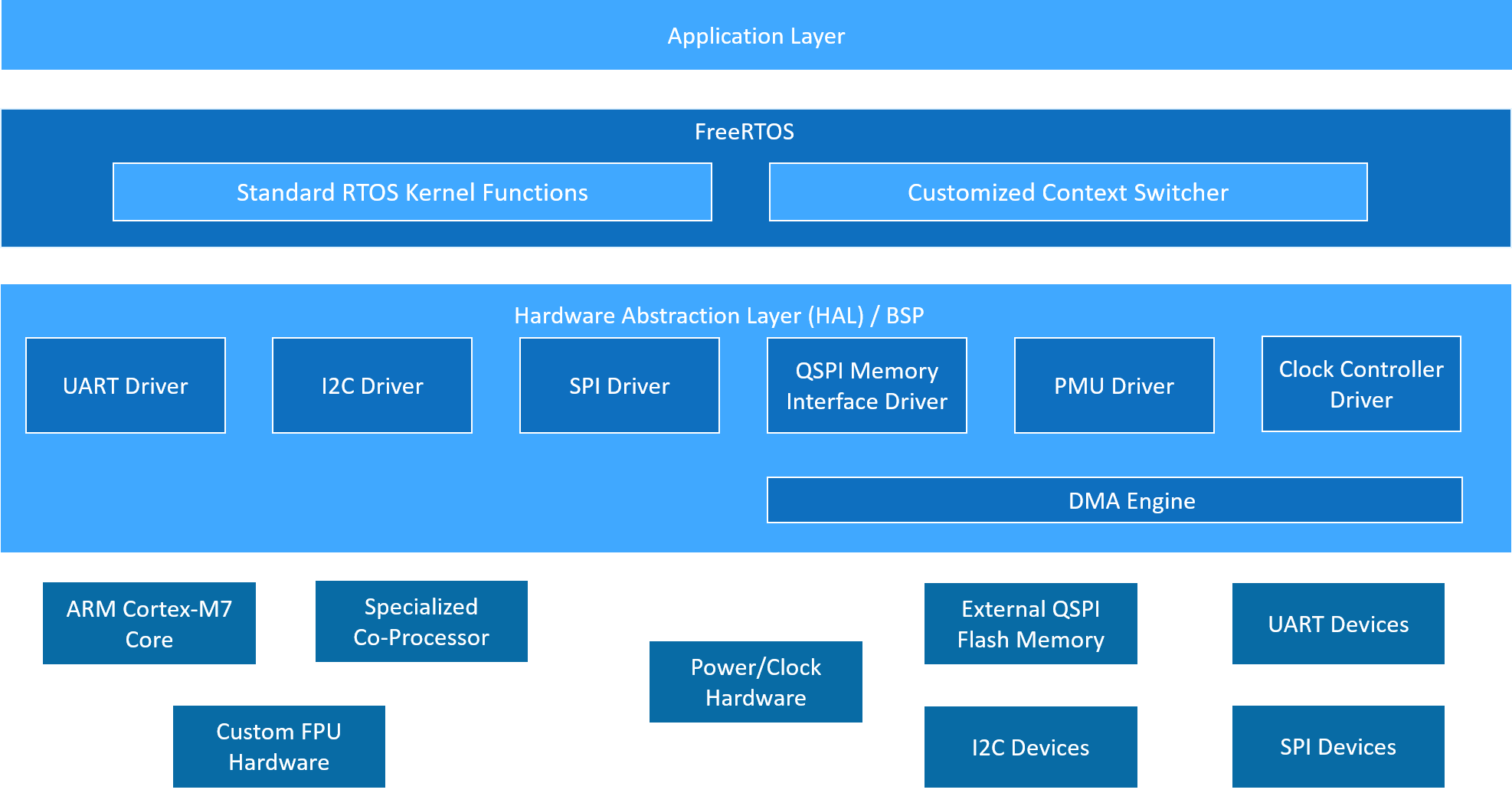
Embien’s engineering team approached the project by dividing the software stack into three critical layers: the Hardware Abstraction Layer (HAL), the Real-Time Operating System (RTOS) integration, and the Deployment/Update infrastructure.
High-Performance Hardware Abstraction Layer (HAL)
The core of the BSP was built around a highly modular driver architecture. We enabled a suite of standard peripherals including UART, I2C, and SPI, providing both polling-based and interrupt-driven mechanisms to give end-developers flexibility.
For high-traffic data paths, we leveraged the MCU’s DMA (Direct Memory Access) engines. This was particularly critical for the QSPI Memory Interface, where we optimized data throughput to ensure that external flash access did not become a bottleneck for the high-speed Cortex-M7 core. The Power Management Unit (PMU) and Clock Controller drivers were designed with a fail-safe approach, ensuring stable transitions across various low-power states, a necessity for secure, always-on industrial applications.
Custom FPU & Co-processor Integration
One of the most complex aspects of the development was the integration of the Custom FPU. Standard compilers and RTOS kernels are designed for generic ARM FPUs. Embien’s specialists wrote low-level ARM Assembly routines to handle the unique register set of the custom FPU.
We also developed a dedicated interface layer for the specialized co-processor. This allowed the main M7 core to offload cryptographic and quantum-resistant calculations efficiently. Our team ensured that the communication between the M7 core and the co-processor was thread-safe and optimized for minimal latency, providing a clean API for end-users to invoke high-level security functions.
RTOS Porting: FreeRTOS Customization
To provide a familiar environment for application developers, we ported FreeRTOS to the platform. The challenge lay in the context switching logic. Since the MCU utilized a custom FPU and co-processor, the standard FreeRTOS task switcher had to be modified to save and restore the states of these specialized registers during every context switch.
Failure to do so would lead to silent data corruption in multi-threaded applications. Embien meticulously updated the FreeRTOS kernel port, ensuring that the FPU state was preserved with minimal overhead, thus maintaining the high-performance deterministic nature of the Cortex-M7.
Secure Bootloader & Update Mechanism
A silicon product is only as good as its updateability. Embien developed a versatile bootloader capable of managing firmware images across different interfaces. Features included:
- UART & SPI RAM Download: Enabled developers to quickly push and test code directly in RAM during the prototyping phase.
- Flash Programming Routines: A robust engine to write images to internal and external (QSPI) flash securely.
- Seamless Transition: Logic to validate image integrity before switching execution from the bootloader to the main application.
Validation and Quality Assurance
Given that this BSP would be used by third-party developers, "good enough" was not an option. Embien implemented an exhaustive Unit Testing framework. We achieved near-total code coverage, testing every peripheral driver under stress conditions, edge cases, and error-handling scenarios. By utilizing static analysis and hardware-in-the-loop (HIL) testing, we ensured the package was "shippable" on day one.
Benefits
Accelerated Silicon Launch: The startup met its aggressive launch timeline with a fully functional software ecosystem.
Optimized Hardware Utilization: Expert use of DMA and custom Assembly ensured the silicon's high-performance features (FPU/QSPI) were fully exploited.
End-Customer Ready: The BSP was delivered with clean APIs and documentation, making it easy for the customer’s clients to adopt the new MCU.
Enhanced Reliability: Rigorous unit testing and a robust bootloader minimized post-launch support costs and firmware bricking risks.
Future-Proof Security: Seamless integration of the quantum-resistant co-processor allowed users to leverage advanced security features out-of-the-box.
Conclusion
Building a BSP for an advanced Cortex-M7 secure MCU requires a rare blend of low-level architectural knowledge and high-level software engineering. Embien Technologies successfully bridged the gap between raw silicon and a developer-friendly platform, enabling our customer to ship a robust, high-performance product to the market. Our deep expertise in FreeRTOS porting, custom hardware integration, and bootloader design makes us the ideal partner for silicon vendors worldwide.
Are you looking to empower your new silicon with a production-grade software stack? Contact Embien today to discuss your BSP and firmware requirements.