CASE STUDY SNAPSHOT
Customer : Leading Global Medical Device OEMSize : >1000 – 10000
Project vertical : Medical Instrumentation / Laboratory Equipment
Challenge : Component obsolescence (Infineon MCU), legacy FPGA integration, and maintaining strict form-factor requirements.
Solution : Full hardware redesign using STM32 MCU, driver porting, application logic preservation, and USB communication optimization.
Services & Products Availed : Embedded Hardware Design, Firmware Development,
Tools and Technologies :
- Key Hardware: STM32
- Software Development: C
- Tools: Altium Designer
- Peripherals: FPGA, USB Stack
- Others: Windows Application Integration
Introduction
A world-renowned Medical OEM faced a critical supply chain threat when the primary controller of their flagship particle size analyzer reached end-of-life status. To prevent production downtime, the client required a comprehensive re-engineering of their control electronics, migrating from a legacy Infineon architecture to a modern, high-performance STM32 platform.
Challenge
The primary challenge lay in the architectural complexity of the existing instrument. The legacy system utilized a specialized FPGA for high speed data acquisition that was not part of the obsolescence cycle; therefore, the new design had to interface perfectly with this existing silicon. Furthermore, the physical constraints were absolute the new PCB had to match the exact form factor and mounting points of the original design to avoid costly mechanical housing changes. On the software side, the client possessed proprietary, highly sensitive algorithms that had to be preserved without a single line of modification to maintain regulatory compliance and measurement accuracy.
Solution
Embien’s engineering team initiated the project with a rigorous "Black-Box" analysis of the existing system to ensure the re-engineered hardware would remain electrically and functionally transparent to the rest of the instrument. The solution was executed across three critical phases: Hardware Design, Firmware Porting, and System Integration.
Advanced Hardware Redesign
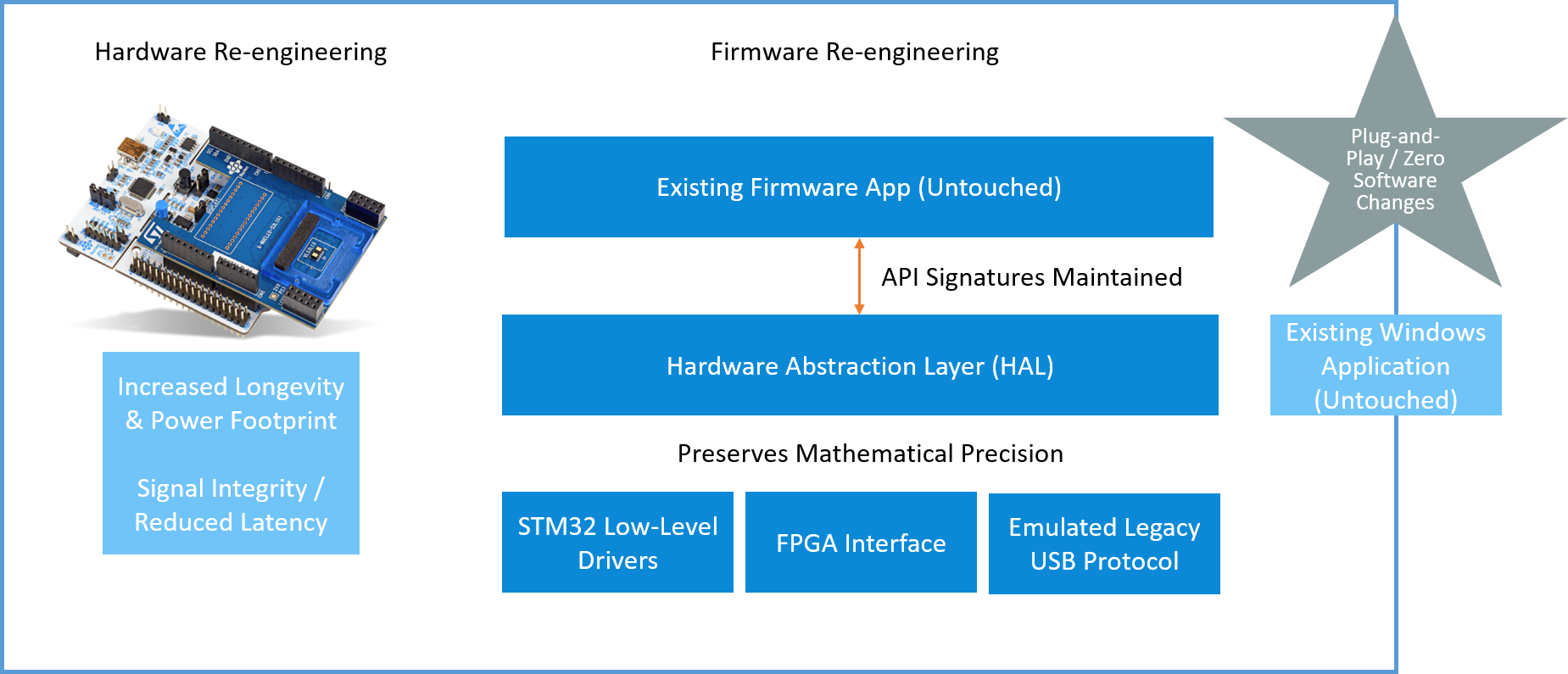
The hardware team selected a high-performance STM32 microcontroller to replace the aging Infineon chip. This choice was driven by the need for longevity, superior computational power, and a rich set of peripherals required for high-precision laboratory equipment. One of the most intricate tasks was maintaining the exact physical footprint. Using advanced multi-layer PCB design techniques, Embien successfully replicated the legacy form factor while optimizing the layout for better signal integrity and reduced electromagnetic interference (EMI). We meticulously mapped the pin-outs to ensure the existing FPGA-to-MCU communication bus remained stable, handling the timing differences between the old and new architectures through precise hardware-level synchronization.
Driver Porting and Logic Preservation
A core requirement was that the existing application logic and complex particle analysis algorithms remain untouched. To achieve this, Embien developed a robust Hardware Abstraction Layer (HAL). We ported the underlying low level drivers including those for memory management, peripheral control, and sensor interfacing to the STM32 platform while maintaining identical API signatures for the upper application layers. This “wrapper” approach allowed the legacy C++ codebases and proprietary algorithms to execute on the new MCU without realizing the underlying hardware had changed. This ensured that the mathematical precision of the particle size measurements remained consistent with historical data, a vital requirement for the OEM’s end users in the medical and pharmaceutical sectors.
Performance Optimization and USB Integration
While the primary goal was parity, Embien identified opportunities for tactical performance enhancements. By leveraging the faster clock speeds and DMA (Direct Memory Access) capabilities of the STM32, we reduced data processing latency during high-resolution scans.
A significant hurdle was the communication between the instrument and the host Windows application. The legacy system used a specific USB protocol that the existing PC software expected. Instead of rewriting the Windows application,which would have triggered a massive software validation cycle for the client, Embien’s firmware experts performed tactical "tweaks" at the USB descriptor and stack level. We emulated the legacy communication behavior so perfectly that the existing Windows software recognized the re-engineered hardware as the original device, allowing for immediate "plug-and-play" functionality.
Rapid Delivery and Quality Assurance
Despite the complexity of the data paths and the strict medical-grade requirements, Embien completed the entire lifecycle, from hardware prototyping to final system integration, in just 8 months. Rigorous regression testing was performed to compare the outputs of the legacy system against the re-engineered platform, ensuring zero variance in measurement results.
Benefits
Zero-Downtime Migration: Successfully mitigated component obsolescence without requiring changes to the existing mechanical housing or Windows software.
Risk Mitigation: Preserved mission-critical proprietary algorithms, avoiding the need for extensive re-validation of core scientific logic.
Enhanced Performance: Leveraged modern MCU architecture to improve data throughput and system responsiveness.
Cost-Efficient Development: The 8-month turnaround significantly reduced time-to-market compared to a ground-up redesign.
Future-Proofing: Moved the platform to a modern STM32 ecosystem with a clear long-term roadmap and better supply chain availability.
Conclusion
Embien’s expertise in embedded re-engineering turned a potential production crisis into a platform upgrade. By seamlessly migrating the legacy Infineon controller to a modern STM32-based design while preserving existing FPGA logic and PC-side software compatibility, we ensured the longevity of a vital medical instrument. This project highlights Embien's ability to handle complex hardware-software interdependencies under tight timelines. If your organization is facing component end-of-life issues or requires platform modernization, contact Embien today to ensure your legacy systems continue to lead the market.