CASE STUDY SNAPSHOT
Customer : Renesas Electronics, a global leader in automotive and industrial microcontrollersSize : > 10,000
Project vertical : Automotive, Embedded Security, Semiconductor Enablement
Challenge : Develop a production-quality secure bootloader reference implementation across four variants of the Renesas RH850 automotive MCU family, covering encrypted firmware reception over UART and CAN, cryptographic image validation, and secure flash programming, for distribution to Renesas's automotive OEM and Tier 1 customers as a validated starting point for their secure boot implementations
Solution : Secure bootloader reference implementation on Renesas RH850 EVKs across C1MA1, F1KM-S4, F1K, and F1KM-S1 variants featuring encrypted firmware image reception over UART and CAN, RSA-based image validation, secure internal flash programming, and a signing script toolchain, packaged for direct adoption by Renesas's end customers
Services & Products Availed : Embedded Firmware Development, Embedded Security, Secure Boot Development, Automotive Software
Tools and Technologies:
- Target MCUs: Renesas RH850/C1MA1, RH850/F1KM-S4, RH850/F1K, RH850/F1KM-S1
- Platform: Renesas EVKs
- Update Interfaces: UART, CAN
- Security: RSA Asymmetric Signature Validation, AES Decryption
- Flash: Internal Code Flash, Data Flash
- Languages: C
- Tools: Renesas CS+, GHS Multi
Introduction
Automotive ECUs, engine controllers, transmission controllers, ADAS processors, body control modules, and instrument clusters, are increasingly required to implement secure boot as a fundamental cybersecurity control. Secure boot ensures that only authenticated, manufacturer-approved firmware can execute on an ECU, protecting the vehicle's electronic systems against firmware tampering attacks that could alter vehicle behaviour, compromise safety systems, or introduce malicious functionality.
For automotive OEMs and Tier 1 suppliers developing ECUs on the Renesas RH850 MCU family, one of the most widely deployed automotive microcontroller platforms globally, implementing a secure bootloader from scratch is a significant undertaking. It requires deep knowledge of the RH850's flash architecture, security features, and boot sequence, combined with expertise in automotive-grade cryptographic implementation and secure firmware update protocol design.
Renesas Electronics approached Embien to develop a secure bootloader reference implementation across four variants of the RH850 family, C1MA1, F1KM-S4, F1K, and F1KM-S1, that Renesas could provide to their automotive OEM and Tier 1 customers as a validated, production-quality starting point. Rather than each customer independently developing and validating their own secure bootloader from first principles, the reference implementation would give Renesas's ecosystem a proven foundation, reducing development time, lowering implementation risk, and accelerating the adoption of secure boot across RH850-based automotive ECU designs.
Challenge
Developing a single secure bootloader reference implementation that correctly supports four distinct RH850 MCU variants, each with different internal flash architectures, memory maps, peripheral configurations, and security feature sets, required a software architecture that was both highly portable across variants and deeply respectful of each variant's specific hardware characteristics. A naive approach of developing four independent bootloaders would be maintainable only at high cost. A single codebase with hardware abstraction had to be architected carefully to avoid the abstraction layers introducing complexity or overhead that would make the reference harder for end customers to understand and adopt.
The reference implementation had to be genuinely production-quality, not a demonstration that illustrated the concept but cut corners on robustness. Renesas's customers would be adopting this as the foundation of safety-critical automotive ECU firmware, and any weakness in the reference, in cryptographic implementation, flash programming reliability, or error handling, could propagate into production vehicles. The implementation had to handle all fault conditions correctly, manage flash programming atomicity, and behave safely under power-loss scenarios.
Supporting firmware update over both UART and CAN, two interfaces with fundamentally different communication models, within the same bootloader framework required clean interface abstraction. The CAN-based update path in particular required careful management of the CAN protocol's message-oriented nature for reliable transfer of firmware images that may be hundreds of kilobytes in size, with appropriate flow control and error recovery for the automotive network environment.
The reference implementation also had to be comprehensible and well-documented, as its value to Renesas's customers depended not just on its correctness but on their ability to understand it, adapt it to their specific ECU design, and build confidence in its security properties. Overly complex or poorly structured reference code would undermine adoption regardless of its technical quality.
Solution
Multi-Variant Software Architecture
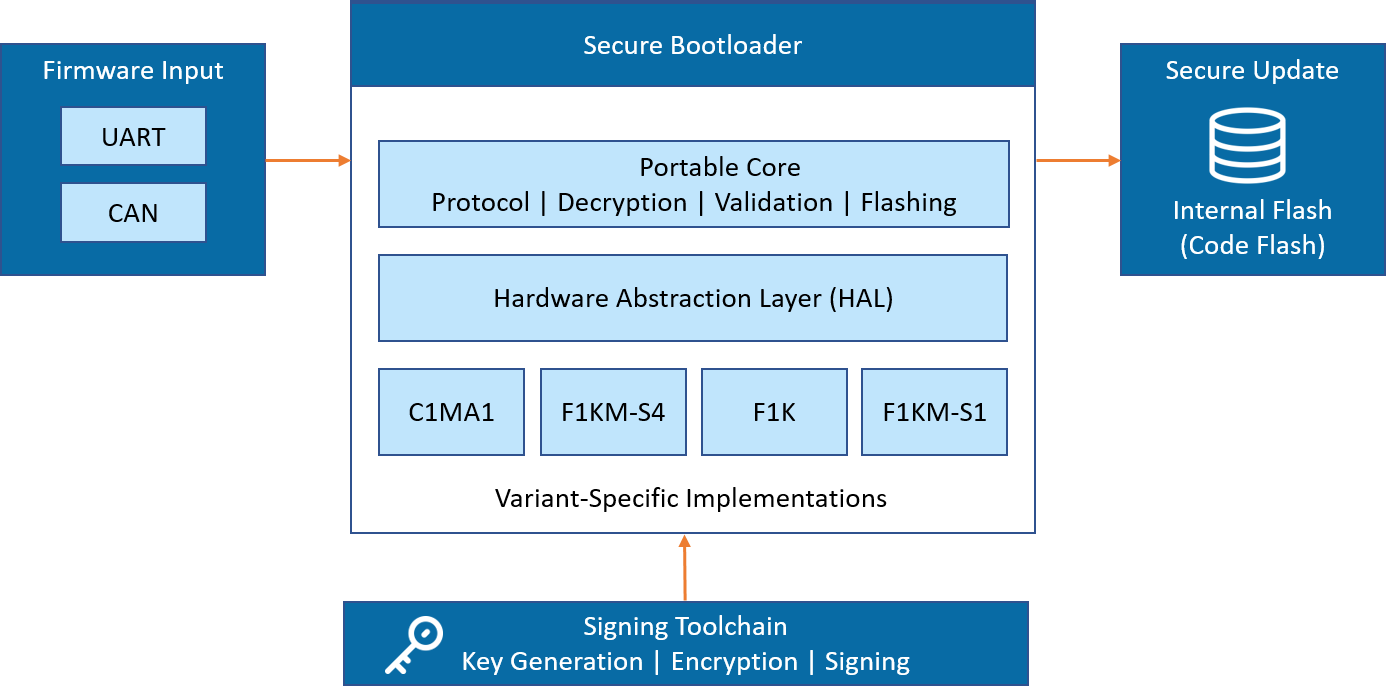
The secure bootloader reference implementation was architected with a clear separation between the portable security and protocol logic and the hardware-specific flash, peripheral, and security feature interfaces for each RH850 variant. A Hardware Abstraction Layer defines the interface between the portable bootloader core and the variant-specific implementations, covering internal flash read, erase, and program operations, CAN and UART peripheral initialisation and data transfer, cryptographic hardware acceleration access where available on each variant, and security-relevant option byte and protection register management.
This architecture enables the portable core, containing the firmware reception protocol, cryptographic validation pipeline, flash programming sequencer, and error handling logic, to be shared across all four RH850 variants without modification. The variant-specific HAL implementations encapsulate the differences in flash architecture, peripheral register maps, and hardware security features between C1MA1, F1KM-S4, F1K, and F1KM-S1, making the per-variant differences explicit, localised, and easy for end customers to review and adapt to their specific board design.
The reference was developed and validated on Renesas's official EVK platforms for each variant, ensuring that the implementation was verified on representative hardware rather than simulated, and that end customers could reproduce the reference behaviour on the same EVK before adapting it to their custom ECU board.
Encrypted Firmware Reception over UART and CAN
Firmware images are received by the bootloader in encrypted form, preventing the firmware content from being exposed in transit or extracted from an ECU undergoing an update in the field. The UART reception path implements a packet-based protocol with sequence numbering, per-packet checksums, and retransmission on error, providing reliable image transfer over the byte-stream UART interface with robust recovery from transmission errors. The CAN reception path implements a message-based transfer protocol suited to CAN's frame-oriented nature, with flow control managing the transfer rate to the bootloader's processing capability and error recovery handling lost or corrupted frames.
Both reception paths deliver the encrypted firmware image to a common staging buffer, from which the decryption and validation pipeline processes the image regardless of which interface it was received over. AES decryption is applied to the received image using a device-specific key, producing the plaintext firmware image for cryptographic signature validation.
RSA Signature Validation and Secure Flash Programming
Following decryption, the firmware image's RSA asymmetric signature is validated using the public key embedded in the bootloader. The SHA256 hash of the decrypted image is computed and compared against the RSA-decrypted signature value, confirming that the image was signed by the holder of the corresponding private key and has not been modified since signing. Images that fail validation are rejected and discarded, with the existing application firmware remaining intact.
Images that pass validation are programmed to the RH850's internal Code Flash using the variant-specific flash programming routines in the HAL. Flash programming is implemented with care for atomicity, ensuring that a power interruption during programming does not leave the flash in a partially written state that prevents the ECU from booting. The bootloader maintains a programming state record in Data Flash that allows it to detect and recover from interrupted programming on the next power-on, either completing the programming operation or reverting to the previous firmware version depending on the extent of the interruption.
Signing Toolchain
A firmware signing toolchain was developed and delivered alongside the bootloader reference, providing scripts for RSA key pair generation, firmware image encryption, and image signing. The toolchain was designed for straightforward integration into automotive ECU firmware build pipelines, producing signed and encrypted firmware images as a standard build output. Documentation covering key management practices, key storage, access control, and rotation procedures, was provided to guide Renesas's customers in establishing secure firmware signing operations appropriate for automotive production environments.
Reference Documentation
Comprehensive reference documentation was produced covering the bootloader architecture, the HAL interface definitions for each RH850 variant, the firmware reception protocol specifications for UART and CAN, the cryptographic implementation details, the flash programming and recovery behaviour, and the signing toolchain usage. The documentation was structured to serve both as a technical reference for engineers adapting the implementation and as security architecture evidence for customers' automotive cybersecurity documentation requirements.
Benefits
- Four-variant RH850 coverage Single reference implementation with clean HAL abstraction supporting RH850/C1MA1, F1KM-S4, F1K, and F1KM-S1, validated on Renesas EVKs, gives the entire RH850 ecosystem a common, proven secure boot foundation
- Dual-interface encrypted update Encrypted firmware reception over both UART and CAN with robust error recovery covers the two primary ECU update interfaces in the automotive field service and production programming environments
- Production-quality cryptographic implementation RSA asymmetric signature validation with AES decryption and SHA256 integrity verification implemented to automotive production standards, not a demonstration shortcut, giving end customers confidence in the security foundation they are adopting
- Power-loss resilient flash programming Atomic programming with Data Flash state tracking and recovery logic protects ECU bootability against power interruption during firmware update, a critical reliability requirement for automotive field updates
- Ecosystem acceleration Renesas's automotive OEM and Tier 1 customers gain a validated, well-documented secure bootloader starting point, reducing individual secure boot development efforts from months to weeks and accelerating adoption of firmware security across RH850-based ECU designs
Conclusion
This Renesas RH850 secure bootloader reference implementation demonstrates Embien's capability to develop production-quality embedded security reference designs for major semiconductor partners targeting the automotive ecosystem. By delivering a clean, well-architected, multi-variant secure bootloader across four RH850 MCU variants, validated on Renesas EVKs, documented to production standard, and accompanied by a complete signing toolchain, Embien provided Renesas with a reference implementation that meaningfully accelerates secure boot adoption across their automotive customer base. This project reflects Embien's established expertise in Renesas RH850 platform development, automotive cybersecurity implementation, and the semiconductor enablement work that bridges silicon capability and production ECU software, a combination that makes Embien a trusted development partner for silicon vendors serving the automotive industry.