CASE STUDY SNAPSHOT
Customer : A leading Indian manufacturer of analytical and scientific instrumentsSize : 51-200
Project vertical : Medical Devices, Scientific Instrumentation, IoT
Challenge : Design and develop a production smart pH meter on NXP KW31Z SoC, with a miniaturised PCB form factor, precision pH and RTD sensor interfaces, configurable sampling, BLE wireless data acquisition to Android and iOS
Solution : Production grade smart pH meter on NXP KW31Z SoC with precision analog front end for pH electrode and RTD temperature sensor, 500-hour coin cell battery life, secure OTA firmware update, and IEC 60601 hardware and IEC 62304 software compliance.
Services & Products Availed : Turnkey Product Engineering, Embedded Hardware Design, Embedded Firmware Development
Tools and Technologies :
- Target SoC: NXP KW31Z
- Standards: IEC 60601-1 (hardware), IEC 62304 (software)
- Sensors: pH electrode, RTD temperature sensor
- Connectivity: BLE 4.2 (Android and iOS)
- Languages: C
- Tools: MCUXpresso IDE
Introduction
pH measurement is a fundamental analytical parameter across clinical laboratories, medical diagnostics, water quality monitoring, and pharmaceutical manufacturing. In medical contexts, the pH of biological samples, such as blood, urine, and body fluids, serves as a critical diagnostic indicator. While traditional benchtop pH meters offer high accuracy, they are often bulky, tethered to fixed power supplies, and unsuitable for field or bedside use.
A leading Indian manufacturer of scientific instruments partnered with Embien to develop a next-generation smart pH meter. The goal was to bridge the gap between laboratory precision and portable convenience. The resulting device is a miniaturized, battery-powered instrument featuring BLE wireless connectivity, configurable sampling, and full compliance with stringent medical device standards (IEC 60601-1 and IEC 62304).
The Engineering Challenge
The primary challenge was the aggressive requirement for miniaturization without compromising signal integrity or safety. Designing a medical-grade instrument involves balancing several competing priorities:
Hardware Miniaturization and Signal Integrity
Fitting a precision pH Analog Front End (AFE), an RTD temperature sensor interface, the NXP KW31Z SoC, a BLE antenna, and power management circuitry into a compact PCB required exceptional discipline. The pH AFE is inherently sensitive; it requires a high-impedance input amplifier to match the glass membrane electrode's impedance (often in the hundreds of megaohms). Achieving measurement performance in a cramped layout demanded meticulous attention to analog routing, ground plane management, and shielding to prevent digital noise from contaminating sensitive readings.
Stringent Regulatory Compliance
IEC 60601-1 (safety for medical electrical equipment) imposes strict requirements on creepage and clearance distances, protective earth connections, and applied part isolation. Meeting these within a miniaturized form factor required creative PCB layout strategies that balanced physical compactness with electrical safety. Simultaneously, IEC 62304 (medical device software lifecycle) mandated a rigorous firmware development process, including detailed design documentation, unit testing, and full traceability between requirements and test results.
Power Constraints
The target was a 500-hour battery life from a standard coin cell. This necessitated ultra-aggressive power management. Every microamp of quiescent current, every peripheral wake-up, and every suboptimal BLE parameter setting had to be scrutinized, as they directly impacted the device’s longevity in the field.
The Solution: NXP KW31Z Platform
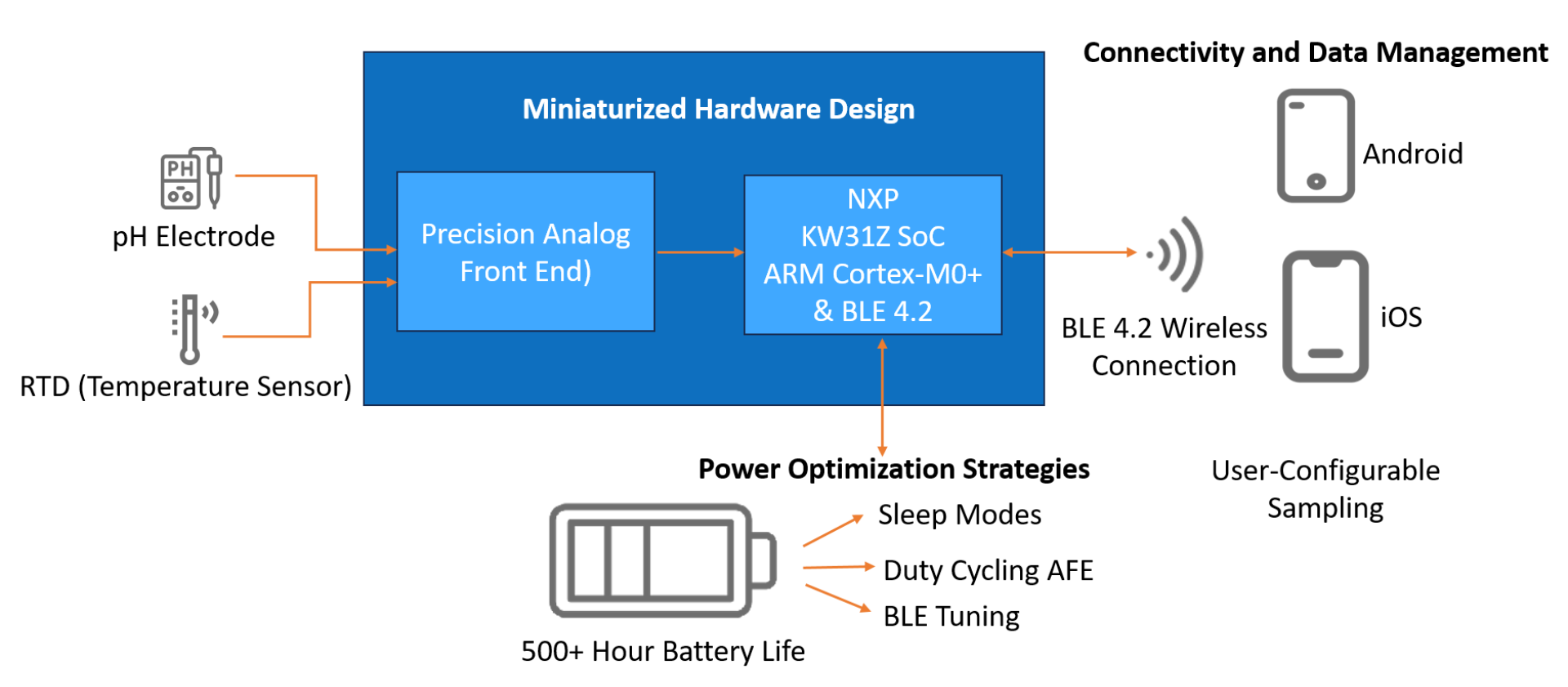
The smart pH meter is built on the NXP KW31Z, a System-on-Chip (SoC) integrating an ARM Cortex-M0+ microcontroller with a BLE 4.2 radio. This platform was chosen for its low-power operating modes and compact packaging, providing a robust foundation for portable medical sensors.
Miniaturized Hardware Design
The PCB was engineered to isolate the sensitive analog section from the digital and RF sections. A single star point connection between the analog and digital ground planes minimized noise coupling. The BLE antenna was strategically placed at the board edge with calculated clearance to ensure high efficiency without increasing the overall footprint.
Precision pH Analog Front End
Because pH electrodes present a very high source impedance, the AFE employs a precision instrumentation amplifier with an input bias current in the picoamp range. This prevents loading the electrode, which would otherwise introduce significant measurement errors.
Temperature compensation is equally vital. The Nernst equation, which governs pH electrode response, is temperature-dependent. To ensure accuracy, an RTD (Resistive Temperature Detector) is interfaced through a dedicated conditioning circuit. This allows for real-time compensation, ensuring the pH value remains accurate across varying environmental conditions.
Connectivity and Data Management
The device leverages BLE 4.2 to enable wireless data acquisition via Android and iOS smartphones.
Custom GATT Profiles and Sampling
A custom GATT profile defines characteristics for:
- Real-time streaming: Live pH and temperature readings.
- Data logging: Retrieval of historical measurements stored in internal flash memory.
- Configuration: Adjusting sampling intervals.
- FOTA: Secure Firmware Over-The-Air updates.
The sampling interval is user-configurable. Short intervals are ideal for monitoring dynamic chemical reactions, while longer intervals extend battery life for slow-changing applications like environmental water quality monitoring.
Power Optimization Strategies
To reach the 500-hour battery life milestone, Embien implemented systematic power optimization:
- Sleep Modes: The KW31Z core remains in a low-power sleep state between scheduled wake events.
- Duty Cycling: The AFE and RTD conditioning circuits are powered on only during the brief measurement window and immediately deactivated thereafter.
- BLE Tuning: Parameters such as advertising intervals, connection intervals, and slave latency were tuned to allow the radio to skip connection events when no data is ready for transmission.
Advanced Features and Compliance
Secure BLE FOTA
Maintaining medical devices in the field requires a secure way to update firmware. The smart pH meter uses a protected update protocol where firmware images are digitally signed and validated on-device. The bootloader is designed with a fallback mechanism; if power is lost during an update, the device remains functional by retaining the last valid firmware, preventing "bricking."
Regulatory and Safety Standards
- IEC 60601-1 Compliance: Hardware design maintained specific creepage and clearance distances. Applied part isolation was implemented to protect the user/patient from electrical hazards through the electrode connection.
- IEC 62304 Compliance: The firmware followed a documented lifecycle, including hazard analysis and rigorous integration testing. The complete documentation package was provided to the customer to support their regulatory technical file for market approval.
Key Benefits
The development of this smart pH meter provided several strategic advantages:
- Clinical-Grade Precision: High-impedance interface and temperature compensation delivered laboratory-standard accuracy in a handheld form factor.
- Extended Operational Life: 500-hour coin cell life enables long-term field deployment without frequent battery changes.
- Seamless Integration: BLE connectivity allows for cable-free data streaming and easy integration with laboratory information systems (LIS).
- Versatility: Configurable sampling allows the same hardware to be used for both high-resolution research and low-frequency environmental monitoring.
- Market Readiness: Full IEC 60601-1 and IEC 62304 compliance ensures the device is ready for the rigorous medical certification process.
Conclusion
This project highlights Embien’s ability to navigate the complex intersection of precision analog measurement, ultra-low-power design, and stringent medical regulations. By integrating the NXP KW31Z platform with a custom high-impedance AFE and secure wireless capabilities, Embien delivered a production-ready tool that successfully transitioned laboratory technology into a portable, clinical-grade solution. This smart pH meter reflects a deep expertise in embedded systems and the specialized requirements of the healthcare technology sector.
This case study illustrates that with the right combination of component selection, creative PCB layout, and disciplined software engineering, it is possible to achieve high-performance analytical measurement within the demanding constraints of a battery-powered, connected medical device.