CASE STUDY SNAPSHOT
Customer : An Indian health and wellness technology startup developing smart wearable devicesSize : < 50
Project vertical : Consumer Electronics, Health and Wellness Wearables
Challenge : Develop production firmware for a smart health ring on the nRF52832 BLE SoC featuring PPG-based heart rate monitoring, accelerometer activity tracking suitable for agile and continuous development.
Solution : Production firmware with SI1153 PPG sensor integration, accelerometer activity tracking, powerline communication for wireless charger interaction, power management, OTA firmware update, and Docker-based CI/CD automated build and test pipeline.
Services & Products Availed : Turnkey Product Engineering, Embedded Hardware Design, Embedded Firmware Development
Tools and Technologies :
- Target MCU: Nordic nRF52832
- Connectivity: BLE 5.0
- CI/CD: Docker
- Languages: C
- Tools: Segger Embedded Studio, nRF Connect SDK
Introduction
Smart rings are among the most challenging form factors in wearable electronics. Packing a complete health monitoring system, optical heart rate sensor, motion sensor, wireless charging, battery management, BLE radio, and the firmware intelligence to make them work together, into a finger-worn device with a PCB measured in millimetres demands exceptional engineering discipline across hardware miniaturisation, ultra-low power firmware design, and sensor algorithm development.
An Indian health technology startup developing a smart health ring targeting the wellness and mindfulness market, approached Embien to develop the complete production firmware for their device.
Challenge
The fundamental challenge of smart ring development is power. Every peripheral, the PPG sensor's LEDs and photodetector, the accelerometer, the BLE radio, the flash memory, and the powerline communication chip, draws current. In a ring form factor where battery capacity is measured in single-digit milliamp-hours, the difference between careless and disciplined power management can be the difference between a device that lasts a day and one that lasts a week. The PPG-based heart rate measurement introduced algorithmic complexity on top of the power challenge. Also, the accelerometer data had to be used in conjunction with the PPG signal to identify and compensate for motion artefacts, a sensor fusion challenge that required careful algorithm design and validation across a range of real-world wearing conditions.
Solution
Smart Ring development with nRF52832 Firmware
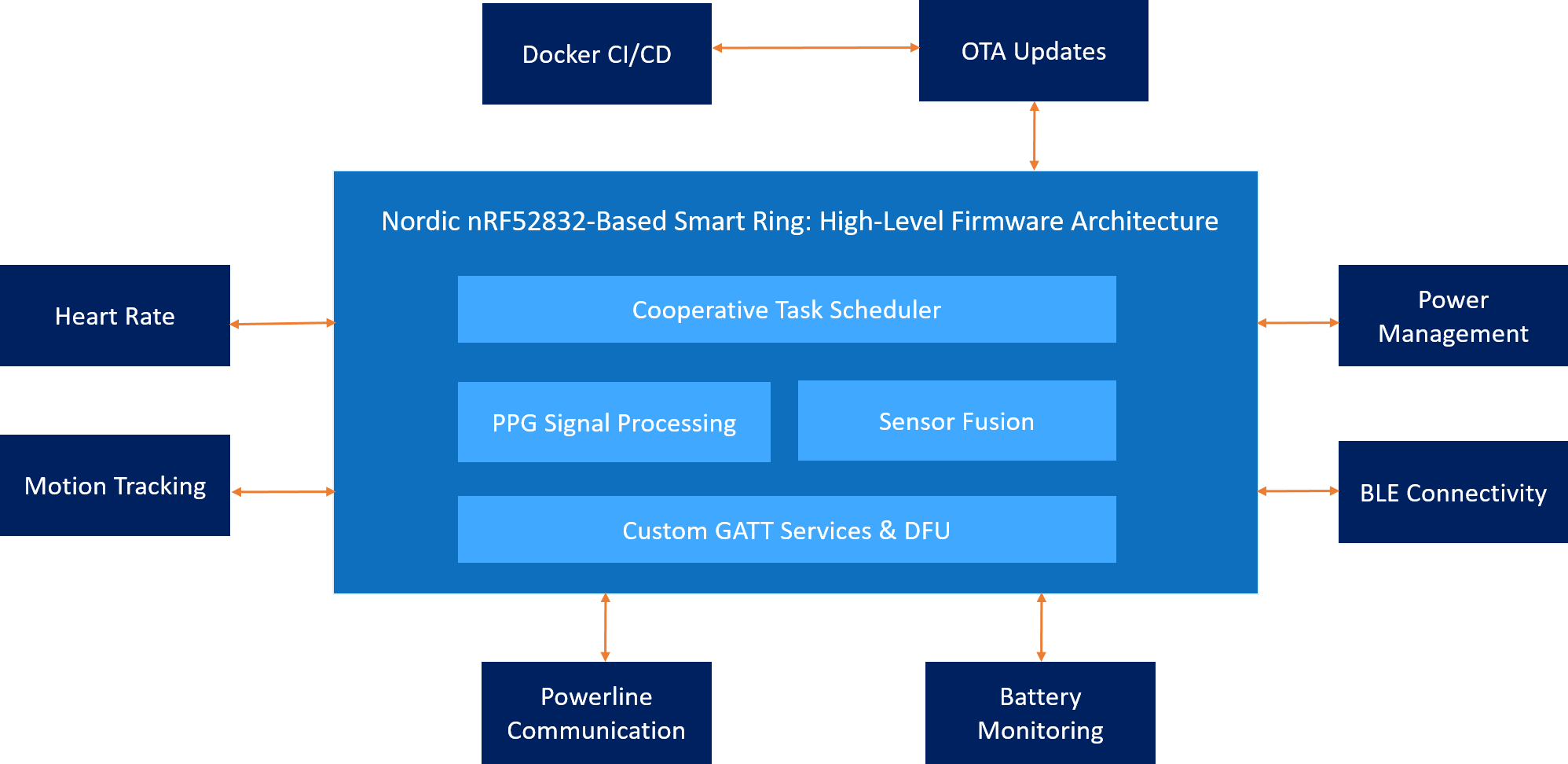
The smart ring development was done on the Nordic nRF52832 BLE SoC using the nRF5 SDK and Nordic SoftDevice S132 BLE stack. The firmware architecture was built around a cooperative task scheduler integrated with the SoftDevice's event-driven model, enabling BLE stack events, sensor acquisition completions, and timer callbacks to be handled in a structured, prioritized manner without the overhead of a full RTOS.
All peripherals, PPG sensor, accelerometer, battery monitor, powerline communication chip, and external flash, are interfaced over I2C and SPI buses managed through the nRF52832's TWI and SPI hardware peripherals with DMA transfers, minimising CPU wake time during sensor data acquisition.
PPG Heart Rate Monitoring
Heart rate monitoring is implemented using the SI1153 optical sensor, which drives a combination of red and infrared LEDs and measures the reflected light intensity from the finger tissue using its integrated photodetector. The SI1153 was configured for the ring's specific optical geometry, with LED drive currents and integration times tuned to maximize signal quality within the ring's power budget. Raw PPG samples are acquired and fed to a signal processing pipeline that applies baseline wander correction, bandpass filtering to isolate the cardiac frequency band, and peak detection to extract the inter-beat intervals from which heart rate is computed.
Motion artefact rejection uses the LIS2DS12 accelerometer data in conjunction with the PPG signal. This sensor fusion approach significantly improves the accuracy of heart rate readings during common daily activities.
Accelerometer Activity Tracking
The LIS2DS12 three-axis accelerometer tracks daily activity, step count, calories burned, distance covered, and activity classification, using the accelerometer's hardware-embedded activity recognition features alongside custom firmware-level processing. The LIS2DS12's hardware step counter and activity/inactivity detection interrupt outputs were leveraged in the smart ring development to minimise the CPU wake time required for activity tracking.
Activity data is accumulated locally in the ring's firmware and synchronised to the companion smartphone application over BLE at configured intervals, contributing to the user's daily wellness dashboard.
MAX20340 Powerline Communication with wireless charging
The MAX20340 powerline communication IC enables bidirectional data exchange between the ring and its wireless charger over the same inductive coil used for wireless power transfer helping achieve the ring's form factor and water resistance. The powerline communication channel is used to exchange charging state information, battery level data, and ring identification information between the ring firmware and the wireless charging base station.
Battery Monitoring and Power Management
Battery state is monitored through the MAX17260 fuel gauge IC, providing accurate state of charge, remaining capacity, and time-to-empty estimates based on coulomb counting with temperature and ageing compensation.
Power management was implemented with aggressive discipline across all firmware subsystems. Peripherals are powered down between acquisition intervals through dedicated power gating controls managed by the TP56720. The nRF52832 core is placed in system-off sleep between scheduled wake events. BLE connection interval and advertising timing were tuned to minimise radio on-time. Combined, these measures delivered a battery life meeting the customer's multi-day continuous wear target.
BLE Connectivity and OTA Update
BLE connectivity is implemented using Nordic SoftDevice S132 with custom GATT services for health data streaming, activity data synchronisation, ring configuration, and OTA firmware update. The OTA update capability uses Nordic's DFU (Device Firmware Update) protocol, enabling the ring firmware to be updated securely over BLE from the companion smartphone application without physical access to the device. Firmware images are validated for integrity before being programmed, protecting the ring against corrupted update images that could render it inoperable.
Docker-Based CI/CD Pipeline
A Docker-based CI/CD pipeline was implemented to support the startup's agile firmware smart ring development process. The complete nRF52832 build environment, compiler toolchain, nRF5 SDK, SoftDevice, and build scripts, was containerized in a Docker image, ensuring a consistent, reproducible build environment across all development machines and the CI server. On each firmware commit, the CI pipeline automatically triggers a Docker container build, compiles the firmware, runs the static analysis checks, and executes the automated unit test suite, producing a build report and flagging any regressions before the change is merged. This pipeline gave the startup's small firmware team confidence that each committed change had been automatically validated before reaching the main branch.
Benefits
- Ultra-low power multi-sensor firmware - Aggressive power gating and BLE duty cycling deliver multi-day battery life from a coin-cell-scale battery in a finger-worn ring form factor
- Motion-compensated PPG heart rate - Sensor fusion of SI1153 PPG and LIS2DS12 accelerometer data with adaptive artefact rejection delivers accurate heart rate readings
- Powerline communication with wireless charger - MAX20340-based bidirectional data exchange over the charging inductive link enables ring-charger communication
- Secure BLE OTA firmware update - Nordic DFU-based OTA update with image integrity validation enables field firmware updates over BLE without physical device access
- Docker-based CI/CD for embedded - Containerised build environment with automated static analysis and unit testing reduced integration risk and accelerating the startup's development cycle
Conclusion
The smart ring development demonstrates Embien's capability to develop production-grade embedded firmware for the most challenging wearable form factor, the smart ring. By delivering a complete multi-sensor firmware stack, PPG heart rate with motion artefact rejection, accelerometer activity tracking, MAX20340 powerline charger communication, accurate battery monitoring, and secure BLE OTA, within the severe power and size constraints of a finger-worn device, Embien provided its health technology startup customer with a production-ready firmware foundation for their wellness wearable product. The addition of a Docker-based CI/CD pipeline gave startup teams the automated validation infrastructure they need to develop confidently at pace.