CASE STUDY SNAPSHOT
Customer : A leading Indian automotive Tier 1 supplier serving major two-wheeler and four-wheeler OEMsSize : 1000–10,000
Project vertical : Automotive, Connected Vehicles, Analytics
Challenge : Develop a TPMS mobile application that pairs with proprietary BLE TPMS sensors on both two-wheelers and four-wheelers, delivers real-time tyre pressure and temperature alerts, synchronises data across user devices via Google Drive, and feeds a cloud analytics engine for tyre health and driver performance profiling
Solution : Android TPMS Monitor App with proprietary BLE sensor integration, Google Drive sync, Room database local storage, 5-year cloud data retention, graphical historical visualisation, and cloud-based tyre and driver analytics
Services & Products Availed : Mobile Application Development, UI/UX Design Services, Cloud Integration
Tools and Technologies:
- Platform: Android
- Language: Kotlin
- Connectivity: BLE (proprietary advertisement protocol)
- Local Storage: Room Database
- Cloud Sync: Google Drive API, Google Cloud Console
- Backend: Cloud analytics engine
- Notifications: FCM
- Data Retention: 5 years cloud storage
Introduction
Tyre pressure is one of the most directly impactful factors on vehicle safety, fuel efficiency, and tyre longevity, yet it remains one of the most commonly neglected maintenance parameters by everyday riders and drivers. A leading Indian automotive Tier 1 supplier, with an extensive portfolio serving major two-wheeler and four-wheeler OEMs, developed a proprietary BLE-based TPMS sensor system to address this gap. They approached Embien to develop the companion Android application, the primary user interface through which vehicle owners would monitor tyre health, receive alerts, and access the analytics insights that would differentiate the product in a competitive market.
The application had to go well beyond a simple pressure display. The customer's vision was to use the continuous stream of tyre pressure, temperature, and vehicle motion data collected from deployed sensors to build meaningful analytics, profiling tyre health over time, identifying patterns indicative of poor inflation habits, and characterising driver behaviour through the lens of tyre stress. This analytics capability, feeding from a 5-year cloud data store, was the core differentiator the customer wanted to take to OEMs and fleet operators.
Challenge
The first technical challenge was the proprietary BLE advertisement protocol used by the customer's TPMS sensors. Unlike standard TPMS implementations that follow established profiles, the sensors broadcast data in a custom advertisement format, requiring Embien to implement a bespoke BLE scanning and parsing engine within the application. The engine had to handle multiple simultaneous sensor advertisements, up to four sensors for a four-wheeler, with reliable deduplication, RSSI-based proximity filtering, and dropout detection.
Supporting both two-wheeler and four-wheeler vehicle configurations within a single application introduced UI and data modelling complexity. A two-wheeler has two tyres with distinct pressure thresholds and riding dynamics; a four-wheeler has four, with additional considerations around axle load distribution and spare tyre monitoring. The application had to handle both cleanly, with vehicle-type-specific visualisation and alert logic.
Google Drive synchronisation, enabling a user's sensor pairings, vehicle configurations, and historical data to be available seamlessly across multiple Android devices, required careful handling of authentication, conflict resolution, and incremental sync to avoid excessive data transfer on cellular connections.
Finally, feeding 5 years of sensor data into a cloud analytics engine in a structured, queryable format, while keeping the mobile application responsive and the data pipeline reliable, required a well-designed backend integration strategy.
Solution
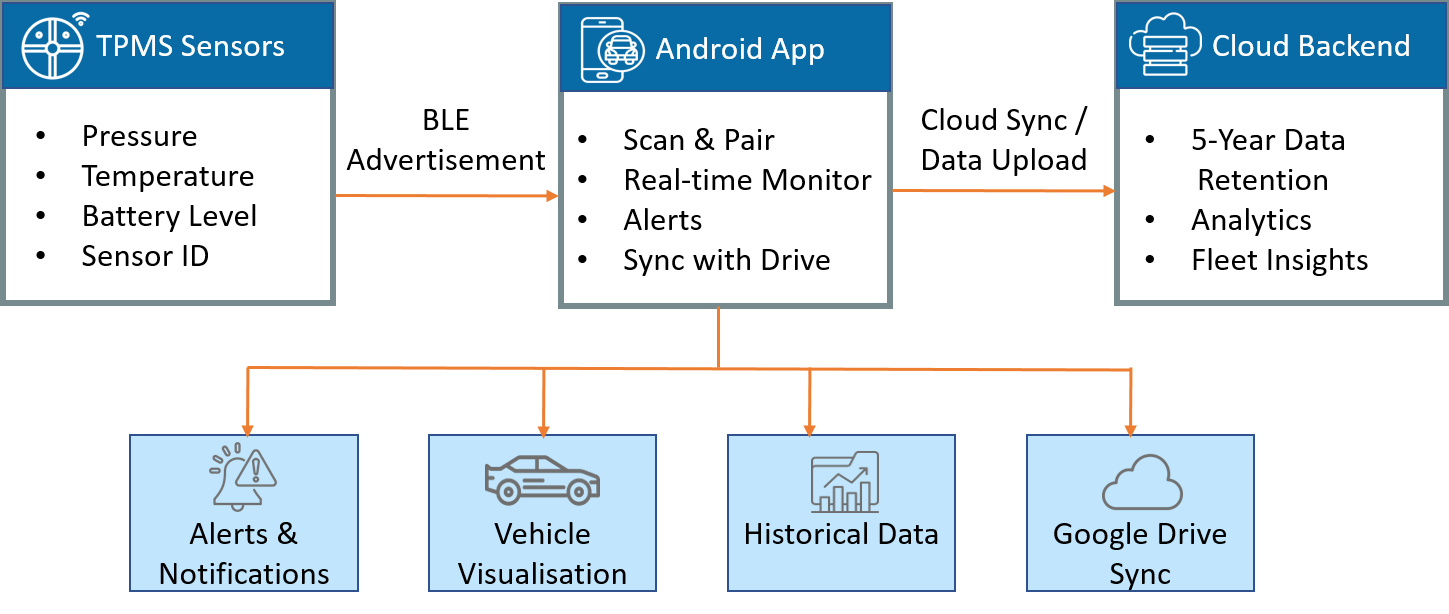
Proprietary BLE Sensor Integration
The BLE layer was built around a continuous background scanning service that monitors for advertisements from the customer's proprietary TPMS sensors. The service parses the custom advertisement payload format to extract tyre pressure, temperature, battery level, and sensor identifier from each broadcast packet. RSSI thresholding is applied to filter out sensors from adjacent vehicles in dense environments such as parking areas. The service maintains a live sensor registry, detecting when a paired sensor goes out of range or stops broadcasting, triggering a connectivity alert to the user.
Sensor pairing is handled through a guided in-app flow that walks the user through physically pressing each sensor in sequence, allowing the application to associate each sensor with its tyre position on the vehicle. Paired configurations, sensor IDs, tyre positions, vehicle type, and pressure thresholds, are stored locally in a Room database and synchronised to Google Drive for cross-device availability.
Vehicle Configuration and Visualisation
The application supports two distinct vehicle modes, two-wheeler and four-wheeler, each with a tailored visual layout. The main monitoring screen presents a graphical representation of the vehicle with each tyre displayed at its physical position. Live pressure and temperature readings update in real time as sensor advertisements are received. Colour coding provides instant status indication, green for normal, amber for low or high pressure approaching threshold, and red for critical conditions requiring immediate attention.
Users configure pressure thresholds per tyre position, with the application applying OEM-recommended defaults based on vehicle type as a starting point. Separate thresholds for moving and stationary conditions are supported, accounting for the pressure increase that naturally occurs in tyres during sustained riding or driving.
Alerts and Notifications
Immediate notifications are triggered for low pressure, high pressure, high temperature, and rapid pressure loss, the latter being a strong indicator of a puncture in progress. Notifications are delivered via FCM and are actionable — tapping the notification opens the application directly to the affected tyre's detail view. Alert history is maintained locally and in the cloud, forming part of the analytics data set.
Google Drive Synchronisation
Google Drive synchronisation enables the user's complete application state, sensor pairings, vehicle configurations, threshold settings, and alert history, to be available on any Android device where they sign in with the same Google account. This is particularly relevant for users who upgrade devices or use the application across a personal phone and a work device. Sync is incremental and bandwidth-conscious, transmitting only changed records rather than full data sets. Conflict resolution logic handles the case where changes have been made on multiple devices since the last sync, prioritising the most recent timestamp.
5-Year Cloud Data Retention and Analytics
Every pressure, temperature, and alert event recorded by the application is uploaded to the customer's cloud backend and retained for five years. This long-duration data store is the foundation of the analytics engine, enabling analysis that is simply not possible with short-retention or device-only data.
The analytics engine processes the accumulated sensor data to generate two categories of insight. Tyre health profiling tracks pressure deviation patterns over time per sensor and per vehicle, identifying tyres that chronically underperform, sensors that show signs of degradation, and seasonal or usage-related pressure trends. Driver performance profiling correlates tyre stress signatures, rapid pressure and temperature changes, high sustained temperatures during long runs, and frequency of low-pressure events, with driving patterns to characterise driver behaviour in terms of tyre impact. These analytics outputs are surfaced in the application as graphical historical views and periodic insight summaries, giving individual users actionable feedback on their tyre maintenance habits and driving style.
For the customer's OEM and fleet operator clients, the same analytics engine aggregates data across vehicle fleets, enabling comparative performance benchmarking, predictive maintenance scheduling based on tyre wear signatures, and population-level insights into tyre performance across different vehicle models and usage environments.
Historical Data Visualisation
Within the application, users can access graphical historical data for any paired sensor, viewing pressure and temperature trends over configurable time ranges, from the past 24 hours up to the full available history. Interactive charts allow users to zoom into specific events, correlating pressure spikes or drops with known journeys or weather conditions. Alert history is presented in a chronological log with timestamps and tyre position context.
Benefits
- Proprietary BLE integration Custom advertisement protocol parsing with multi-sensor simultaneous tracking, RSSI filtering, and dropout detection
- Dual vehicle support Two-wheeler and four-wheeler configurations handled within a single application with vehicle-type-specific visualisation and alert logic
- Google Drive sync Seamless cross-device data availability without requiring a dedicated account system beyond the user's existing Google identity
- 5-year cloud retention Long-duration data store enables analytics insights that short-retention solutions cannot support
- Tyre health profiling Cloud analytics identifies chronic underperformance patterns and sensor degradation trends across the sensor lifetime
- Driver performance analytics Tyre stress signatures correlated with driving patterns provide actionable feedback to individual users and fleet operators
- Fleet-level insights Aggregated analytics across OEM and fleet deployments enable population-level tyre performance benchmarking and predictive maintenance
Conclusion
This TPMS Monitor application demonstrates how a well-designed mobile application can transform a hardware sensor product into a data-driven analytics platform. By combining reliable proprietary BLE sensor integration with 5-year cloud data retention and a sophisticated analytics engine, Embien helped its automotive Tier 1 customer deliver a product that goes far beyond real-time pressure display, providing tyre health insights and driver performance profiling that are genuinely valuable to individual owners, OEM partners, and fleet operators alike. This project reflects Embien's ability to bridge embedded connectivity, mobile application development, and cloud analytics into a cohesive, market-differentiating product.