
A common early misconception in cloud-connectivity projects is treating protocol translation as an afterthought, assuming a Modbus or OPC UA device can somehow just be pointed at a cloud endpoint directly. Neither protocol was designed with cloud connectivity, or MQTT's publish-subscribe model, in mind: Modbus is a request-response, master-polled protocol with no native concept of a message broker or topic hierarchy, and OPC UA's structured, session-based information model doesn't map cleanly onto MQTT's flat topic-and-payload structure without a deliberate translation layer in between. Building an industrial gateway with custom protocol support is what actually bridges this gap, a dedicated device or software layer that speaks each OT protocol natively on one side and publishes a cloud-friendly data model on the other, rather than attempting to force an OT protocol to behave like something it was never designed to be.
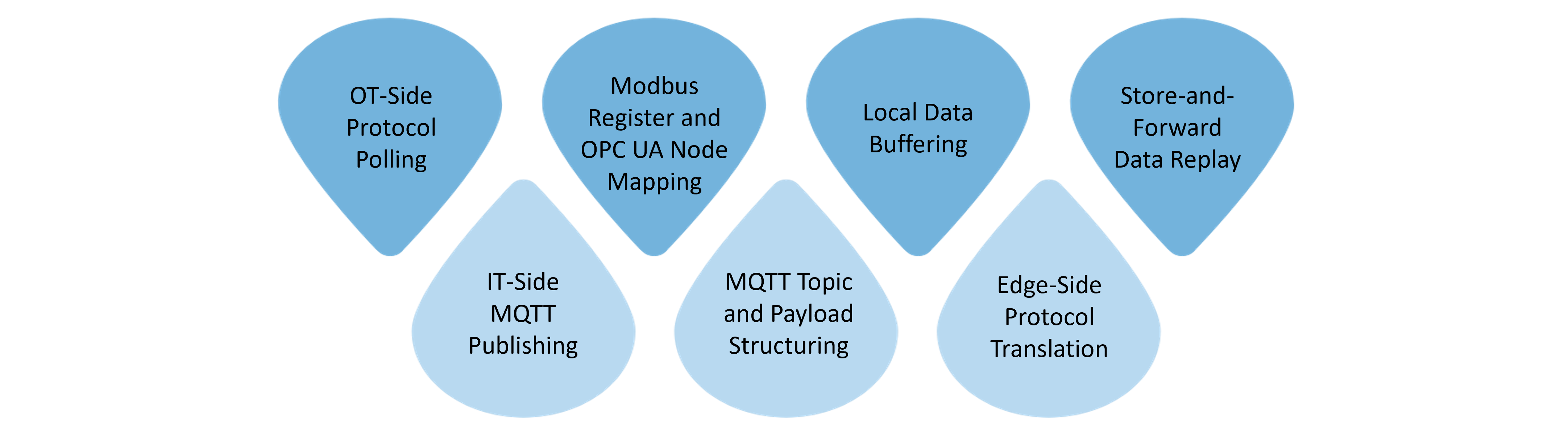
A well-architected gateway separates cleanly into two halves connected by an internal data model. The OT-side half polls or subscribes to field devices using their native protocol, Modbus register reads on a defined schedule, or OPC UA subscriptions against specific nodes, and normalizes whatever it collects into the gateway's own internal representation. The IT-side half takes that internal representation and publishes it outward using MQTT, structuring topics, payloads, and QoS behavior appropriately for the cloud or on-premise broker it's feeding. Keeping these two halves genuinely decoupled, rather than hard-wiring OT polling logic directly into MQTT publish calls, is what lets a gateway support a new field protocol or a new cloud destination later without rearchitecting the whole translation pipeline.
Protocol translation architecture for modbus and opc ua to mqtt lives or dies on this mapping step. A Modbus register is just a numbered 16-bit value with no inherent meaning, register 40012 means nothing to a downstream cloud application until the gateway's configuration assigns it a name, a scaling factor, a unit, and a place in the topic hierarchy, something like plant1/line3/tank2/level. OPC UA nodes carry richer built-in metadata, but still need a deliberate mapping decision, whether to flatten a node's hierarchical browse path directly into an MQTT topic structure, or to re-organize it around how the receiving cloud application actually wants to consume the data. Getting this data model right once, at gateway configuration time, is what saves a cloud-side team from having to hand-decode raw register numbers or OPC UA node IDs downstream. It's also what distinguishes a genuinely useful industrial gateway with custom protocol support from one that merely forwards raw bytes without any real translation behind it.
Cloud connectivity, cellular, satellite, or even a plant's own Wi-Fi backhaul, drops out in ways a local RS-485 fieldbus mostly doesn't, so a gateway built to publish live and nothing else loses data every time the uplink does. A properly designed gateway buffers polled OT data locally, in memory for short interruptions and to a local disk-backed queue for longer ones, and replays it in order once connectivity returns, rather than simply discarding whatever couldn't be published in the moment. This store-and-forward behavior is a core architectural requirement for any industrial gateway development effort targeting field or plant deployments where connectivity, unlike the OT side of the gateway, can't be assumed to be reliably always-on.
Some architectures push protocol translation entirely to the cloud, streaming raw OT protocol data upward and translating it centrally; most real industrial deployments instead do translation at the edge, on the gateway device itself, for good reason. Edge-side translation means the gateway only needs to send the network a smaller, already-normalized MQTT payload rather than a raw, chatty OT protocol stream, it keeps the gateway operational for local logging and store-and-forward even during a full connectivity outage, and it avoids exposing the raw fieldbus protocol, with all of Modbus's and OPC UA's own security limitations, across the wider network at all. How to architect a protocol gateway for industrial iot? in most real deployments comes down to exactly this default: translate at the edge, and reserve cloud-side processing for aggregation and analytics across many already-translated gateways rather than raw protocol handling.
Custom iot gateway development for data aggregation becomes necessary once a single site has more than one OT protocol or more than one field device type feeding the same cloud application, a common real-world condition rather than an edge case. A gateway built for genuine data aggregation needs to poll multiple protocols concurrently without one slow-responding device stalling the others, merge their outputs into one coherent MQTT topic structure rather than several inconsistent ones, and scale its polling architecture as more field devices are added over the deployment's life. Custom iot gateway development for data aggregation done well means the cloud-side application sees one consistent, well-modeled data stream regardless of how many different OT protocols and device types are actually feeding it underneath.
Embien's own delivered work grounds this architecture in real projects rather than theory: a Modbus RTU-to-cloud gateway built with an IP40 enclosure for field deployment, and a separate Modbus RTU-to-Modbus TCP protocol converter handling the serial-to-Ethernet translation step that frequently sits alongside cloud-facing gateway logic in the same deployment. Both projects implement the store-and-forward, edge-side-translation, and data-modeling principles described above against real field hardware and real connectivity constraints, not a lab demonstration, and both illustrate what an industrial gateway with custom protocol support actually looks like once it's been through real field validation rather than a bench test alone.
Industrial gateway development that succeeds in the field combines every piece above into one coherent design: protocol translation layers kept cleanly separated, a deliberate data model connecting OT register and node addresses to meaningful MQTT topics, store-and-forward buffering sized for the deployment's real connectivity profile, and translation logic placed at the edge by default. Industrial gateway development that treats these as one integrated architecture, rather than a collection of independently-built features, is what actually holds up once a gateway moves from a bench prototype to a fleet of units deployed across a real plant or a distributed set of remote sites.
Embien Technologies designs and builds industrial protocol gateways with custom protocol support across Modbus, OPC UA, and MQTT, backed by real delivered gateway and protocol-converter projects including an IP40-enclosure Modbus-to-cloud gateway and a Modbus RTU-to-TCP protocol converter. Our gateway engineering covers edge-side translation, store-and-forward buffering, and data-model design end to end.
To discuss building an industrial gateway with custom protocol support for a Modbus, OPC UA, or mixed-protocol deployment, reach out to Embien's engineering team.

Embien's product engineering services support the development of connected industrial devices and gateways, covering embedded hardware, firmware development, protocol integration, data acquisition, and system validation for reliable industrial applications.

Embien's IoT development services cover custom gateway engineering, Modbus and OPC UA protocol integration, MQTT connectivity, edge-side data processing, and store-and-forward mechanisms to connect industrial equipment with cloud and enterprise applications.

A case study on developing an IP40-enclosed Modbus RTU-to-cloud gateway, highlighting industrial protocol integration, embedded gateway development, and connectivity solutions for collecting and transmitting field-device data to cloud platforms.