
In the technology sector, we have a habit of taking useful engineering concepts and marketing them until they lose their meaning. "Digital Twin" is currently at risk of suffering this fate. It sits at the peak of the hype cycle, often described as a magical 3D visualization that solves all industrial woes.
As engineers and technical leaders, we need to strip away the glossy renderings and look at the plumbing. For us at Embien, a Digital Twin is not just a visual gimmick; it is a rigorous, mathematical, and data-driven bridge between a physical entity and digital intelligence. It is the convergence of high-fidelity modeling and high-frequency Industrial IoT Strategy.
If you are a developer or a stakeholder looking to implement Digital Twin Services, you need to understand that the Return on Investment (ROI) doesn't come from the 3D model itself; it comes from the bi-directional flow of data that creates actionable insights.
To build a strategy, we must first agree on the taxonomy. A "Digital Twin" is not a monolith; it is a hierarchy of granularity. When clients approach Embien, we often start by categorizing their needs into three distinct levels:
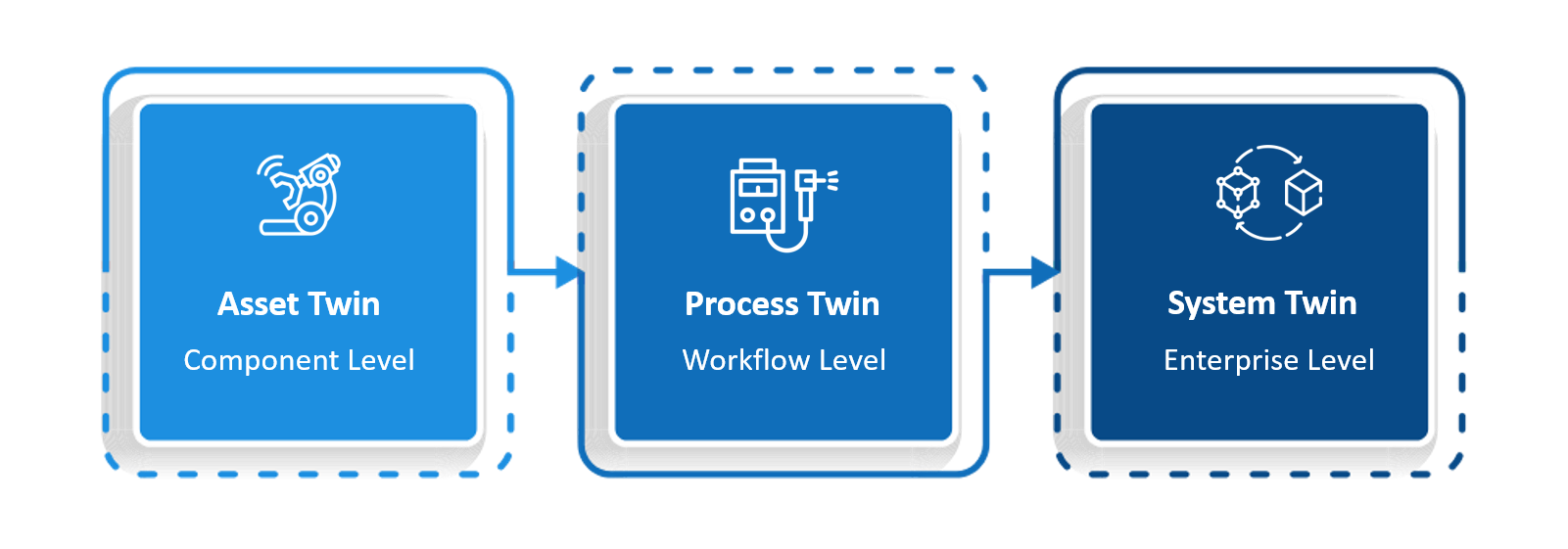
The Asset Twin (Component Level): This is the granular representation of a single piece of hardware, such as a motor, a pump, or a robotic arm. Here, we care about specific telemetry: vibration, temperature, and RPM. The goal is usually predictive maintenance or analyzing component stress.
The Process Twin (Workflow Level): This aggregates multiple asset twins to model a function. For example, an entire welding station or a bottling line. The focus shifts from "Is this motor hot?" to "Is this line balanced?" The metrics here are throughput, cycle time, and bottlenecks.
The System Twin (Enterprise Level): The macro view. This connects process twins across a facility or supply chain. It provides visibility into how a delay in raw material intake (System) affects the operation of a specific CNC machine (Asset).
Understanding this hierarchy is the first step in calculating ROI. You do not need a System Twin if your primary pain point is the failure rate of a specific gearbox.
This is the most common point of confusion for developers and C-suite executives alike. "We have CAD models and we run Finite Element Analysis (FEA). Do we have a Digital Twin?"
The answer is usually no.
A simulation is a snapshot. It is a mathematical model studying a theoretical set of conditions. It is static. A Digital Twin, however, is stateful. It is tethered to the physical world via a continuous stream of real-time data.
Digital Twin = Physics Model + Real-Time Sensor Data + Bi-directional Connectivity
If the digital representation does not change the moment the physical asset changes (within an acceptable latency window), it is just a simulation.
To move from a buzzword to a deployable asset, we must look at the architecture. A robust Digital Twin relies on a stack that handles data ingestion, processing, and visualization.
This is where the rubber meets the road. We are talking about retrofitting legacy machines with vibration sensors, accelerometers, and flow meters. This layer involves protocol conversion, translating Modbus, CAN, or Profinet into a unified stream (often MQTT or OPC-UA).
Sending raw millisecond-level vibration data to the cloud is expensive and inefficient. We utilize Edge AI to pre-process data locally. For instance, performing Fast Fourier Transforms (FFT) on the edge to detect anomalies before sending only the alerts to the cloud.
This is where the "Twin" lives. It combines the physics-based model (how the machine should behave) with the sensor data (how the machine is behaving). Discrepancies between these two generate the insights.
Why invest in this complexity? Because the ROI is measurable and significant, particularly in capital-intensive industries.
This is the "low-hanging fruit" of Digital Twin ROI. By monitoring the degradation curves of components in real-time, the Twin predicts failure before it happens.
Before the physical machine is even built, the control software can be tested on the Digital Twin. We can debug the logic, test failure modes, and train operators in a virtual environment.
Advanced Twins feed data back to the machine. If a temperature sensor indicates overheating, the Twin can instruct the VFD (Variable Frequency Drive) to ramp down RPM automatically, preserving the asset while maintaining production. Embien's predictive maintenance with Digital Twin services enables reliable closed-loop Digital Twin Technology across the diverse industries and domains it serves under real-world operating conditions.
Digital Twin Technology delivers genuine ROI only when the data flowing into the model is accurate, timely, and continuous — the 3D dashboard is the final mile. A rigorous Industrial IoT Strategy covering sensor selection, protocol conversion, and edge filtering is what converts a proof-of-concept into a production system with measurable Digital Twin ROI across reduced downtime, faster commissioning, and closed-loop process optimisation.

Discover how Embien's edge computing services pre-process industrial telemetry at the source, ensuring digital twins receive clean, low-latency data from every asset.
See how Embien's industrial automation services translate digital twin predictions into closed-loop control actions that reduce downtime and increase throughput.

Case study: Embien engineered an automated test bench for an industrial DAQ device, validating data accuracy across multiple sensor channels under real-world conditions.