
Embedded AI solutions are what developers need when the challenges of embedded AI — resource constraints, lack of scalability, expertise shortages, fragmented architectures, data security risks, and rapid obsolescence — threaten to stall product delivery. This article explores actionable embedded AI solutions to these challenges, emphasizing open architecture, algorithm optimization, security measures, cloud and distributed AI, and bridging the skill gap to unlock the full potential of embedded AI.
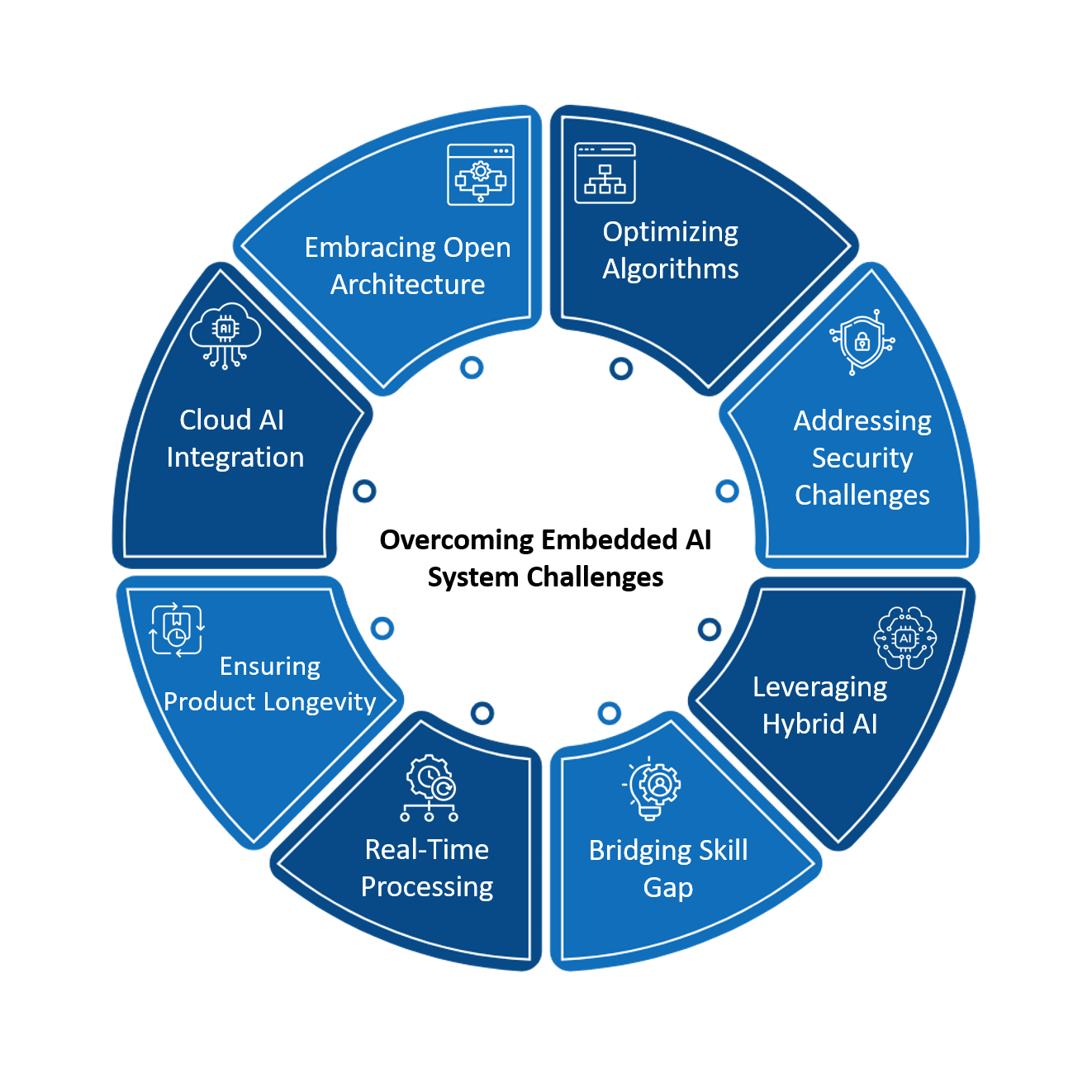
The absence of standardized architecture in embedded AI systems leads to fragmented ecosystems, limiting cross-portability and scalability. Each vendor, such as NXP or Qualcomm, follows proprietary models, making it difficult to develop universal AI applications. An open architecture — industry-wide hardware and software standards — is a foundational embedded AI solution that ensures seamless integration and scalability.
By adopting open standards, developers can create embedded AI solutions that run across diverse platforms, reducing redevelopment costs and enabling feature expansion. For example, frameworks like ONNX (Open Neural Network Exchange) and TensorFlow Lite for Micro support multiple hardware targets, promoting portability.
Resource constraints—limited computational power, memory, and energy—are a hallmark of embedded AI systems. To address this, algorithm optimization is essential to balance performance and efficiency. Techniques like pruning, quantization, and knowledge distillation reduce model size and complexity without significantly sacrificing accuracy.
Pruning removes redundant neurons or layers from neural networks, shrinking models like MobileNet for deployment on microcontrollers.
Quantization converts floating-point weights to lower-bit integers (e.g., 8-bit), reducing memory usage and speeding up inference.
Knowledge distillation trains a smaller “student” model to mimic a larger “teacher” model, achieving comparable performance with fewer resources.
These techniques enable embedded AI systems to run efficiently on low-power processors, such as Arm Cortex-M MCUs, while meeting power budgets for battery-powered devices.
Data security is a critical concern in embedded AI systems, which often process sensitive information like health metrics or industrial data. Poorly designed systems can expose vulnerabilities, enabling malicious actors to exploit unencrypted data, weak authentication, or outdated firmware.
To mitigate risks, developers should implement end-to-end encryption for data transmission and storage, ensuring sensitive information remains secure. Secure boot mechanisms verify firmware integrity during startup, preventing unauthorized modifications. Federated learning, where models are trained locally on devices without sharing raw data, enhances privacy by minimizing cloud dependency.
Hardware-based security features, such as Trusted Execution Environments (TEEs) or cryptographic accelerators, provide robust protection without compromising performance. Regular over-the-air (OTA) firmware updates address emerging threats, extending system security over time.
While edge AI excels at low-latency, real-time processing, resource constraints can limit its ability to handle computationally intensive tasks, such as training large models or processing high-resolution data. Leveraging cloud and distributed AI offers a hybrid embedded AI solution, offloading heavy computations to the cloud while maintaining edge processing for latency-sensitive tasks. Embien's cloud services provide the scalable backend infrastructure needed for these cloud and distributed AI architectures.
For example, an autonomous vehicle might use edge AI for real-time object detection but rely on the cloud for map updates or model retraining. Distributed AI, where processing is split across edge devices and cloud infrastructure, optimizes resource usage and enhances scalability. This approach to leveraging cloud and distributed AI also supports OTA updates, enabling continuous improvements in AI models without hardware upgrades. Embedded AI Services that span both cloud and edge layers are essential to making this architecture production-ready.
The development of embedded AI systems requires a rare blend of expertise in hardware, AI algorithms, sensor integration, and domain knowledge. However, the global shortage of professionals with these skills hinders progress. Most AI experts focus on cloud-based deep learning, while embedded engineers may lack experience with AI frameworks, creating a significant skill gap. Bridging the skill gap is itself a core embedded AI solution — one that pays dividends across every subsequent project.
Bridging the skill gap is crucial for unlocking the full potential of Edge AI Development. Companies can invest in cross-training programs to upskill their teams, combining hardware and AI expertise. Partnerships with academic institutions and online platforms like Coursera or Udacity can provide access to specialized courses in embedded AI and TinyML. Collaboration with firms like Embien Technologies, which offer end-to-end embedded AI solutions and edge computing services, can accelerate development while building internal capabilities.
Open-source communities, such as TinyML and Edge Impulse, foster knowledge sharing and provide pre-built tools, reducing the learning curve for developers. Hackathons and industry workshops further encourage innovation and skill development. This collaborative approach to bridging the skill gap is what separates teams that ship embedded AI products from those that remain stuck in prototype.
Many embedded AI applications, such as industrial robotics or drones, demand real-time processing with minimal latency. Achieving this on resource-constrained hardware is challenging, as complex models can introduce delays. Developers must optimize both algorithms and code to meet stringent timing requirements.
Efficient algorithms, such as those based on convolutional neural networks (CNNs) optimized for edge devices, reduce inference time. Code optimization techniques, like loop unrolling or inline functions, enhance execution speed. Hardware acceleration using neural processing units (NPUs) or digital signal processors (DSPs) offloads AI tasks, enabling faster processing without excessive power consumption.
Rapid obsolescence is a significant challenge, as embedded AI systems often outlive their hardware or software support. To ensure product longevity, developers should select future-proof components with long-term availability guarantees from vendors. Modular designs with OTA update capabilities allow for continuous improvements in AI models, firmware, and protocols, extending system lifespans.
Incorporating scalable hardware, such as SoCs with expandable memory or co-processors, provides flexibility for future enhancements. Standardizing communication protocols, like MQTT or OPC UA, ensures compatibility with evolving ecosystems.
Delivering robust embedded AI solutions requires a combination of open architecture, algorithm optimisation, security-by-design, and strategies for leveraging cloud and distributed AI alongside bridging the skill gap. Embedded AI Services that span model development through to on-device deployment are the accelerator that turns research into production, while Edge AI Development practices ensure that the final product meets the latency and power constraints of real-world embedded targets. Embien helps organizations accelerate digital transformation through intelligent embedded AI solutions and edge-enabled innovation.

Discover Embien's edge computing solutions — enabling embedded AI to run on constrained hardware by bridging cloud-trained models and real-time edge inference.

Explore how Embien's cloud services support hybrid embedded AI architectures — managing training, model updates and data aggregation while edge devices handle local inference.

See how Embien applied embedded AI solutions — leveraging cloud and distributed AI alongside on-device inference — to build a rapid PoC for a real-time disaster management early warning system.