
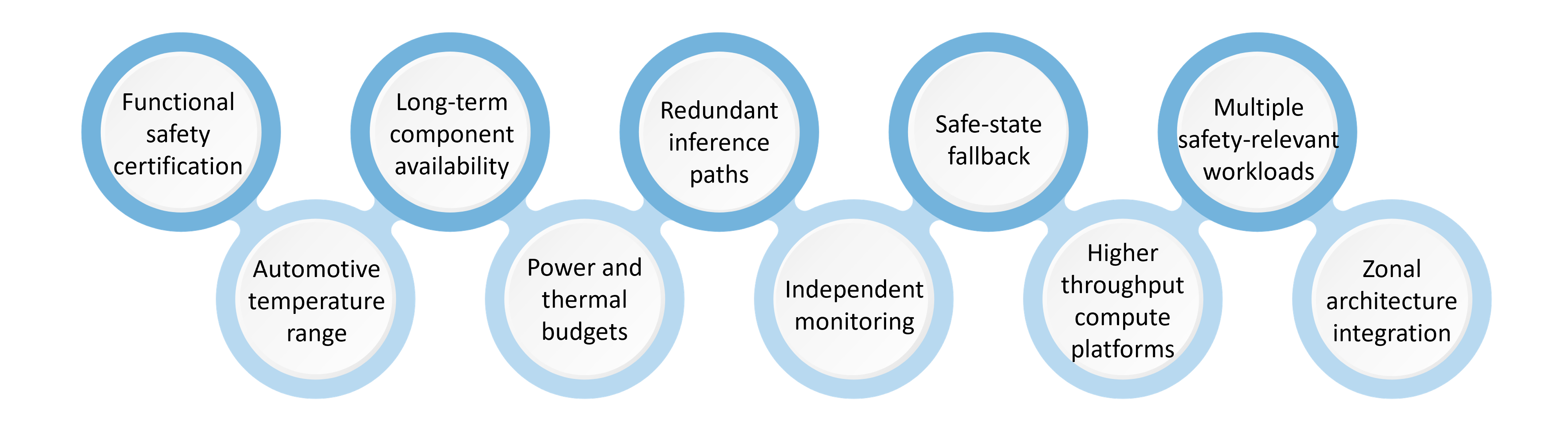
General-purpose edge AI hardware guidance assumes a world of consumer devices, industrial gateways, and enclosures that get replaced or upgraded every few years. A vehicle program operates under none of those assumptions. Automotive-grade ai accelerators: choosing compute for in-vehicle inference is a distinct hardware selection discipline, shaped by functional safety certification, an extreme temperature range, and a component availability horizon measured in a decade or more, not a couple of product cycles. Our technology-pillar guides to embedded AI hardware selection and embedded AI compute architectures cover the domain-agnostic version of this problem; this article covers what changes specifically for automotive.
Why does automotive ai compute selection differ from general edge ai hardware? comes down to three constraints that rarely apply with equal weight outside the automotive domain at once: functional safety certification for any inference path that feeds a safety-relevant decision, an operating temperature range far wider than a typical consumer or industrial edge device sees, and a multi-year, often decade-long, production and support commitment that rules out silicon with a short product lifecycle regardless of how attractive its raw performance numbers look. A chip that is an excellent choice for a smart camera or industrial vision system can be entirely unsuitable for an in-vehicle inference path once these three constraints are applied.
Asil-rated ai accelerators and functional safety certification for inference hardware is required wherever an AI inference result feeds a decision with safety consequences, which increasingly includes ADAS perception, driver monitoring, and other functions no longer treated as purely advisory. Certifying an AI accelerator to a target ASIL level involves demonstrating diagnostic coverage for the specific failure modes of that silicon, documented fault detection and safe-state behavior, and, in many cases, architectural safety mechanisms like lockstep execution or redundant compute paths built into the accelerator itself. ASIL-rated AI accelerators and functional safety certification for inference hardware narrows the available silicon options considerably compared to the broader edge AI hardware market, since not every accelerator vendor invests in the safety documentation and architectural features a certified automotive program requires.
Automotive temperature range and long-term component availability for ai compute together eliminate a large share of the AI accelerator market before functional safety is even considered. Automotive-grade operating temperature requirements, often spanning -40°C to 105°C or wider depending on mounting location, are far outside what most consumer and even many industrial edge AI chips are qualified for, and thermal derating of inference performance at the high end of that range has to be accounted for in system design rather than assumed away. Long-term availability matters just as much: a vehicle platform can stay in production for seven to ten years, and an AI accelerator selected for a program needs a realistic path to remaining sourceable, or at minimum having a qualified drop-in successor, for the platform's full production life, which rules out silicon built primarily for fast-moving consumer product cycles.
AI compute for in-vehicle inference competes for power and thermal budget against every other electrical load in the vehicle, and unlike a data center accelerator, it typically cannot rely on active cooling dedicated solely to itself. Power budget constraints shape accelerator selection directly: a chip with excellent raw inference throughput but a power draw that exceeds what its mounting location's cooling and the vehicle's electrical budget can sustain is not a viable choice regardless of its benchmark numbers. Thermal budget planning has to account for the accelerator's placement, whether it sits in a well-ventilated zone controller or a more thermally constrained location closer to a sensor, and for the reality that inference workload, and therefore heat generation, is rarely constant across a drive cycle.
Redundancy requirements for safety-relevant ai inference paths in vehicles follow the same functional safety logic applied to other safety-relevant compute in the vehicle: a single point of failure in an inference path that feeds a safety decision is generally not acceptable, which means the AI compute architecture has to include some combination of redundant inference paths, independent monitoring of inference output plausibility, or a documented safe-state fallback when the AI path is unavailable or its output cannot be trusted. Redundancy requirements for safety-relevant AI inference paths in vehicles add real cost and complexity to the compute architecture, but they are non-negotiable wherever an inference result directly triggers a safety-relevant vehicle action rather than only informing a human driver.
The trend toward zonal E/E architecture is directly reshaping where automotive AI accelerators live in the vehicle. Rather than dedicated AI compute embedded in each sensor or ECU, zonal and centralized domain-controller architectures increasingly consolidate AI inference onto shared compute platforms serving multiple functions, which changes the accelerator selection calculus toward higher-throughput, higher-redundancy parts capable of serving several safety-relevant inference workloads concurrently rather than many smaller, single-purpose accelerators scattered across the vehicle.
Embien Technologies helps automotive programs navigate automotive-grade ai accelerators: choosing compute for in-vehicle inference decisions across ASIL certification requirements, automotive temperature and availability constraints, power and thermal budgeting, and redundancy architecture for safety-relevant inference paths. This work builds on our broader embedded AI hardware and compute architecture engineering, applied to the specific constraints a vehicle program cannot design around. To discuss AI compute selection for a new or existing vehicle program, reach out to Embien's engineering team.

Explore Embien's expertise across Automotive, Medical Devices, Industrial Automation, Consumer Electronics, Semiconductor, and other embedded technology domains.

Embien's Edge AI Development services enable intelligent processing on embedded devices with optimized AI models, real-time inference, and efficient edge compute architectures.

A case study on developing a smart automotive manager application with embedded intelligence, connectivity, and vehicle-focused software capabilities.