
Knowing what ISO 26262 requires on paper and being ready to demonstrate compliance to an independent assessor are two different levels of readiness, and the gap between them is where most programs discover their real exposure. Automotive functional safety audits: preparing for an ISO 26262 assessment means treating the assessment itself as a distinct engineering deliverable, one that requires organized evidence, defensible rationale for every safety decision, and a team that understands what an assessor is actually going to probe, rather than assuming that following the standard's process automatically produces an assessment-ready program.
What a functional safety assessor actually evaluates during an audit is not simply whether documents exist for every ISO 26262 work product, it's whether the safety argument those documents build is internally consistent and traceable: does the hazard analysis and risk assessment justify the ASIL assigned, do the safety requirements at each level correctly decompose from the ones above them, and does verification evidence actually confirm what the requirement claims. What a functional safety assessor actually evaluates during an audit also extends to process discipline, whether configuration management, change control, and tool qualification were genuinely followed during development or only formalized afterward for the audit, a distinction an experienced assessor can usually tell apart from the coherence of the trail alone.
Common documentation gaps that surface during iso 26262 assessments tend to cluster around traceability breaks rather than missing documents outright: a safety requirement that exists but can't be traced back to the hazard it mitigates, a verification report that confirms a test ran without clearly confirming it exercised the specific safety requirement under review, or a deviation from planned process that was never formally recorded as a deviation. These gaps rarely reflect an unsafe design, more often they reflect documentation that was produced in parallel with engineering work rather than genuinely driven by it, which is exactly the distinction a thorough functional safety audit is designed to surface before it becomes a certification blocker.
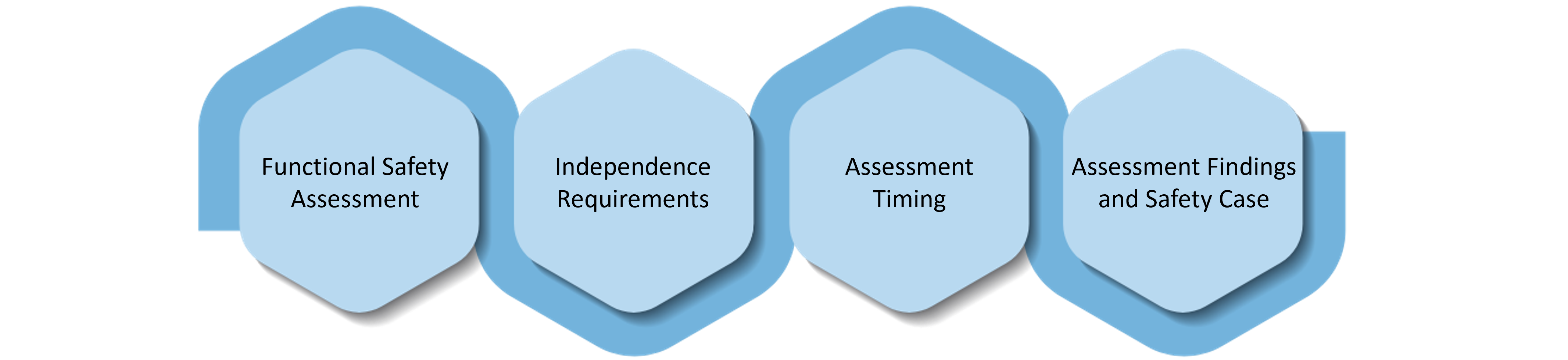
Independence requirements for functional safety assessment teams scale with the ASIL of the item under assessment, ISO 26262 defines increasing degrees of independence from the development team, ranging from a different person reviewing the work up to an entirely separate organizational unit conducting the assessment for the highest ASIL levels. Independence requirements for functional safety assessment teams shape program structure well before the audit itself, a program that assumes a development engineer can also serve as the independent assessor for an ASIL D item discovers the mismatch only when a certification body rejects the assessment's validity, which is a far more expensive place to discover it than during initial program planning.
Treating functional safety assessment as a single event at the end of development is one of the most common and costly planning mistakes a program can make. ISO 26262 assessment is meant to occur at defined milestones across the lifecycle, concept phase, system design, hardware and software development, and integration, so that gaps are caught and corrected while the affected work is still open rather than after the architecture has hardened around an undetected flaw. A program that schedules its only assessment activity immediately before production release routinely finds findings that require architectural rework, at a point in the schedule where that rework is the most expensive it will ever be.
How functional safety assessment findings get remediated under program pressure is where the difference between a mature safety culture and a compliance-theater one becomes visible. Findings should be triaged by actual safety impact, a traceability gap for a low-ASIL requirement is not the same class of problem as a hazard that was never adequately mitigated, and remediation plans need real engineering time allocated against them rather than being handled as documentation patch-ups squeezed in around unrelated program deadlines. Programs that let schedule pressure push safety-relevant findings into a rushed, superficial fix create exactly the gap the next assessment, or worse, a field issue, is likely to expose.
An ISO 26262 assessment is, at its core, an independent evaluation of whether a program's safety case actually holds up, whether the argument that the system is acceptably safe is supported by evidence rather than asserted by documentation. Our safety case development article covers how that argument gets built across a program; a functional safety audit is best understood as the point where an independent party tests whether that argument survives scrutiny. Programs that build the safety case deliberately, as a coherent argument rather than a document checklist, consistently find the assessment process faster and less disruptive because the assessor's questions have real, ready answers.
A successful ISO 26262 assessment is not only a technical milestone, for programs operating in markets where regulatory frameworks reference functional safety as part of type approval, assessment outcomes can feed directly into the broader compliance picture our UN R155/R156 regulatory mandates article describes for cybersecurity and software update management. Automotive functional safety audits: preparing for an iso 26262 assessment is, in that sense, one part of a program's overall readiness to demonstrate to regulators and customers alike that its safety-relevant engineering claims are real.
Embien Technologies helps automotive programs prepare for automotive functional safety audits: preparing for an ISO 26262 assessment, building traceable safety cases, structuring independent assessment activity at the right lifecycle milestones, and closing documentation gaps before an external assessor finds them. See our safety case development article for how that underlying argument gets built.
To discuss functional safety assessment readiness for an upcoming ISO 26262 program, reach out to Embien's engineering team.

Explore Embien's expertise across Automotive, Medical Devices, Industrial Automation, Consumer Electronics, Semiconductor, and other embedded technology domains.

Embien's Product Regulatory Compliance Services support testing, certification, documentation, and compliance requirements for safety-critical and regulated embedded products.

A case study on developing an i.MX8-based Android Automotive Smart Cluster, covering embedded platform integration, automotive software, display, and system development.