
Automotive instrument clusters are a crucial component of modern vehicles, providing drivers with vital information about the vehicle's performance and status. The automotive instrument cluster architecture has evolved significantly over the years, becoming increasingly complex with advancements in technology. In this article, we delve deep into the automotive instrument cluster architecture, exploring the hardware and software components, as well as other cluster design considerations. With various types of cluster development possible — segment LCD based, graphics based, or hybrid clusters — the underlying automotive instrument cluster architecture remains consistent across all variants.
At the heart of every automotive instrument cluster architecture lies a microcontroller (MCU) that is connected to various interfaces and devices. The following block diagram illustrates the hardware architecture:
The system typically operates on the 12V vehicle battery and is designed to handle input fluctuations ranging from 8V to 36V.
As the nervous system of the automobile, instrument cluster development with CAN and LIN is central to acquiring vehicle information from multiple ECUs. The CAN bus delivers high-speed powertrain and chassis data, while the LIN bus handles lower-speed body electronics signals. Instrument cluster development with CAN and LIN therefore requires both transceiver hardware and a robust software stack capable of parsing dozens of signals in real time.
As a mandatory system within an automobile, the automotive instrument cluster architecture's software layer should be robust and modular, ensuring reliable performance and ease of maintenance.
In addition to hardware and software, there are several other cluster design considerations that engineers must address. Ergonomics is one such consideration — the automotive instrument cluster should allow the driver to access and interpret information quickly and comfortably, minimizing distractions and enhancing safety.
Customization and personalization are also key considerations in the modern automotive instrument cluster architecture. With digital displays, clusters can now offer customizable layouts allowing drivers to personalize the information displayed, colour schemes, and overall theme. The durability and reliability of the automotive instrument cluster are equally important — it must withstand temperature variations, vibrations, and electromagnetic interference throughout the vehicle's lifespan.
Modern automotive instrument cluster architecture increasingly leverages high-performance MCUs such as the i mx rt1170 based digital cluster platform from NXP. The i mx rt1170 based digital cluster combines dual-core Cortex-M7/M4 processing with a dedicated 2D graphics accelerator, enabling smooth animations and multi-layer compositing without a discrete GPU. To complement the rendering capability, a robust connectivity stack for clusters is required — covering CAN-FD, LIN, Ethernet, Bluetooth, and Wi-Fi. The connectivity stack for clusters manages protocol parsing, signal multiplexing, and OTA update plumbing, all within the timing constraints demanded by the automotive instrument cluster architecture. Embien has delivered production programs on the i mx rt1170 based digital cluster and similar SoCs. Explore our cross-domain embedded services to learn how we apply this expertise across automotive, industrial, and two-wheeler cluster programs.
Successful instrument cluster development with CAN and LIN requires more than simple transceiver integration. The automotive instrument cluster architecture must define the CAN database (DBC file), signal scaling and offset tables, LIN descriptor (LDF) files, and diagnostic message handling (UDS). Instrument cluster development with CAN and LIN also involves rigorous testing using CANoe, Vector tools, or similar environments to validate signal accuracy and timing under all operating conditions. Our Qt application development services complement instrument cluster development with CAN and LIN by providing a cross-platform HMI framework that can render CAN-sourced data with minimal latency on the automotive instrument cluster display.
At Embien, we possess extensive expertise in the full scope of automotive instrument cluster architecture. Our team of skilled engineers and designers has a deep understanding of the hardware and software components involved, as well as the design considerations that determine production success. With a focus on innovation and user experience, we strive to create automotive instrument clusters that seamlessly integrate into vehicles, provide accurate information, and enhance the driving experience. Our engineers are knowledgeable in AUTOSAR and functional safety, ensuring cluster development is carried out at the highest class possible. Our credentials include turnkey design and delivery of stepper-motor based, segment-LCD based, graphic LCD based, and hybrid automotive instrument clusters for both ICE and EV vehicles.
In conclusion, the automotive instrument cluster architecture — encompassing hardware, software, instrument cluster development with CAN and LIN, connectivity, and UX design considerations — works together to create a seamless user experience. By comprehending this architecture, we can design automotive instrument clusters that meet specific requirements, provide accurate information, and enhance the overall driving experience.

Embien's cross-domain embedded services cover the full automotive instrument cluster architecture — from hardware schematic design and instrument cluster development with CAN and LIN to HMI software and production validation.

Embien's UI/UX design services translate automotive instrument cluster architecture requirements into compelling HMI experiences — covering theme design, widget development, and animation scripting for digital cluster platforms.
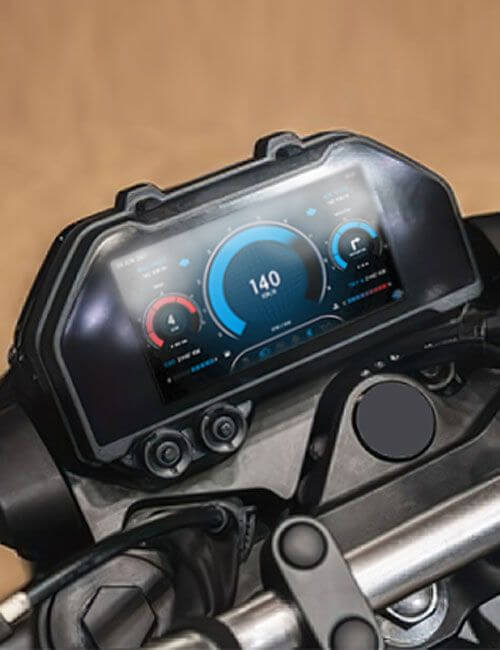
A case study on developing an i mx rt1170 based digital cluster using Sparklet embedded GUI — covering automotive instrument cluster architecture bring-up, CAN integration, connectivity stack for clusters, and HMI delivery.