
AUTOSAR Classic is a static, compile-time automotive software framework for microcontroller-based ECUs handling hard real-time, safety-critical functions (braking, steering, engine control). Adaptive AUTOSAR is a dynamic, Linux/POSIX-based platform for high-performance SoC ECUs requiring flexible, service-oriented communication (central computers, ADAS domain controllers, software-defined vehicle HPCs). Most modern vehicles need both.
The AUTOSAR architecture was originally developed as 'Classic AUTOSAR' (standardised in 2003) for microcontroller-based ECUs. As vehicle E/E architectures evolved toward centralised computing and software-defined vehicles, AUTOSAR Adaptive was introduced in 2017 to address the new requirements of high-compute SoC platforms.
Classic AUTOSAR architecture layers:
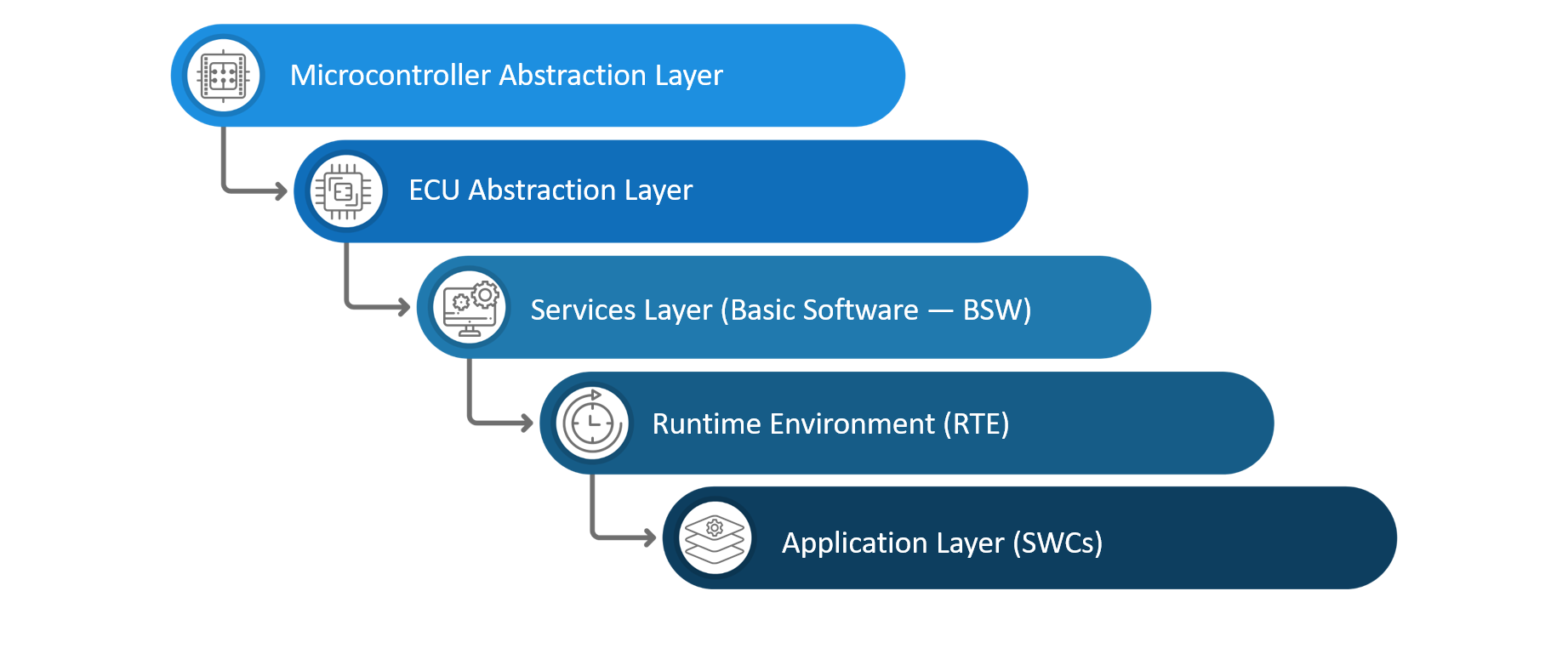
Classic AUTOSAR uses a static, configuration-time architecture: all SWC connections, communication mappings, and OS tasks are defined in ARXML and generated before compilation. There is no dynamic service discovery at runtime.
Adaptive AUTOSAR for software-defined vehicles uses a fundamentally different architecture based on POSIX (typically Linux or QNX), C++14/17, and a service-oriented communication model:
| Dimension | Classic AUTOSAR | Adaptive AUTOSAR |
|---|---|---|
| Target hardware | Microcontrollers (S32K, RH850, TC3xx) | SoCs and MPUs (Qualcomm SA8xxx, NXP S32G, Renesas V4H) |
| OS basis | AUTOSAR OS (OSEK-based, static) | POSIX (Linux, QNX, Integrity) |
| Communication | Signal-based (COM stack, PDU) | Service-oriented (ara::com, SOME/IP) |
| Configuration | Static, compile-time (ARXML) | Dynamic, runtime service discovery |
| Programming language | C (MISRA-C) | C++14/17 |
| OTA updates | Limited (boot loader based) | Native UCM support |
| Safety use cases | ASIL D capable | Ongoing (QM to ASIL B currently) |
| Typical ECUs | Engine, brakes, body, cluster | Central computer, ADAS domain controller, HPC |
The choice between AUTOSAR Classic vs Adaptive depends on three factors:
Modern zone architectures in software-defined vehicles typically deploy Classic AUTOSAR in zone ECUs (ASIL-C/D safety functions) and Adaptive AUTOSAR in the central vehicle computer (OTA, services, apps) — connected via Automotive Ethernet.
Embien Technologies has hands-on AUTOSAR development experience on both platforms. Our Classic AUTOSAR work spans BSW configuration (using Vector DaVinci Developer, EB tresos), MCAL integration on NXP S32K, Renesas RH850, and Infineon TC3xx, SWC development to ASIL-D, and full V-cycle validation. Our Adaptive AUTOSAR work covers ara::com integration, SOME/IP binding, UCM setup, and Adaptive Application development for Qualcomm SA8xxx and NXP S32G.

Embien Technologies delivers end-to-end embedded product engineering across automotive, industrial, medical, and IoT sectors.

Embien develops edge AI and embedded ML solutions on NVIDIA Jetson, NXP eIQ, and TinyML platforms for real-time inference.
ISO 26262, AUTOSAR, ADAS, and protocol stack development for automotive OEMs and Tier-1 suppliers.