
ISO 26262 functional safety is the international standard for the safety of electrical and electronic (E/E) systems in road vehicles. Published by ISO (International Organization for Standardization), it defines a systematic, risk-based approach to identifying hazards caused by malfunctioning E/E systems, assigning Automotive Safety Integrity Levels (ASIL), and demonstrating that safety requirements have been met throughout the development lifecycle.
ISO 26262 functional safety applies to all vehicle types with production volumes greater than one per year, covering the complete development lifecycle from concept through production, operation, and decommissioning.
ASIL classification is the process of determining the required safety integrity level for a safety goal, based on a systematic hazard analysis and risk assessment (HARA). ISO 26262 defines four ASIL levels:
ASIL classification is determined by three factors from HARA: severity (S0–S3), exposure (E0–E4), and controllability (C0–C3). The combination maps to an ASIL level or QM (Quality Management — not safety-critical).
ASIL decomposition allows a single ASIL D requirement to be split into two independent ASIL B subsystems, each developed separately with redundancy, making high-ASIL system development more practical.
The automotive safety lifecycle defined by ISO 26262 covers five main phases:
ISO 26262 is structured as a V-model: requirements flow down from concept through hardware and software design, and verification activities confirm compliance at each level on the way back up. Our Product Engineering Services support the development of safety-critical automotive products through robust design, engineering, validation, and lifecycle management.
ISO 26262 functional safety requires specific documentation artefacts as evidence of compliance:
Achieving ISO 26262 functional safety compliance presents several engineering and organisational challenges:
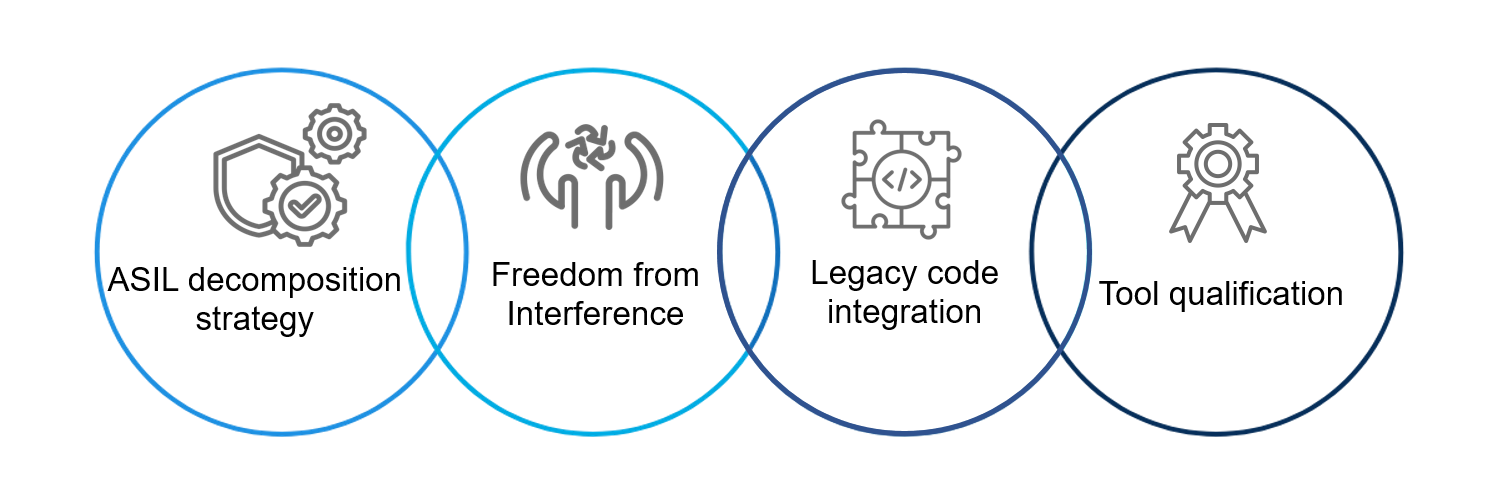
Embien Technologies provides ISO 26262 functional safety engineering services for automotive OEMs and Tier-1 suppliers. Our expertise spans the complete automotive safety lifecycle: HARA, safety concept definition, hardware safety analysis, ASIL-D software development, and safety case compilation.
We have delivered ISO 26262 compliant ECU software for body control, ADAS, instrument cluster, and telematics domains, working with AUTOSAR Classic and Adaptive platforms on NXP S32K, Renesas RH850, and Qualcomm SA8xxx silicon. Our automotive embedded software development team is experienced in ASIL decomposition, FFI analysis, and tool qualification for safety-critical development.

Functional safety expertise supporting automotive and other safety-critical domains where reliable embedded systems are essential for safe operation.

Cybersecurity solutions that complement functional safety by protecting automotive and embedded systems against threats, unauthorized access, and security vulnerabilities.

A case study on developing a secure bootloader for an ArduPilot-based drone using STM32H7, enabling authenticated firmware updates and secure system operation.