
The climate control system is one of the most human-facing electronic systems in the vehicle. Passengers form immediate, subjective impressions of climate control quality, how quickly the cabin reaches the set temperature, how quietly the fan operates, how precisely the system maintains comfort on a sunny afternoon with outside temperatures varying from stop to motorway speed. These expectations have grown significantly as occupants accustomed to smart home thermostats bring the same precision expectations into their vehicles.
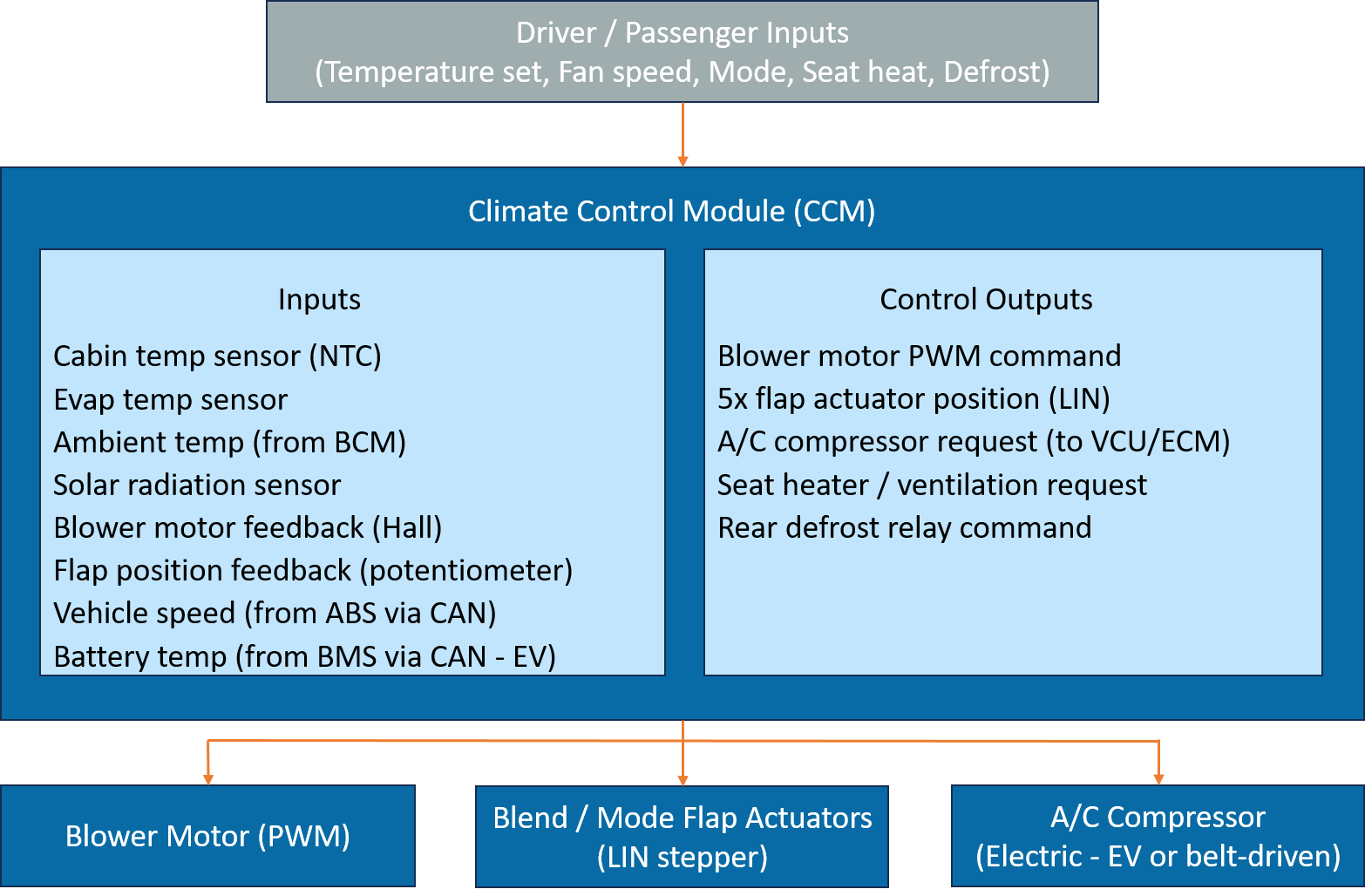
Behind this occupant-facing experience lies a sophisticated embedded control system, the Climate Control Module (CCM) or HVAC ECU. This ECU integrates temperature sensing from multiple zones, actuator control for up to eight or more mechanical flaps, blower motor speed regulation, and coordination with the powertrain for compressor requests and, in EVs, with the battery thermal management system for heat pump and battery cooling integration.
The CCM is not a safety-critical ECU in the ISO 26262 sense, HVAC failure is an inconvenience, not a hazard. But it is a complexity-critical ECU, managing more simultaneous control loops, sensor inputs, and actuator outputs than most other body domain ECUs. Its design involves real challenges in real-time control, LIN bus management, and EV-specific thermal integration that make it an interesting and technically rich embedded development target.
The CCM's primary function is to achieve and maintain the driver- and passenger-requested cabin temperature by controlling the airflow rate, temperature blend, distribution path, and in EVs the heat source, as efficiently as possible across all operating conditions.
Key Inputs
| Input | Sensor Type | Purpose |
|---|---|---|
| Cabin temperature | NTC thermistor (aspirated) | Primary feedback for temperature control loop |
| Evaporator temperature | NTC thermistor | Prevents evaporator icing, minimum temp limit |
| Ambient temperature | NTC thermistor (via BCM) | Feed-forward for initial temperature target |
| Solar radiation | Photodiode sensor | Asymmetric left/right solar load compensation |
| Blower motor speed | Hall-effect sensor on motor | Closed-loop blower speed control feedback |
| Flap positions | Potentiometer on actuator | Actual flap angle vs commanded angle verification |
| Vehicle speed | CAN from ABS ECU | RAM pressure compensation for air volume at speed |
| Battery temperature | CAN from BMS (EV only) | Battery thermal management integration |
| Refrigerant pressure | Pressure transducer (optional) | A/C system health monitoring |
Operating Modes
| Mode | Description |
|---|---|
| Manual | Driver explicitly sets temperature, fan speed, and distribution |
| Auto / Comfort | ECU controls all parameters to maintain set temperature |
| Defrost Front | Maximum airflow to windshield, elevated temperature, A/C compressor on |
| Defrost Rear | Rear heated element activated, mirror heaters activated |
| Economy | Reduced compressor use, temperature comfort traded for range (EV) |
| Pre-conditioning (EV) | Remote cabin heating/cooling before drive, off-plug or battery powered |
| Battery Thermal (EV) | HVAC system directed to battery cooling or heating as required |
Microcontroller
The CCM does not require a safety-grade lockstep MCU, ASIL requirements are absent or minimal. The typical silicon is a mid-range automotive MCU: the Renesas RA6 series, NXP S32K1xx, or STMicroelectronics SPC56 family. A Cortex-M4 or Cortex-M33 core at 80–120 MHz provides more than sufficient processing capability for the temperature control algorithms and LIN bus management.
The peripheral set requirements drive the MCU selection: the CCM needs multiple PWM outputs (blower motor, seat heater), a LIN master channel (flap actuators), ADC inputs (temperature sensors, blower feedback), CAN FD (vehicle bus), and sufficient GPIO for relay and switch management. The NXP S32K144 with its integrated LIN physical layer and automotive-qualified CAN FD is a common choice.
LIN Bus Architecture
The flap actuator network is the most distinctive hardware interface in the CCM. A typical dual-zone HVAC system has five to eight motorised blend and distribution flaps, temperature blend, fresh/recirculation, distribution (face/foot/defrost), and left/right zone blend. Each flap is driven by a small stepper or DC motor with a potentiometer position sensor, packaged as a smart LIN actuator node.
The CCM acts as LIN master, polling each actuator for position feedback and commanding target positions. LIN's 20 kbps bandwidth and master-slave topology are well-suited to this application, the actuators are slow-moving (typical travel time 2–5 seconds for full travel), the number of nodes is small (under 16), and LIN's lower cost versus CAN is significant when multiplied across 6–8 actuator nodes per vehicle.
Blower Motor Drive
Modern HVAC systems use brushless DC blower motors driven by a dedicated motor controller IC (typically an integrated H-bridge or three-phase driver) receiving a PWM duty cycle command from the CCM. The CCM implements closed-loop blower speed control using Hall-effect sensor feedback from the motor, achieving precise speed targets for noise and airflow comfort regardless of battery voltage variations.
On conventional ICE vehicles, the blower motor runs from 12V. On EVs, some systems use 48V or direct HV-fed blower motors to increase power density and reduce current draw. HV blower motor interfaces require additional isolation and safety design that significantly changes the CCM hardware architecture.
AUTOSAR Classic - Standard Implementation
CCM software runs on AUTOSAR Classic in most production implementations. The LIN driver and LIN interface BSW modules manage flap actuator communication. The PWM driver controls the blower motor command output. Application SWCs handle the temperature control logic above the RTE.
Application Software Components
Temperature Control SWC: Implements the core auto-climate control algorithm. Receives temperature setpoint from driver inputs and cabin temperature feedback from sensors. Computes the required blend flap position, blower speed, and A/C compressor request using a cascade control structure, an outer temperature loop producing a target air delivery temperature, and an inner loop computing actuator positions to achieve that temperature. Feed-forward from solar radiation and ambient temperature accelerates response to disturbances.
Flap Management SWC: Manages the LIN-bus communication with each flap actuator. Issues position commands and monitors actual position feedback. Detects flap stall (actuator reporting no movement despite command) and sets the appropriate DTC. Implements end-stop learning routines executed at ignition on, each flap is driven to its mechanical limits to calibrate the position feedback range, compensating for assembly tolerance variation.
Blower Control SWC: Closed-loop blower speed controller. Maps the requested airflow level (from driver input or auto-climate algorithm) to a target RPM, then uses Hall-effect feedback to close the speed loop via PWM duty cycle adjustment. Implements soft start and ramp rate limiting to prevent the startling effect of sudden blower speed changes.
EV Thermal Integration SWC (EV platforms only): Coordinates with the Battery Management System via CAN to integrate battery thermal management into the HVAC strategy. When the battery requires cooling, the EV thermal integration SWC requests that the HVAC compressor routes refrigerant through the battery chiller circuit rather than (or in addition to) the cabin evaporator. When the battery requires heating in cold conditions, it requests heat from the heat pump (where fitted) or the PTC heater. This coordination requires continuous negotiation between cabin comfort demands and battery thermal needs, a multi-objective optimisation problem whose quality directly affects both occupant comfort and vehicle range. Embien's Automotive Engineering Services deliver intelligent HVAC ECU solutions with thermal management, body electronics, and vehicle network integration expertise.
EV platforms are driving a fundamental rethink of HVAC architecture. Heat pump systems, which extract heat from the ambient air rather than generating it electrically, achieving 2–3x the energy efficiency of resistive PTC heaters, are becoming standard on premium EVs and increasingly available on mainstream models. The CCM's role expands significantly in heat pump systems: it must manage the refrigerant circuit's reversible cycle, balancing heat pump, defrost, and battery conditioning demands simultaneously.
Personalised climate zones are extending beyond left/right dual-zone to occupant-specific microzone conditioning, individual seat ventilation, radiant heating, and targeted airflow. This requires a more sophisticated sensor array and a CCM capable of managing a larger number of actuators and control loops simultaneously.
Embien has experience in developing body domain ECU software including LIN master/slave implementations, actuator position control SWCs, and CAN FD communication stacks on NXP S32K and Renesas RA platforms. Our RAPIDSEA suite includes a production-ready LIN stack that accelerates HVAC actuator network development. We have worked on automotive climate system integration programs and are familiar with EV thermal management coordination requirements from a software architecture perspective.
To discuss your HVAC ECU or climate system development requirements, reach out to the Embien team.

Embien's cross-domain expertise enables intelligent climate control solutions for automotive, industrial, and connected mobility applications.

Embien's Embedded Hardware Development Services deliver reliable automotive-grade controller hardware for HVAC, body electronics, and thermal management systems.
A case study on developing an ASIL-D Electric Power Steering demonstrator featuring AUTOSAR architecture, functional safety, motor control, diagnostics, and real-time vehicle steering control.