
While vehicle performance in terms of fuel efficiency, safety and responsiveness are paramount buying criteria, comfort and convenience play a very important role too. A study indicates 67% of buyers view it as a 'very important criterion' when purchasing a new car. Automotive HMI design — encompassing the instrument cluster, infotainment system, steering wheel controls and all other interaction surfaces — forms a crucial part of this equation. Let us see how automotive HMI design will evolve in an EI car.
Today, the automotive industry is moving toward larger display interfaces. Starting from small displays, 7 to 12-inch infotainment systems have become standard. Pillar-to-pillar displays are the next step, with some OEMs already adopting them. Automotive HMI design will continue this trajectory — as autonomous levels increase, the interface can occupy larger space dynamically based on what the driver and passengers want to do. Conducting video conferences, playing games or projecting content on the full windshield will all be within the scope of future automotive HMI design.
The quantum of vehicle information to be conveyed to the driver will grow significantly, demanding a fundamental overhaul of the cluster. Automotive HMI design must evolve from presenting static vehicle data to delivering a rich connected car UX — one that integrates road conditions, navigation intelligence, driver state, passenger preferences and external services into a single, coherent interface.
The steering wheel will also host a display and touch interface enabling more complex yet intuitive controls. Connected car UX principles demand that these controls feel effortless — reducing cognitive load on the driver while increasing the depth of information available when needed.
HMIs will not be limited to the cluster or infotainment system — they will extend across the complete vehicle. The EI car will continuously monitor the driver, sense his state of mind and respond as a whole system. Automotive HMI design in this context is not about individual screens — it is about orchestrating every interaction surface in the vehicle into a unified connected car UX.
The Electronic Power Steering can tighten itself to prompt the driver's concentration. Acceleration response can be reduced if the EI car detects that the driver is not focused. These are examples of driver-centric HMI that go beyond screens — using the physical vehicle as an interface in its own right.
Steering wheel hands-off detection will become the norm, automatically adjusting the autonomous level based on hand placement. The EI car will respond to voice in any language the driver is comfortable with — processing everything locally without going online. This local processing is a cornerstone of both good driver-centric HMI and sound automotive HMI design: privacy, speed and reliability must all be guaranteed without cloud dependency.
Each passenger will have a dedicated interface, enabling independent interactions. Hyper-local audio technology may evolve to create non-overlapping audio zones for each occupant — a key challenge and opportunity for driver-centric HMI and automotive HMI design teams alike. Automotive HMI design in an EI car must account for every person in the cabin, not just the driver.
In summary, automotive HMI design in emotionally intelligent cars will be spread across the entire vehicle — not confined to a cluster or a screen. The EI car's HMI will feel like an extension of the driver's own senses, enabling minimal-effort, maximum-convenience interaction. Emotionally intelligent cars push automotive HMI design into territory that is closer to human perception than traditional interface design. Embien's edge computing services power the real-time processing that makes this immersive automotive HMI design possible.
A central pillar of automotive HMI design in EI cars is the digital instrument cluster — the primary visual interface for the driver. HMI development for digital instrument clusters involves graphics acceleration, real-time data rendering, multi-zone display management and seamless integration with the AI core. As software-defined vehicles become standard, HMI development for digital instrument clusters will shift increasingly toward software — enabling continuous updates that improve the connected car UX over the vehicle's lifetime.

Explore Embien's integrated product development services that span the full stack of automotive HMI design — from driver-centric HMI architecture to connected car UX implementation.

Embien's UI/UX design services deliver the connected car UX and driver-centric HMI interfaces that define automotive HMI design in next-generation EI cars.
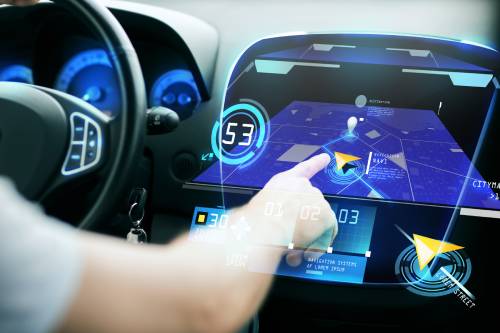
A case study on Embien's rapid automotive HMI design for a connected car dashboard using Flint — showcasing HMI development for digital instrument clusters and connected car UX.