
In the quest for Level 4 and Level 5 autonomy, the automotive industry has reached a critical crossroads. The "Cloud-First" mantra of the early 2020s collides with the hard physics of real-time safety. While the cloud offers near-infinite compute, it possesses a fatal flaw for autonomous vehicles: latency. In a safety-critical control loop, the difference between a successful emergency brake and a tragic collision is measured in milliseconds — a constraint that drives the entire autonomous driving embedded architecture. Autonomous vehicles traveling at 65 mph cover nearly 100 feet per second, so even a 100 ms round-trip to the cloud translates to an additional 10 feet of uncontrolled vehicle movement.
Effective latency reduction for autonomous vehicles requires moving decision-making from distant data centers into on-board silicon. Latency reduction techniques proven in production ADAS deployments include Edge AI inference running neural network models locally on NPUs, dedicated sensor preprocessing hardware that filters raw LiDAR and camera streams before they reach the main SoC, interrupt-driven sensor acquisition pipelines that eliminate polling overhead, and deterministic RTOS task scheduling that guarantees bounded response times.
AI dashcam deployments demonstrate latency reduction in practice: these devices run 30+ AI models simultaneously to detect distracted driving, eyelid closure, or lane swerving — all with audible alerts firing in milliseconds because processing happens on-device using specialized Neural Processing Units. This on-device approach has reduced accidents in commercial fleets by up to 60%. For autonomous vehicles, Embien's automotive cybersecurity services ensure that edge inference pipelines remain tamper-proof, so latency-critical braking decisions cannot be spoofed or intercepted over external communication channels.
Safety-critical control loops in autonomous vehicles — pedestrian detection, lane-keep assistance, emergency braking — must propagate from perception to actuation in under 20–50 milliseconds. This constraint places real-time embedded systems at the center of every autonomous vehicle design. Real-time embedded systems provide the deterministic scheduling guarantees that cloud compute cannot: a task that misses its deadline in a real-time embedded systems environment raises a fault flag and triggers a graceful fallback, while a missed cloud response simply leaves the vehicle without a command. Engineers designing real-time embedded systems for autonomous vehicles must characterize worst-case execution times (WCET) for every safety-critical path and verify them through formal timing analysis and HiL testing.
The autonomous driving embedded architecture debate is not really "Edge vs Cloud" — it is about assigning the right task to the right compute tier. Autonomous driving embedded systems serve as the vehicle's "reflex arc": they handle real-time object detection, emergency braking, and lane-keep in under 50 ms. Cloud systems serve as the "cortex": they handle HD map updates, fleet-wide model retraining, and long-term predictive maintenance. The future of autonomous vehicles is a hybrid model where the autonomous driving embedded edge makes real-time decisions and the cloud accumulates learning.
To make this autonomous driving embedded model work requires a Hardware Abstraction Layer (HAL) that allows AI models to run efficiently on diverse automotive silicon — whether it is an NXP S32, a Renesas RH850, or an Infineon Traveo. A single autonomous driving embedded SoC can generate up to 4 terabytes of sensor data daily; edge processing acts as a filter, sending only refined insights or critical event logs to the cloud while keeping raw data local. Embien's digital transformation services support autonomous vehicles teams architecting these hybrid platforms with production-ready autonomous driving embedded middleware and OTA pipelines.
Autonomous vehicles represent the most demanding application of mission critical embedded systems in the commercial world. Mission critical embedded systems for autonomous vehicles must meet ASIL-D safety classifications, deliver deterministic sub-millisecond task execution, and continue operating safely even when subsystems fail. The RAPIDSEA middleware suite provides silicon-agnostic protocol stacks and safety-rated drivers that serve as the mission critical embedded systems foundation for autonomous vehicle ECUs — ensuring that safety-critical logic is never blocked by unoptimized device drivers or non-deterministic middleware layers.
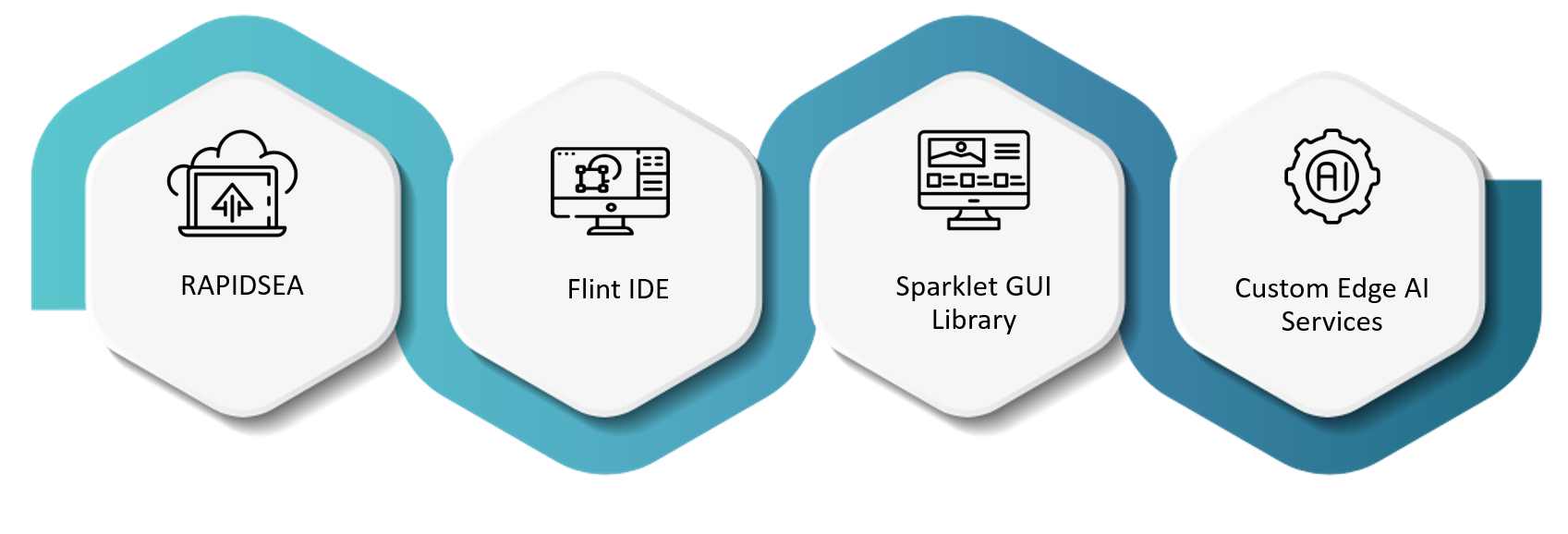
Edge AI Ecosystem for Autonomous Vehicles
The roadmap to Level 5 autonomy for autonomous vehicles is paved with data, but that data must be processed with surgical speed. Effective latency reduction through optimized autonomous driving embedded systems and specialized AI hardware is not just a performance optimization — it is a safety imperative. By building real-time embedded systems that think at the edge and learn in the cloud, we are not just building faster autonomous vehicles; we are building a safer future for everyone on the road.

Embien’s expertise across industries enables resilient embedded architectures and low-latency system design essential for safer autonomous vehicle operation.

Embien’s Cybersecurity Services strengthen autonomous vehicle resilience with secure communication, threat mitigation, and low-latency protection for safety-critical automotive systems.

A case study on enabling secure boot and HSM integration for automotive TCUs, demonstrating resilient cybersecurity implementation for connected vehicle platforms.