
Introduction
An embedded team building conventional, deterministic medical device firmware has a well-worn regulatory path: IEC 62304, verify against a fixed specification, submit, done until the next major revision. AI-powered diagnostic medical firmware breaks that pattern in a specific way, when the algorithm itself is designed to learn or update over time, the regulatory question shifts from "does this fixed software work as specified" to "how will this software's behavior be managed as it changes, and how do we know it stays safe and effective while doing so." That's a genuinely different engineering and regulatory problem, not a harder version of the same one.
In short: FDA AI/ML medical device regulation for embedded teams centers on the distinction between locked algorithms, which behave identically to their validated state indefinitely, and adaptive algorithms, whose real-world value often comes precisely from continuing to learn, and the regulatory framework around Predetermined Change Control Plans exists specifically to make responsible adaptive-algorithm updates possible without a new submission for every change.
Why AI/ML Medical Devices Need Different Regulatory Treatment Than Static Software
Conventional medical device software validation assumes the software being validated is the software that ships and stays unchanged until the next formal update, an assumption IEC 62304's lifecycle process is built around. An adaptive AI/ML algorithm, one that continues learning from new data post-deployment, breaks this assumption at its root: the software validated at submission time is not necessarily the software running in the field six months later. Regulators had to develop a framework that could evaluate and authorize a defined scope of future change in advance, rather than requiring a new submission for every incremental model update, which is exactly what the Predetermined Change Control Plan framework was built to address.
What a Predetermined Change Control Plan (PCCP) Is and Why It Matters
A PCCP is a pre-authorized, pre-specified description of what a device's AI/ML algorithm is allowed to change over time, and the methodology used to make and validate those changes, submitted and reviewed as part of the initial marketing authorization rather than negotiated fresh for each future update. A well-constructed PCCP defines the specific types of modifications anticipated (retraining on new data within a defined scope, for example), the verification and validation methodology that will be applied to each such update, and the performance criteria an update has to meet before deployment. This lets a manufacturer make legitimate, clinically-beneficial algorithm improvements without a new full submission for each one, while still giving the regulator confidence the update process itself is controlled and validated.
Locked vs. Adaptive Algorithm Classification
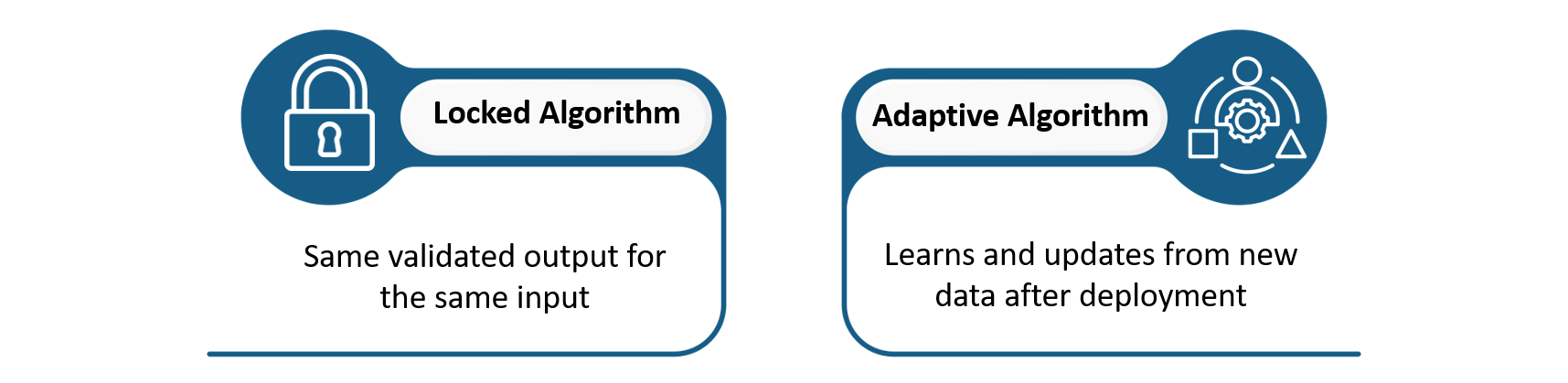
A locked algorithm produces the same output for the same input every time, regardless of what new data it processes in the field, essentially conventional deterministic software even when its internal logic is a trained model. An adaptive algorithm is explicitly designed to change its behavior based on new data encountered post-deployment. This classification isn't just a technical detail, it fundamentally changes the regulatory pathway: a locked algorithm follows a conventional software validation approach, while an adaptive algorithm needs either a PCCP defining its permitted evolution or, absent one, a new submission for each material behavioral change. Many teams default to locked algorithms specifically to avoid the additional PCCP planning burden, a reasonable choice when the clinical benefit of continuous adaptation doesn't clearly outweigh that added regulatory complexity.
Documentation and Validation Burden This Creates for Embedded Teams
Embedded teams building toward an adaptive algorithm and a PCCP face a documentation burden beyond conventional IEC 62304 evidence: the training data provenance and characteristics need documentation sufficient to justify the model's generalizability, the update validation methodology needs to be specified precisely enough that a regulator can evaluate whether it will actually catch a problematic update before deployment, and a real-world performance monitoring plan needs to exist to detect model drift or degraded performance post-deployment, not just at the point of each formal update. This is meaningfully more upfront planning work than a locked-algorithm submission requires, which is exactly why the decision to pursue an adaptive algorithm and PCCP should be made deliberately, weighed against the clinical benefit, rather than defaulted into.
Where This Intersects With IEC 62304 and Cybersecurity Requirements
IEC 62304's software lifecycle process still applies underneath an AI/ML PCCP framework, the PCCP governs how the algorithm's data and model can change; IEC 62304 still governs how the surrounding software (data pipeline, update mechanism, safety interlocks) is developed and verified. Cybersecurity requirements intersect directly with the update mechanism itself: a device that can receive model updates, whether through a formal PCCP-governed process or a conventional firmware update channel, needs the same secure update infrastructure, authenticated firmware/model packages, integrity verification before an update is applied, rollback capability if an update proves problematic, that any connected medical device's cybersecurity submission requires, with the added wrinkle that a compromised update channel for an adaptive algorithm could introduce a subtly degraded model rather than an obviously broken one.
Sensor Integration for Medical Diagnostics: Where Data Quality Determines Model Validity
Sensor integration for medical diagnostics matters enormously for AI/ML diagnostic devices specifically because a model is only as reliable as the sensor data it was trained and validated against. A diagnostic algorithm trained on data from a well-characterized sensor chain can perform unpredictably if deployed against sensor hardware with different noise characteristics, calibration drift, or failure modes than the training data reflected. This is where rigorous sensor and hardware engineering, not just algorithm development, directly determines a diagnostic device's real-world clinical validity, evidenced in Embien's own diagnostic device development work building a rapid patient health monitor prototype for a Fortune 500 medical, industrial, and aerospace company, using our eStorm-C1 platform, RAPIDSEA, and Flint IDE alongside COTS sensors for a multi-parameter monitor.
Embedded Firmware for Medical Diagnostics Devices: Practical Implications for Product Roadmap
Embedded firmware for medical diagnostics devices incorporating AI/ML needs a product roadmap that accounts for update cadence from the start: if a PCCP-governed adaptive algorithm is the goal, the update infrastructure, monitoring pipeline, and validation methodology all need to be designed and validated before the first submission, not added once the base product ships. If a locked algorithm is the pragmatic choice for a first-generation product, the roadmap should still plan explicitly for what a future model update, and the regulatory submission it requires, will look like, rather than treating "we'll figure out updates later" as an acceptable answer for a device intended to stay in the field and improve over years.
Diagnostic Device Development: Getting the Foundation Right
Good diagnostic device development for an AI/ML-enabled product starts well before the algorithm: validated sensor hardware, a documented and controlled data pipeline, and a realistic assessment of whether the clinical benefit of an adaptive algorithm justifies the additional PCCP planning and validation burden compared to a locked-algorithm approach. Teams that get this foundation right before committing to an adaptive-algorithm regulatory strategy avoid the expensive rework that follows from building toward the wrong classification.
Embien's Capabilities
Embien brings embedded hardware, sensor integration, and firmware development experience to medical diagnostics device programs, including rapid prototyping of multi-parameter patient monitoring devices using our eStorm-C1 platform and RAPIDSEA product development suite. Our engineering process integrates the sensor validation, secure update infrastructure, and IEC 62304-aligned software lifecycle that AI/ML-enabled diagnostic devices need from the foundation up.
To discuss embedded hardware and firmware development for AI-powered diagnostic medical firmware or a conventional diagnostic device, reach out to Embien's engineering team.