
Introduction
5G's rollout has already reshaped what's possible for connected industrial and medical devices, and 6G's development, now well underway in standardization bodies with commercial deployment targeted around 2030, promises to extend that reshaping further. IoT and cloud integration services powered by 5G and 6G are becoming the connectivity foundation industrial and medical IoT products increasingly build around, not because 5G is simply a faster version of previous cellular generations, but because its specific technical characteristics, ultra-low latency, massive device density, and network slicing among them, unlock use cases that earlier connectivity generations genuinely couldn't support.
In short: 5G's ultra-reliable low-latency communication and massive device density directly enable industrial and medical IoT use cases that previous connectivity generations couldn't, private 5G deployments give industrial and medical facilities dedicated, secure connectivity independent of public network congestion, and 6G's research-stage promise of terahertz-frequency speeds and native AI integration points toward further gains still years from commercial reality, making today's practical connectivity architecture decisions ones that should account for this trajectory without over-betting on 6G capability that isn't deployable yet.
5G's Real Advantages for Embedded Connectivity and IoT
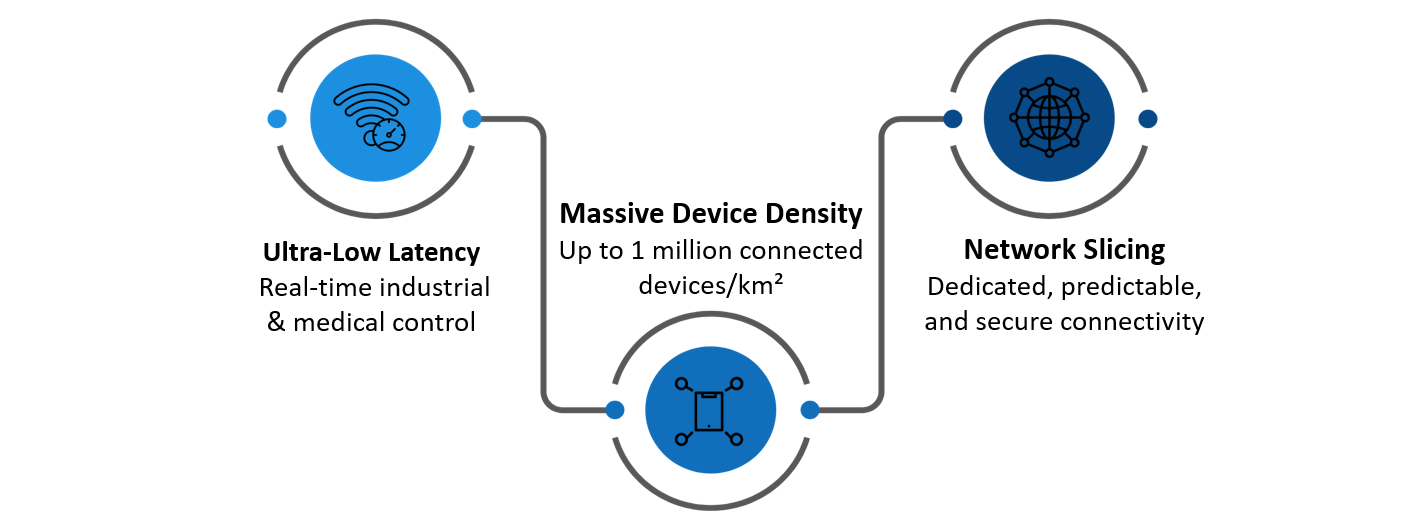
5G Technology, now fully rolled out across major markets, delivers peak speeds of 10 to 20 Gbps, latency as low as 1 millisecond, and capacity for roughly a million devices per square kilometer, figures that matter concretely, not just as marketing specifications, for industrial and medical IoT design. Ultra-reliable low-latency communication and massive machine-type communication together let a single 5G network segment support the kind of dense, latency-sensitive sensor and device population an industrial facility or a hospital genuinely needs, something earlier cellular generations' latency and device-density limits made impractical at real deployment scale. Network slicing, the ability to carve dedicated virtual network segments with guaranteed performance characteristics out of shared physical infrastructure, is particularly relevant for industrial and medical deployments needing predictable, isolated performance rather than best-effort shared bandwidth.
Ultra-Reliable Low-Latency Communication (URLLC) for IoT: Why It Matters for Industrial and Medical Use Cases
Ultra-reliable low-latency communication (URLLC) for IoT is the specific 5G capability that unlocks the most safety- and time-critical industrial and medical use cases. Industrial applications needing split-second closed-loop control, coordinated robotics, safety-interlocked machinery, real-time process control, depend on the kind of sub-10-millisecond, highly reliable latency URLLC is specifically designed to guarantee, latency and reliability characteristics that earlier connectivity generations, and even standard best-effort 5G service, can't consistently deliver. Medical applications carry similarly high stakes, remote surgical assistance and haptic feedback systems, and continuous, life-critical patient monitoring, where a dropped or delayed connection has genuine safety consequences, are the use cases URLLC's reliability guarantees exist to make viable.
Private 5G for Industrial and Medical IoT: Dedicated Connectivity Where It Matters Most
Private 5G for industrial and medical IoT deployments give a facility its own dedicated 5G network infrastructure, independent of public carrier network congestion and with configurable coverage, security, and performance characteristics tuned to the specific facility's needs, rather than depending on shared public network capacity that can't guarantee the same predictability. A manufacturing plant running latency-sensitive robotics or a hospital running continuous wireless patient monitoring both benefit from the same core advantage private 5G provides: connectivity performance and security posture the facility controls directly, rather than one it depends on an external carrier to guarantee under varying and sometimes uncontrollable network load conditions.
Industrial Connectivity Solutions: Where 5G Fits Alongside Existing Wireless Options
5G is one option within a broader set of industrial connectivity solutions a facility has to weigh against Wi-Fi, wired industrial Ethernet, and sub-1GHz wireless sensor networking, and the right choice depends on the specific application's latency, mobility, and device-density requirements rather than defaulting to whichever technology is newest. 5G earns its place specifically where mobility combined with low latency and high device density matters, a mobile robot fleet needing continuous, reliable connectivity as it moves through a facility, for instance, a combination that fixed wired infrastructure and standard Wi-Fi both struggle to support as well as a well-deployed private 5G network can.
5G and 6G Connectivity for Connected Medical Devices: What's Already Real and What's Still Ahead
For medical devices specifically, that connectivity picture today largely means 5G, already deployed and delivering real value for remote patient monitoring, telehealth, and latency-sensitive applications like remote surgical assistance. 6G remains firmly in the research and standardization phase, with terahertz-frequency operation targeting speeds exceeding 1 Tbps and native AI integration for self-optimizing networks, promising capability, but not yet commercially deployable, meaning medical device roadmaps should treat 6G as a genuine future direction worth architectural awareness rather than a capability to design around today.
What 6G's Research-Stage Promise Actually Means for Planning Today
6G's standardization work, targeted for completion around 2026 with commercial deployment following around 2030, means product teams have a multi-year window before 6G capability becomes something a shipping product can actually depend on. The practical planning implication isn't to wait for 6G before building connected industrial or medical IoT products, 5G already supports the vast majority of today's use cases, it's to architect connectivity abstraction layers in firmware and cloud integration flexibly enough that a future transition to 6G, when it becomes commercially viable, doesn't require the product's entire connectivity architecture to be rebuilt from scratch.
IoT and Cloud Integration Services Powered by 5G and 6G: The Full Stack That Makes This Work
Realizing 5G's benefits for industrial and medical IoT requires more than cellular modem hardware alone. IoT and cloud integration services powered by 5G and 6G span the full stack: embedded firmware and protocol integration that correctly leverages 5G's network-slicing and low-latency capabilities rather than treating it as a drop-in replacement for previous cellular generations, and cloud-side architecture, built through the IoT cloud integration platform layer, capable of ingesting and processing the higher device density and data volume 5G's massive machine-type communication capability makes possible. Getting this full stack right, not just the radio link, is what actually delivers the low-latency, high-density connectivity industrial and medical IoT applications need.
Embien's Capabilities
Embien brings embedded connectivity and IoT cloud integration experience spanning 5G-ready protocol stack development, private network architecture evaluation, and cloud platform design for high-density, latency-sensitive industrial and medical device fleets. Our engineering process evaluates 5G and emerging 6G capability against a product's actual latency, density, and reliability requirements rather than defaulting to the newest connectivity generation without a concrete use case behind it.
To discuss IoT and cloud integration services powered by 5G and 6G for an industrial or medical connected product, reach out to Embien's engineering team.