
In Part 1, we covered six locking mechanisms suited to compact, product-level IP67 housings. This part addresses industrial control panels, outdoor distribution cabinets, server housings, HVAC enclosures, and large-format junction boxes. At this scale, a single-point lock that works perfectly on a 100mm sensor housing will allow a 600mm cabinet door to bow at its center, under-compressing the gasket mid-span and creating exactly the kind of localized ingress path that causes IP67 failures in the field.
Why Compact Enclosure Locks Don't Scale to Industrial Panels
A gasket running around the perimeter of a large enclosure door can span several hundred millimeters on each side. When a single central latch pulls the door closed, the door deflects, bowing outward between the latch point and the corners, reducing gasket compression in those zones. Industrial IP67 enclosure design moves away from single-point retention towards mechanisms that distribute clamping force uniformly across the full door perimeter.
7. Cam Latch (Quarter-Turn Cam Latch)
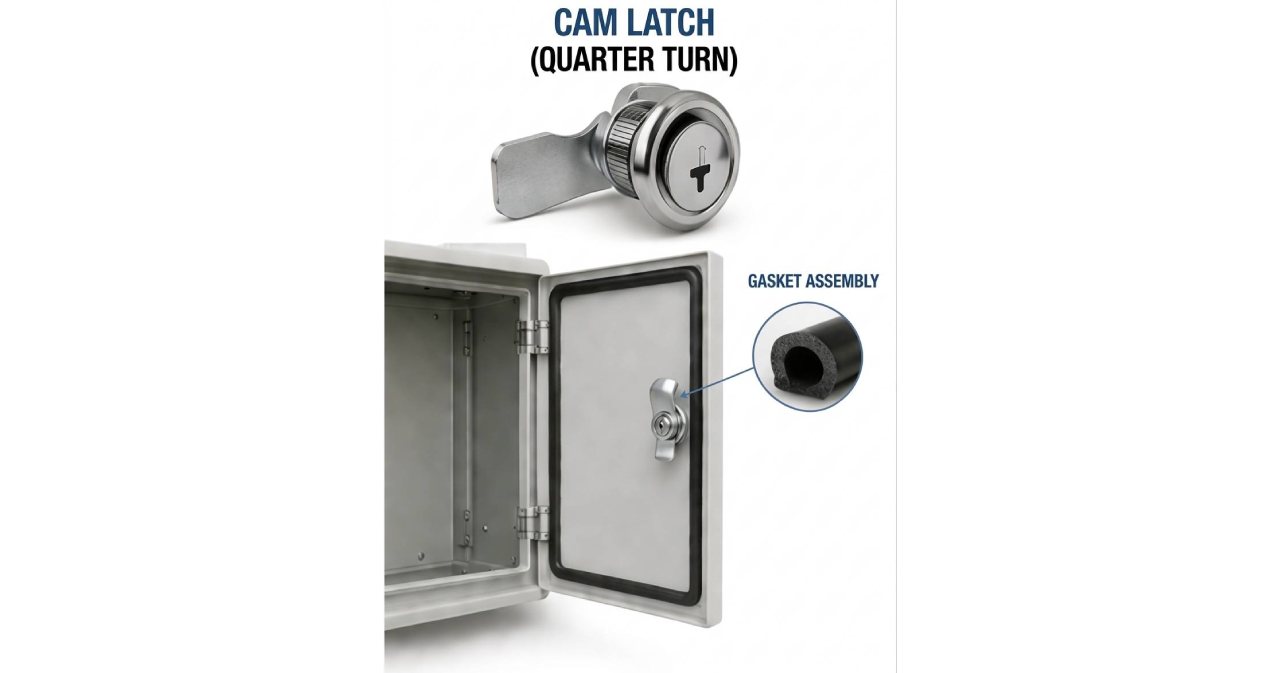
A cam latch consists of a rotating body mounted through a hole in the enclosure door, with a cam arm on the interior face. When the user turns the external knob, key, or handle by approximately 90 degrees, the cam arm rotates behind the fixed inner panel, drawing the door tightly against the frame. Actuation heads range from screwdriver slots to key cylinders, T-handles, or simple knobs.
IP67 Suitability: Moderate to high depending on configuration. On larger doors, multiple cam latches distributed around the perimeter maintain uniform gasket compression. Cam latches with integrated compression features are available specifically for IP-rated applications.
Best Application: Electrical distribution boxes, industrial control panels, outdoor IoT gateway housings, flush-mounted access doors, outdoor high voltage switch gear.
Pros: Versatile actuation options; no dedicated strike plate required; reliable across thermal and vibration exposure; available in keyed variants; high cycle life.
Cons: Single cam latch is insufficient for large doors, multiple units required; moderate gasket compression compared to swing handle or multi-point.
8. Slam Latch (Push-to-Close / Rotary Latch)
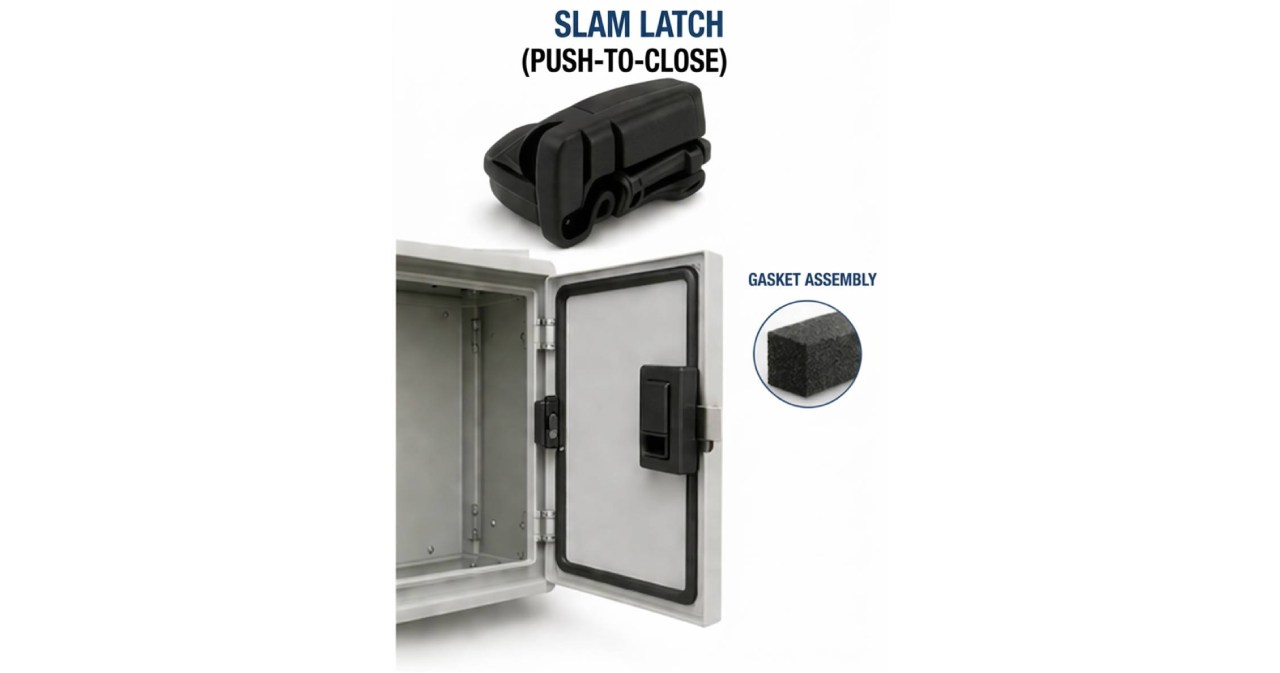
A slam latch is a spring-loaded mechanism in which a rotating cam or bolt automatically engages a strike plate when the enclosure door is pushed shut, no manual turning, twisting, or locking action required. The cam's leading edge is chamfered so that contact with the striker during door closure drives the cam to retract, pass the striker, and spring back to the locked position.
IP67 Suitability: Moderate. The slam latch's automatic engagement ensures the enclosure is always closed, eliminating the risk of a door being left unlatched. However, it does not generate active gasket compression, gasket compression depends on pre-load and frame geometry.
Best Application: HVAC equipment panels, vehicle-mounted electronics cabinets, roadside infrastructure enclosures, industrial toolboxes, any application where self-closing action is a safety or operational requirement.
Pros: Automatic self-closing, no deliberate locking step; fast one-handed operation; available in keyed and tool-operated variants; high cycle life.
Cons: Does not actively compress gasket; limited suitability for wide doors without multiple latch points; spring mechanism can accumulate debris outdoors.
9. Compression Latch / Toggle Latch (Over-Centre Latch)
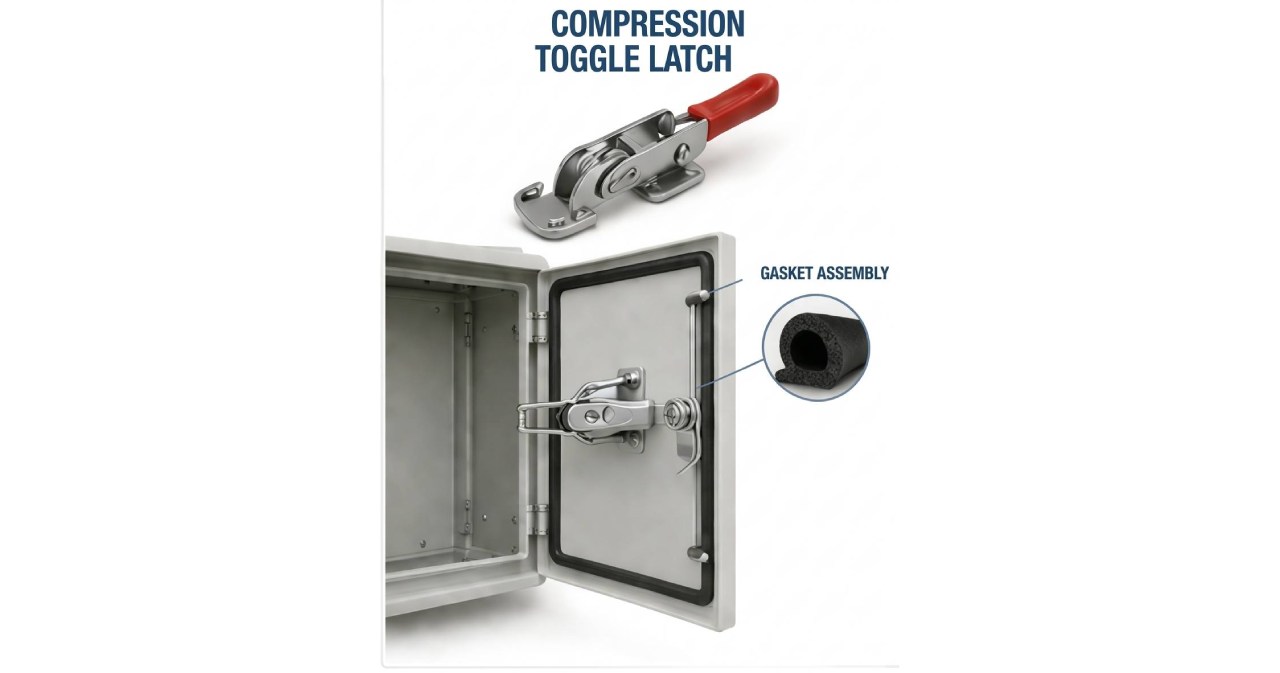
A compression latch uses a pivoting lever arm that passes over its mechanical Centre point during closure. As the lever travels past the Centre, it generates a strong compressive clamping force. Once over-Centre, the mechanism is geometrically self-locking, vibration, impact, and pressure differential cannot drive it back to the open position.
IP67 Suitability: High. The active compressive force generated as the lever goes over-centre directly squeezes the gasket or O-ring. This is not passive retention, it is active sealing. Standard fitting on IP-rated instrument cases, transit cases, and portable industrial equipment.
Best Application: Portable instrument cases, field survey equipment, transit and transport enclosures, ruggedized portable electronics, military equipment
Pros: Active gasket compression on every closure; self-locking geometry resists vibration; long service life; tool-free operation.
Cons: Lever protrusion adds to external profile; miniaturization constrained; lever may snag in dense panel installations.
10. Swing Handle Latch
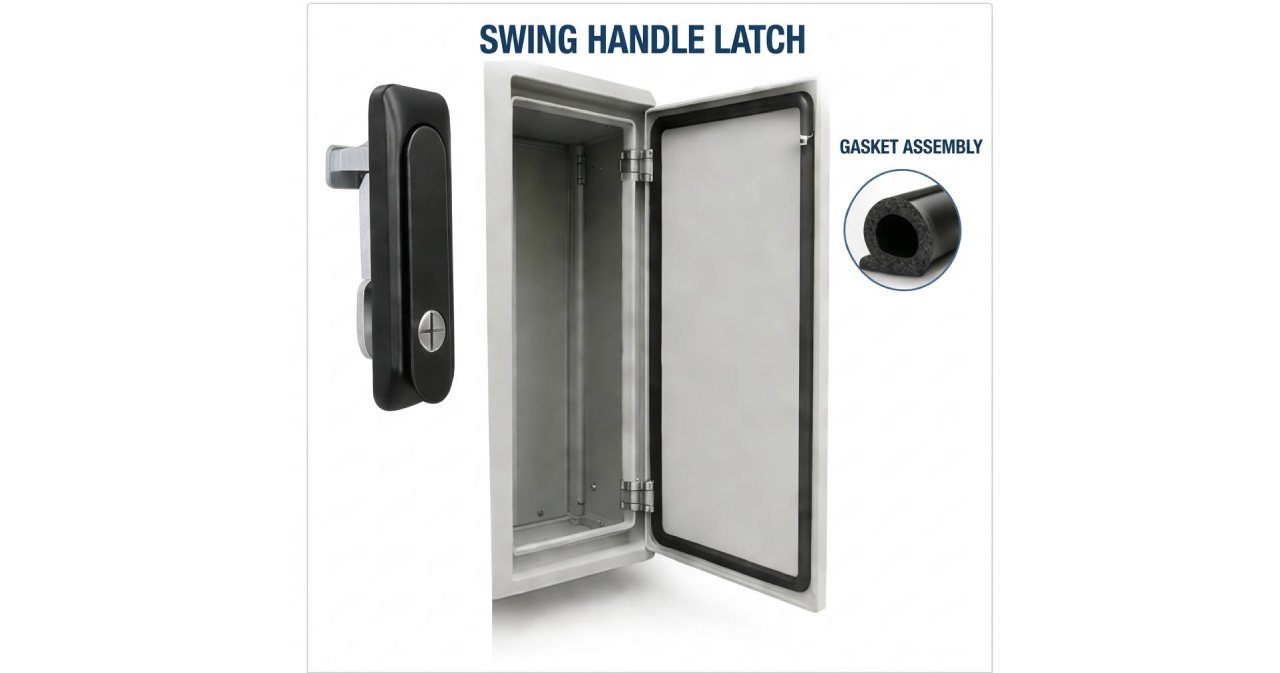
A swing handle latch is an extended cam latch in which the actuation element is a folding or pivoting handle rather than a simple knob. The user lifts the handle from its recessed position and rotates it, driving an internal cam that compresses the door against the enclosure frame. The extended handle provides a significantly greater mechanical advantage than a standard cam latch knob.
IP67 Suitability: High. Swing handle latches designed for IP-rated applications incorporate an internal O-ring seal around the spindle penetration through the door panel. IP65-rated swing handle variants are widely available; IP67 is achievable with appropriate spindle sealing.
Best Application: Outdoor control cabinets, server and network enclosures, switch cabinets, industrial automation panels, where both environmental sealing and access security are design requirements.
Pros: High gasket compression force; spindle O-ring sealing at actuation penetration; compatible with multi-point locking rods; supports keyed and padlock access control; ergonomic for gloved operation.
Cons: Higher unit cost than cam latches; handle protrusion when open requires clearance; heavier than cam latches.
11. Multi-Point Latch System (3-Point / 5-Point Latch)
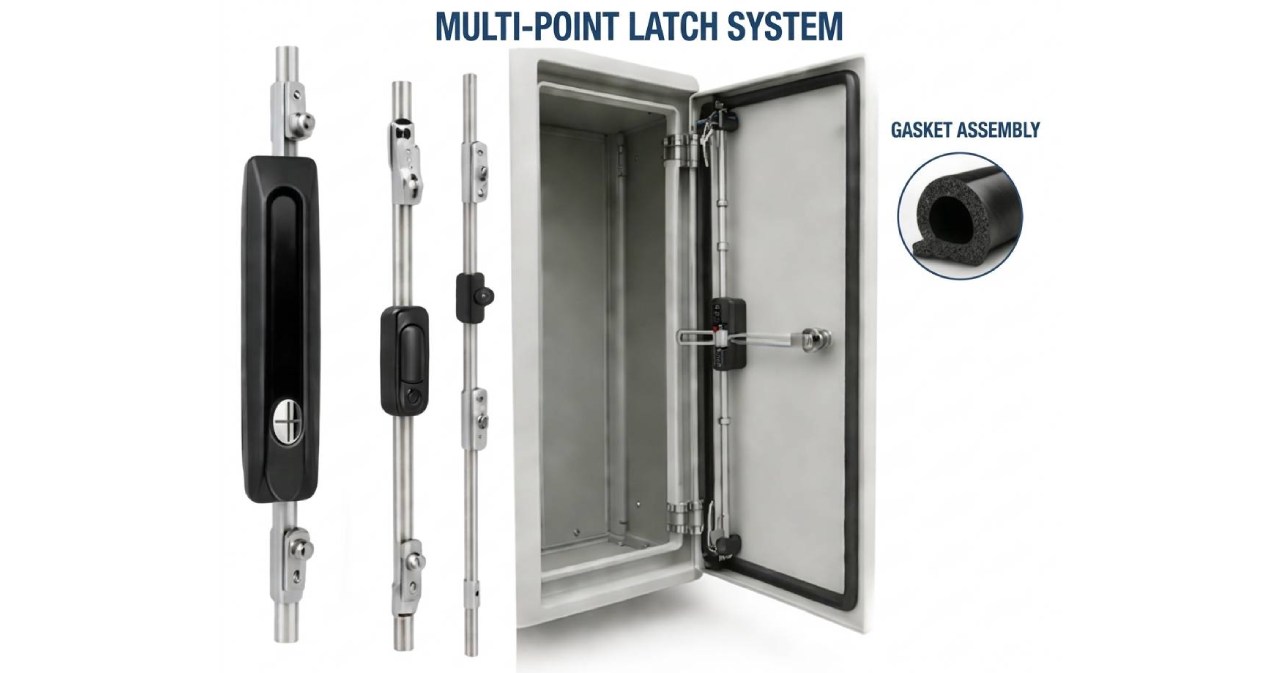
A multi-point latch system uses a single central handle to simultaneously actuate multiple locking bolts distributed around the perimeter of the enclosure door via internal connecting rods. In a three-point system, the handle drives a central bolt plus rods extending to top and bottom locking points. Five-point systems add further points at the left and right sides.
IP67 Suitability:High, specifically suited to large-format enclosures where single-point or dual-point locking creates unacceptable cover deflection. UL-validated for NEMA 4/4X on enclosures up to approximately 1,070mm wide.
Best Application:Large industrial enclosures across manufacturing, utilities, petrochemical, wastewater treatment, freestanding floor-mount electrical distribution panels, wall-mount outdoor gateway cabinets, double-door control enclosures.
Pros: Uniform clamping force distribution, prevents cover deflection; single user action engages all locking points; UL-validated for NEMA 4/4X; padlock hasp integration; long service life.
Cons:Higher cost and mechanical complexity; internal rod system requires door design accommodation; less suitable for compact or shallow enclosures.
Side-by-Side Comparison: 5 Compact Enclosure Locking Mechanisms
| Mechanism | IP67 Suitability | Tool-Free | Active Gasket Compression | Access Frequency | Best Application |
|---|---|---|---|---|---|
| Cam Latch | Moderate–High | ✅ | Moderate | High | Electrical panels, flush doors |
| Slam Latch | Moderate | ✅ | Low–Moderate | Very High | HVAC, vehicle-mounted cabinets |
| Compression Latch | High | ✅ | High (active) | Medium | Instrument & transit cases |
| Swing Handle | High | ✅ | High | Medium | Server/outdoor control cabinets |
| Multi-Point Latch | High | ✅ | High (distributed) | Low–Medium | Large industrial panels |
Master Decision Framework: All 11 Mechanisms
- Compact + IP67 + cylindrical → Twist-to-Lock Bezel or Bayonet Lock
- Compact + IP67 + rectangular → Screw Lock with parting-line O-ring
- Compact + tool-free + modular serviceability → Bayonet or Wedge + Flush Button
- Industrial panel + small-to-medium door + high access frequency → Cam Latch
- Industrial panel + very high access frequency + self-closing → Slam Latch
- Industrial panel + portable instrument case + vibration environment → Compression Toggle Latch
- Industrial panel + medium-to-large door + sealing + security → Swing Handle Latch
- Industrial panel + large or very large door + uniform compression critical → Multi-Point Latch
Frequently Asked Questions
A cam latch uses a rotating cam arm on the interior face of an enclosure door that, when turned 90 degrees via an external knob or key, swings behind the frame to pull the door closed against the gasket. It is one of the most common industrial enclosure locking mechanisms, available in tool-free, keyed, and T-handle configurations, suitable for IP67 applications when multiple units are used on larger doors.