
Introduction
A device cleared for the U.S. market isn't automatically compliant for the EU, and the two paths to medical device certification diverge in ways that reach well beyond paperwork, they shape engineering decisions from early in the design process. Teams planning a single-region launch first, then expanding, often discover late that a design choice made for one region's pathway creates real rework for the other's, rework that earlier awareness of both regimes' technical requirements would have avoided.
In short: the FDA and CE-MDR pathways differ enough in classification logic, technical documentation expectations, and post-market obligations that a genuinely dual-region-ready device has to be designed with both regimes' requirements in view from the start, not adapted from one to the other after the fact.
FDA 510(k)/De Novo/PMA Pathways at a Glance
The FDA's device pathway depends primarily on risk classification and the existence of a predicate device. A 510(k) submission demonstrates substantial equivalence to an already-cleared predicate device and is the most common pathway for moderate-risk (Class II) devices. De Novo applies to novel, moderate-risk devices with no suitable predicate, establishing a new device classification in the process. Premarket Approval (PMA), the most rigorous pathway, applies to the highest-risk (Class III) devices and requires clinical evidence demonstrating safety and effectiveness, not just substantial equivalence. Choosing the right pathway early, and confirming predicate availability before committing to a 510(k) strategy, meaningfully shapes both the required technical evidence and the realistic submission timeline.
CE-MDR's Classification and Conformity Assessment Process
The EU's Medical Device Regulation (MDR) classifies devices into Class I, IIa, IIb, and III based on risk, with classification rules considering duration of contact, invasiveness, and whether the device is active or software-driven. Unlike the FDA's predicate-based approach, CE-MDR conformity assessment for anything above Class I generally requires a Notified Body's independent review of technical documentation and, depending on classification, the manufacturer's quality management system. MDR also introduced more demanding clinical evidence requirements and post-market surveillance obligations compared to its predecessor directive, changes that have materially lengthened certification timelines across the industry since MDR's transition.
Where the Two Regimes' Technical Requirements Actually Diverge
Beyond the high-level pathway differences, the technical documentation itself diverges in ways engineering teams need to plan for. FDA submissions center on demonstrating substantial equivalence or, for PMA, direct safety and effectiveness evidence, with a technical file structure the FDA specifically expects. CE-MDR technical documentation follows a different structure entirely, built around the General Safety and Performance Requirements (GSPRs) and a more extensive clinical evaluation report, and MDR's software-specific classification rule (Rule 11) can classify standalone software more aggressively than the FDA's equivalent framework would for a functionally similar product. A device team that builds its technical file only against FDA's expectations often has to substantially restructure, not just translate, that documentation for an MDR submission.
Timeline and Cost Differences That Affect Go-to-Market Planning
FDA 510(k) review timelines are typically measured in months for a well-prepared submission with a clear predicate, though De Novo and PMA pathways extend considerably longer. CE-MDR timelines have lengthened significantly since the regulation's transition, driven partly by a shortage of Notified Body capacity across the EU, and manufacturers frequently report CE-MDR certification taking longer than the equivalent FDA pathway for a comparable device today, a reversal of the historical pattern where CE marking was often the faster route. This timeline reality needs to enter go-to-market planning explicitly rather than being assumed based on outdated pathway comparisons.
Design Decisions That Ease Dual-Region Certification
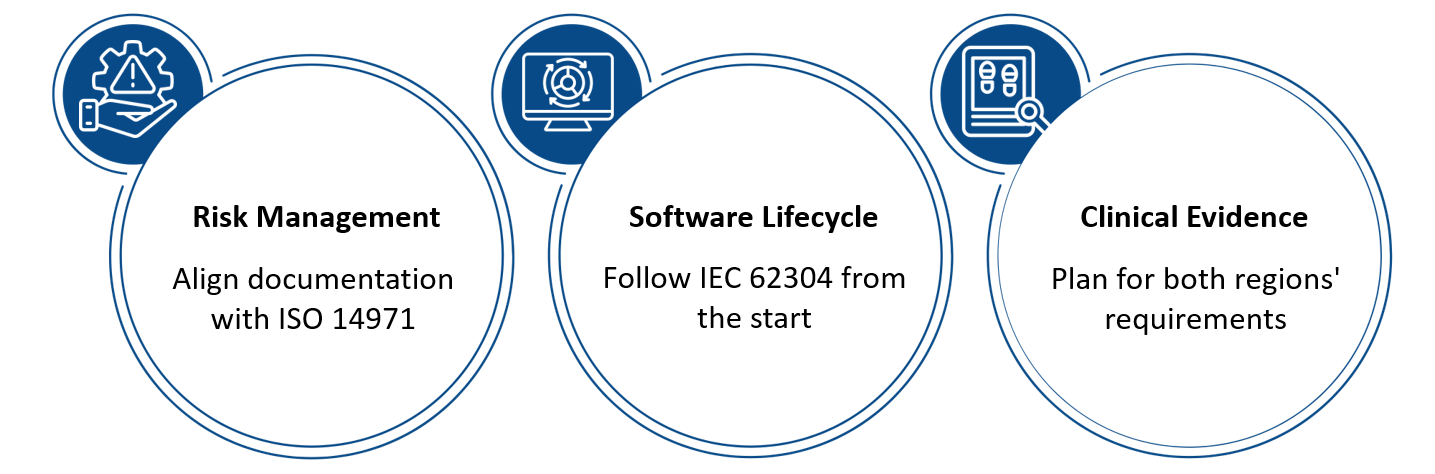
Several design and documentation decisions materially ease pursuing both regions rather than treating the second region as an afterthought. Building the technical file's risk management documentation to ISO 14971, which both regimes reference (FDA increasingly aligns with it, MDR requires it directly), rather than a region-specific risk framework, avoids duplicating that work. Structuring software documentation to IEC 62304 from the start satisfies both regimes' software lifecycle expectations without a rework. And designing the clinical evaluation strategy with both regions' evidence expectations in mind from the outset, rather than generating FDA-sufficient clinical data and discovering MDR's clinical evaluation report needs materially more, avoids an expensive second clinical evidence-generation effort.
FDA 21 CFR Part 820 for Quality Systems and Its EU Equivalent
FDA 21 CFR Part 820 for quality systems establishes the FDA's Quality System Regulation requirements for design controls, document control, and corrective and preventive action. The EU's equivalent expectation runs through ISO 13485 certification, which a Notified Body will expect as part of CE-MDR conformity assessment for most device classes. Building a quality management system aligned with both frameworks concurrently, rather than building to Part 820 first and retrofitting ISO 13485 alignment later, avoids duplicating quality-system documentation work across two structurally similar but not identical frameworks.
What Are the Steps for FDA Approval in Healthcare Tech?
What are the steps for FDA approval in healthcare tech, in practical sequence? Confirm device classification and pathway (510(k), De Novo, or PMA) early, ideally through a pre-submission meeting with the FDA for anything ambiguous. Build the technical file, software documentation under IEC 62304, risk management under ISO 14971, and verification and validation evidence, concurrently with development rather than after. Submit and respond to any Additional Information requests promptly, since round-trip delays are a common source of submission timeline overrun. And plan post-market obligations, adverse event reporting, quality system maintenance, from the submission stage rather than as a post-clearance afterthought.
When to Plan for One Region First vs. Both Simultaneously
Pursuing both regions simultaneously makes sense when the underlying technical file, risk management, software lifecycle documentation, and clinical evidence strategy can genuinely be built once and adapted for each region's specific submission format, which is realistic when both regions' requirements are understood from the design stage. Sequencing one region first makes more sense when a company needs revenue or clinical validation from an initial market before committing the additional Notified Body or clinical evidence investment the second region requires, but that sequencing decision should still be made with the second region's requirements in view, so the first submission's technical file doesn't have to be substantially rebuilt later.
Embien's Capabilities
Embien supports medical device programs with FDA approval support for medical devices and EU CE-MDR certification pathways alike, building technical documentation, risk management under ISO 14971, and software lifecycle evidence under IEC 62304 in a form that serves both regimes rather than requiring a rebuild between them. Our compliance-by-design engineering process integrates quality system documentation aligned with both FDA 21 CFR Part 820 and ISO 13485 from the start of a program.
To discuss certification strategy for a single-region or dual-region medical device program, reach out to Embien's engineering team.