
Introduction
The chip that trains a large language model in a data center and the chip that has to run inference inside a battery-powered robot's own body are solving fundamentally different engineering problems, even when the underlying silicon shares a lineage. Physical AI for autonomous machines keeps running into products built on early prototypes that repurposed a cloud-inference accelerator never designed for power, thermal, or real-time constraints outside a data center, an approach that works for a demo and fails to scale to a shippable product.
In short: purpose-built silicon for physical AI vs repurposed cloud AI chips isn't a marginal performance difference, it's a difference in what the chip was actually designed to guarantee, and a physical AI product's power budget, thermal envelope, and real-time determinism requirements need a chip designed around those constraints from the start, not one adapted from a data-center design after the fact.
Why Cloud AI Accelerators Are a Poor Fit for Embedded Physical AI
Cloud AI accelerators are engineered for a specific, very different optimization target: maximum inference throughput across many concurrent requests, running in a rack with active cooling and effectively unconstrained power delivery. Every one of those assumptions inverts for an embedded physical AI product. A mobile robot or autonomous machine has a battery budget measured in watts, not a data center's power infrastructure. It has passive or, at best, modest active cooling, not a server room's climate control. And it typically needs to process one real-time inference stream reliably and predictably, not maximize aggregate throughput across many parallel jobs. A chip optimized for the data center's problem is, almost by construction, not optimized for the embedded product's problem.
Power and Thermal Envelopes Real-World Robots and Machines Demand
A battery-powered robot's compute budget is often measured in single-digit watts for the entire compute subsystem, sensors, processing, and communications combined, not just the AI accelerator. A cloud-inference chip drawing tens or hundreds of watts simply has no path into that budget regardless of how capable its inference performance is on paper. Thermal constraints compound this: a sealed or lightly-ventilated robot enclosure has nowhere near a server's airflow, so a chip's actual sustained performance under passive cooling is often far below its rated peak performance, a gap that only shows up once the chip is integrated into a real enclosure and rarely appears in a vendor's headline benchmark numbers.
Real-Time Determinism Requirements Cloud Chips Aren't Built For
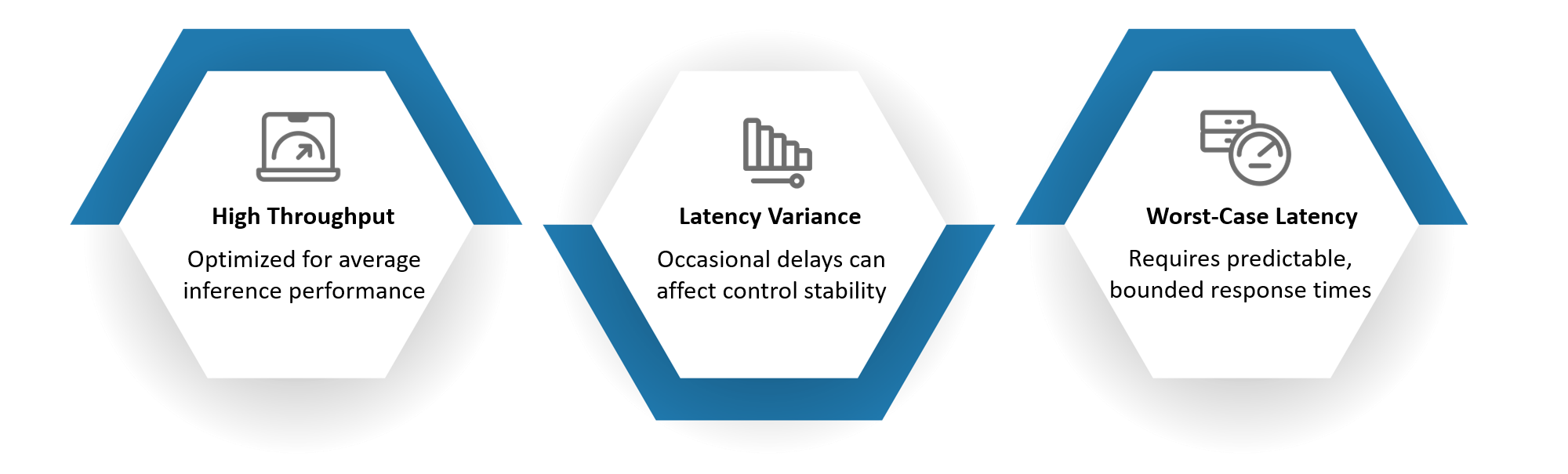
Cloud inference accelerators are optimized for high average throughput, and are generally permitted occasional latency variance because a slightly slower response to one request among thousands rarely matters. A physical AI system controlling a real actuator has the opposite requirement: a control loop that occasionally takes twice as long to complete isn't a minor throughput statistic, it's a stability or safety problem. Embodied AI hardware design has to prioritize worst-case latency guarantees over average-case throughput, which is precisely the opposite of what a cloud accelerator's architecture and scheduling model were built to optimize for.
Physical AI Actuator Control Development: Where Determinism Actually Bites
Physical AI actuator control development is where the determinism gap between cloud and embedded silicon becomes concrete and unforgiving. A robotic arm's grip-force control loop, a legged robot's balance controller, or a drone's flight stabilization loop all depend on predictable, bounded inference and control latency cycle after cycle. A chip that delivers excellent average inference speed but occasional latency spikes, entirely acceptable for a cloud service, can cause a dropped object, a loss of balance, or an unstable flight response in a physical actuator control loop. This is a hardware architecture property, not something a software scheduling fix can fully paper over after the fact.
The Emerging Landscape of Purpose-Built Edge AI Silicon
The response to this mismatch has been a genuinely purpose-built category of edge AI silicon: platforms like NVIDIA's Jetson family (Nano, Orin, AGX Xavier) bring GPU-accelerated inference into a power and thermal envelope designed for robotics and embedded vision from the ground up, not adapted from a data-center GPU design after the fact. NXP's i.MX 8M with the eIQ toolkit targets a different point on the power-versus-capability curve, application-processor-class compute with efficient AI inference for products that don't need Jetson-class throughput. And ARM Cortex-M platforms with TinyML deployment (TensorFlow Lite for Microcontrollers, CMSIS-NN) push physical AI down to sensor-level, milliwatt-power inference for tasks that don't need a dedicated AI accelerator at all. Each of these families was designed against embedded constraints from its architecture's inception, not retrofitted from a cloud-first design.
How to Evaluate Hardware for a Physical AI Product Roadmap
Evaluating edge ai compute for robotics and other physical AI applications should start from the product's actual constraints, not a chip's headline benchmark numbers. The right evaluation sequence is: define the real-time latency budget the control loop actually requires, establish the power and thermal envelope the physical product's battery and enclosure can support, then evaluate candidate silicon against sustained (not peak) performance under those specific constraints. A chip that looks superior on a data-center-oriented throughput benchmark can be the wrong choice once evaluated against a specific product's actual latency and power ceiling, and the only way to catch that mismatch early is to evaluate against the product's real constraints rather than a vendor's marketing benchmark.
Where This Decision Needs to Happen in the Product Lifecycle
Compute platform selection for a physical AI product needs to happen early enough to still shape the model architecture, not after a model has already been developed and optimized around a different platform's assumptions. Making this decision at the concept stage, informed by a realistic power, thermal, and latency budget rather than a demo built on whatever development kit was on hand, avoids the expensive respin that follows when a promising prototype built on repurposed cloud-inference hardware turns out to have no viable path to a production-representative embedded platform.
Embien's Capabilities
Embien designs physical AI products around purpose-built edge silicon, NVIDIA Jetson, NXP i.MX 8M with eIQ, and ARM Cortex-M with TinyML deployment, selected against each product's actual power, thermal, and real-time latency budget rather than against benchmark throughput alone. Our hardware and AI teams evaluate platform choice at the concept stage, before model architecture decisions lock in assumptions the target silicon can't actually support.
To discuss compute platform selection for an autonomous machine, robot, or any other physical AI for autonomous machines product, reach out to Embien's engineering team.