
Introduction
Manufacturers have talked about AI-driven automation for years without most of it reaching the factory floor in a form that actually changed operations. That's shifted. Physical AI for industrial automation, AI models that perceive, reason, and act through real sensors and actuators on real equipment rather than in a cloud dashboard, has moved from pilot curiosity to funded programs at manufacturers who were watching from the sidelines two years ago. The investment case has gotten specific: quality inspection, materials handling, and hazardous-environment monitoring are producing measurable returns, not just proof-of-concept demos.
In short: the business case for physical AI now rests on real, on-device economics, cheaper and more capable edge compute plus mature model-optimization techniques, not on speculative future capability, which is exactly why manufacturers who sat out the first wave are now building real budget lines for it.
What Is Physical AI?
What is physical AI, in concrete terms for a manufacturing audience? It's the engineering discipline of running AI inference directly on embedded hardware inside a physical product or piece of equipment, a camera system, a robotic arm, a sensor node, so the system perceives its environment and acts on it in real time without depending on a cloud round-trip. For industrial automation specifically, that means vision AI running on a camera at the inspection station, anomaly-detection models running directly on a vibration sensor, or feedback control running inside a robotic arm's own controller, not a data pipeline that ships raw sensor data to the cloud for a decision that comes back too late to act on.
Physical AI vs Generative AI: A Different Investment Case Entirely
It's worth being explicit about physical AI vs generative AI because manufacturers evaluating AI investment are often implicitly comparing the wrong things. Generative AI produces text, images, or code from a prompt, typically running on cloud infrastructure with no real-time or physical-world constraint. Physical AI runs on embedded hardware with hard real-time deadlines, tight power budgets, and a direct connection to sensors and actuators, closer in spirit to control systems engineering than to a chatbot. The two categories share model-architecture lineage but almost nothing else about their deployment economics, latency requirements, or evaluation criteria, and treating them as one undifferentiated "AI investment" bucket leads manufacturers to apply the wrong evaluation criteria to physical AI pilots.
What's Actually Changed to Make Physical AI Investable Now
Three things converged to make physical AI a funded line item rather than a research curiosity. Edge AI compute got dramatically more capable per dollar and per watt, platforms like NVIDIA Jetson and NXP's i.MX 8M with the eIQ toolkit now deliver inference performance that would have required a rack-mounted server five years ago. Model optimization techniques, quantization to INT8, structured pruning, knowledge distillation, matured to the point where a model trained at full precision can be compressed 10-100x with acceptable accuracy loss for a specific industrial task. And TinyML deployment on ordinary microcontrollers extended physical AI's reach down to sensor-level anomaly detection that doesn't need a dedicated AI accelerator at all. Together, these shifts moved physical AI's unit economics from "only justifiable for the highest-value use cases" to "justifiable for a much broader set of manufacturing problems."
Where Early ROI Is Showing Up
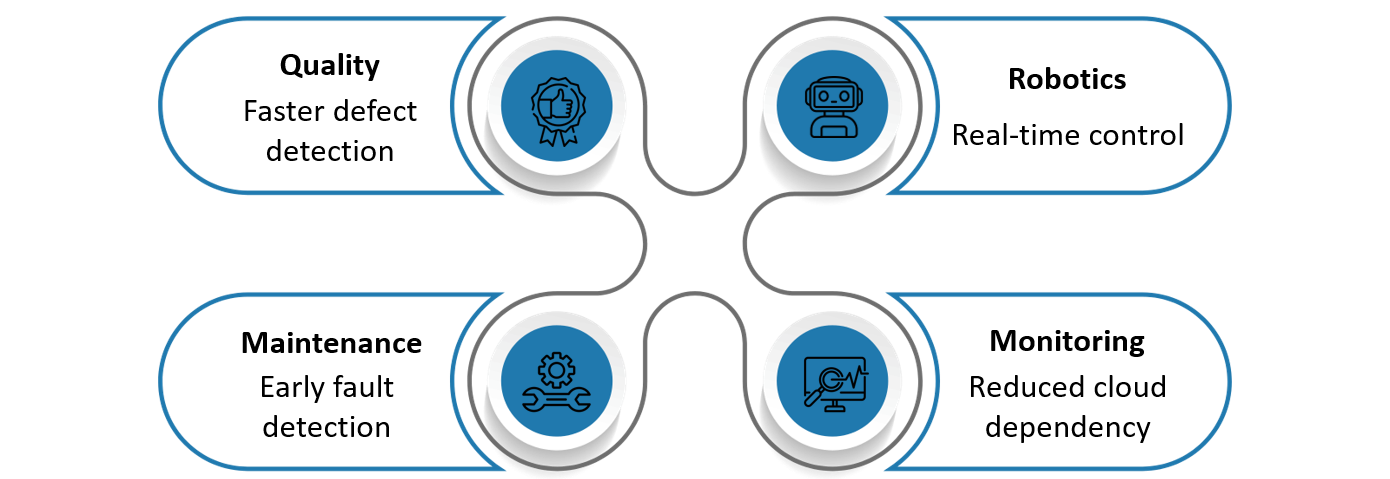
The clearest early returns cluster around a few specific categories. Quality inspection using vision AI on edge compute catches defects at line speed without the cost and latency of shipping every frame to a cloud inference service. Materials handling and robotic arm control benefit from embedded AI systems with real-time feedback loops that adjust grip force or trajectory based on sensor input faster than a networked control loop could respond. Hazardous-environment and predictive-maintenance monitoring, vibration anomaly detection running directly on a low-power sensor node, catches developing equipment failures without requiring continuous cloud connectivity from every monitoring point in a plant, which matters enormously in facilities where reliable network coverage to every asset isn't a given.
The Build-vs-Partner Decision for Manufacturers Without Embedded AI Teams
Most manufacturers evaluating physical AI don't have an in-house embedded AI team, and building one from scratch for a single pilot program rarely pencils out. This is where the choice between building internal capability and engaging physical AI development services from an established partner becomes a real strategic decision, not just a staffing convenience. A capable physical AI development partner brings platform expertise across Jetson, NXP eIQ, and Cortex-M TinyML deployment that would otherwise take a manufacturer years to build internally, along with the model-optimization pipeline knowledge, quantization, pruning, hardware-specific compilation, that determines whether a pilot's model actually fits the target hardware's power and compute budget.
Common Failure Modes in First Physical AI Pilots
First pilots fail in recognizable ways: a model that performs well in a lab environment but was never validated against the plant floor's actual lighting, vibration, or electrical noise conditions; a proof-of-concept built on development-kit hardware with no plan for how it survives the transition to a production-representative enclosure and power budget; and a pilot scoped around a technically interesting problem rather than one with a clear, measurable operational metric that justifies scaling it past a single line or station.
What Separates a Successful Pilot from a Stalled One
Pilots that make it to production share a few traits: a specific, pre-agreed success metric tied to an operational outcome (defect escape rate, unplanned downtime hours, cycle time) rather than a general "does the AI work" evaluation; validation against production-representative conditions from the start rather than a lab-only proof of concept; and a deployment architecture chosen with production scale in mind from day one, so the pilot's hardware and software architecture doesn't need a full redesign to go from one line to twenty.
A Realistic Timeline for Pilot-to-Production
A well-scoped physical AI pilot, from initial feasibility assessment through a production-representative proof of concept, typically runs three to six months for a well-understood use case like vision-based quality inspection, and longer for novel sensor fusion or control problems. Scaling from a validated single-line pilot to a full production rollout adds real integration time, but that phase moves considerably faster when the pilot's hardware and software architecture were chosen with scale in mind from the outset rather than as an afterthought once the pilot proved the concept.
Embien's Capabilities
Embien delivers physical AI development services across NVIDIA Jetson, NXP i.MX 8M with eIQ, and ARM Cortex-M TinyML deployment, including production experience with a TinyML-based water leakage detection system for industrial equipment and embedded AI systems for quality inspection and predictive maintenance. As an NXP Independent Design House, our team brings model-optimization and embedded hardware expertise together from the first pilot design rather than treating them as separate workstreams.
To discuss a physical AI pilot or production program for your manufacturing operation, reach out to Embien's engineering team.