
Introduction
A robot or autonomous machine only acts as well as it perceives, and no single sensor gives it a reliable enough picture of an unstructured physical environment to act on. Physical AI sensor integration services exist specifically to solve this: combining camera, LiDAR, IMU, and force/torque sensing into a fused perception stack that gives a robot a usable, real-time model of its surroundings, one that's more robust than any individual sensor's output and degrades gracefully rather than catastrophically when one input becomes unreliable.
In short: sensor fusion for physical AI is as much a compute-architecture and latency-budget problem as it is a perception-algorithm problem, and the two have to be designed together, not handed off between an AI team and a hardware team working from separate specs.
Why Single-Sensor Perception Fails in Unstructured Physical Environments
A single sensor modality has predictable, well-documented failure modes that an unstructured environment reliably triggers. Cameras lose reliable object detection in low light, glare, or when a target is partially occluded. LiDAR struggles with reflective or transparent surfaces and offers no color or texture information to help classify what it detects. IMUs drift over time without an external reference to correct against. Force/torque sensing tells you what's happening at a single point of contact but nothing about what's approaching before contact occurs. A structured factory environment with controlled lighting and known object geometry can sometimes get away with a single dominant sensor; a robot or autonomous machine operating in a real, variable physical environment generally cannot.
The Core Sensor Modalities and What Each Contributes
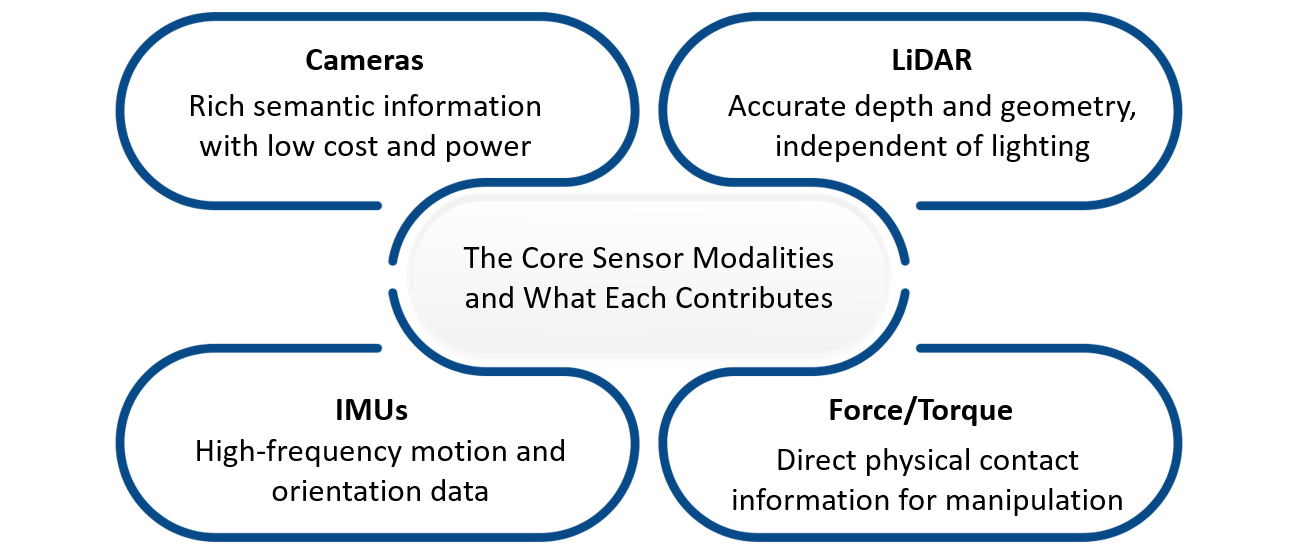
Effective sensor fusion starts with understanding what each modality is actually good at, rather than treating them as interchangeable data sources. Cameras contribute rich semantic information, what an object is, not just where it is, at relatively low cost and power, but need adequate lighting and struggle with precise depth estimation on their own. LiDAR contributes accurate, lighting-independent depth and geometry data, valuable for obstacle avoidance and mapping, but at higher cost, power, and data-rate than cameras. IMUs contribute high-frequency motion and orientation data essential for control loop stability, filling the gaps between slower-updating vision or LiDAR frames. Force/torque sensing contributes ground-truth physical contact information no remote sensor can substitute for, critical for manipulation tasks like grasping where visual estimation of grip force is unreliable.
Fusion Architectures: Early, Late, and Hybrid Approaches
How and where sensor data streams combine is itself a design decision with real performance consequences. Early fusion combines raw or lightly processed sensor data before any independent per-sensor interpretation, potentially extracting correlations a later-stage fusion would miss, but at the cost of a more complex, tightly coupled processing pipeline that's harder to debug and validate sensor-by-sensor. Late fusion processes each sensor modality independently to a high-level interpretation, then combines those interpretations, easier to develop, test, and validate per sensor, but potentially losing cross-modal correlations that only show up in the raw data. Hybrid approaches, fusing at multiple stages for different sensor pairs based on where the correlation actually matters, are increasingly common in production systems precisely because they let a team apply the right fusion strategy to each specific sensor combination rather than a single architecture across the whole stack.
Physical AI Chip and Sensor Integration: Latency and Compute Tradeoffs
Physical AI chip and sensor integration decisions directly determine how much fusion sophistication a real-time system can actually afford. High-resolution computer vision, dense LiDAR point-cloud processing, and multi-modal fusion running at the update rates a fast-moving robot needs demand serious compute, which is why production physical AI systems increasingly rely on custom hardware acceleration, FPGAs for deterministic, low-latency fusion stages, dedicated NPUs, and GPU platforms like NVIDIA Jetson for the heavier vision and fusion workloads, rather than trying to run everything on a single general-purpose processor. The chip selection and the fusion architecture have to be decided together: a fusion approach that looks appealing on paper but exceeds the target compute platform's real-time budget isn't actually a viable design.
Handling Sensor Degradation and Conflicting Inputs
A production-grade fusion system has to keep operating sensibly when a sensor degrades or when sensors disagree, not just when everything is working normally. Practical approaches include confidence-weighted fusion that reduces a degraded sensor's influence on the fused output rather than trusting it equally with healthy sensors, explicit fault detection that flags a sensor reading as an outlier when it disagrees sharply with corroborating sensors, and a defined fallback behavior, reduced speed, a safe stop, reliance on a more limited sensor subset, for when degradation crosses a threshold the system can no longer safely fuse around. Building this in from the start, rather than assuming all sensors will always report cleanly, is what separates a fusion system that fails safely from one that fails silently.
Robotics Perception and Control Embedded Design: Closing the Sense-Decide-Act Loop
Perception only matters if it feeds a control decision fast enough to act on. Robotics perception and control embedded design has to treat the fused perception output and the control loop it feeds as one latency budget, not two separately optimized stages, because a perception pipeline that's individually fast but poorly integrated with the control loop's timing can still produce a robot that reacts too late. This is where sense-decide-act hardware systems earn their name: the sensing, decision, and actuation stages have to be architected together against a single end-to-end latency target, typically with the most time-critical control loops running as close to the actuator as possible and higher-level perception and planning running on separate, appropriately provisioned compute.
How Does Physical AI Work in Robotics?
How does physical AI work in robotics, pulling this together end to end? Sensors capture the raw physical-world data; a fusion stage, running on FPGA, NPU, or GPU-accelerated compute matched to the required latency and power budget, combines that data into a coherent environmental model; a decision stage, an AI model or a more traditional control algorithm, or often both together, determines the appropriate action; and an actuation stage executes it, with the results feeding back into the next sensing cycle. Getting each stage right in isolation doesn't guarantee a working robot: the stages have to be co-designed against the same real-time and power constraints from the start.
What This Means for Embedded Compute Platform Selection
Platform selection for a physical AI perception stack should follow from the fusion architecture and latency budget, not precede it. NVIDIA Jetson platforms suit vision-heavy, GPU-accelerated fusion workloads with moderate power budgets. NXP i.MX 8M with the eIQ toolkit suits systems needing a strong balance of AI inference and general application processing on a single chip. FPGA-based acceleration, using toolchains like Xilinx Vitis AI, suits the most latency-critical fusion stages where deterministic timing matters more than raw model flexibility. Choosing the platform before the fusion architecture and latency requirements are understood is a common and expensive mistake, one that frequently forces a costly hardware respin once the actual compute demands become clear.
Embien's Capabilities
Embien delivers physical AI sensor integration services spanning custom hardware acceleration for multi-modal sensor fusion, FPGA-based signal processing, and embedded AI deployment on NVIDIA Jetson, NXP eIQ, and ARM Cortex-M platforms. Our team designs the sensor fusion architecture and the embedded compute platform together from the first design review, rather than selecting hardware before the fusion and latency requirements are fully understood.
To discuss a sensor fusion or robotics perception requirement for a physical AI product, reach out to Embien's engineering team.