
Introduction
Connectivity choice is one of the most consequential infrastructure decisions in modern smart factory solutions, and private 5G has emerged as a genuinely compelling option alongside Wi-Fi 6 and wired industrial Ethernet, not as a wholesale replacement for either, but as the right fit for a specific, growing category of factory automation needs. Deciding whether private 5G is worth the investment for a given facility requires weighing its real advantages, mobility, device density, and guaranteed performance, against its real costs, honestly rather than by hype.
In short: private 5G gives a factory dedicated cellular connectivity with guaranteed performance and security a facility controls directly rather than depending on shared spectrum, making it the stronger choice for mobile robotics, dense sensor deployments, and applications needing predictable low latency, while Wi-Fi 6 remains a lower-cost, well-understood option for less demanding connectivity needs, and the investment case for private 5G comes down to whether a facility's specific automation requirements genuinely need what private 5G uniquely provides.
What Private 5G Actually Means for a Factory Environment
A private 5G network gives a facility its own dedicated cellular infrastructure, either fully independent of public carrier networks or operating on a carrier-provided but logically isolated network slice, with coverage, capacity, and security policy configured specifically around that facility's needs rather than shared with public network traffic. This dedicated model is the core distinction from both public 5G service and Wi-Fi: a factory operating private 5G controls its own network performance and security posture directly, rather than depending on external infrastructure whose performance and availability the factory doesn't control.
Private 5G Vs Wi-Fi 6 for Factory Automation: A Direct Comparison
The comparison comes down to a few concrete technical differences that matter for specific use cases. Private 5G offers superior mobility support, maintaining reliable connectivity for equipment and vehicles moving continuously through a facility in a way Wi-Fi's access-point handoff model handles less gracefully at scale. Private 5G also supports substantially higher device density per coverage area and offers more consistent, guaranteed latency characteristics through network slicing, while Wi-Fi 6 offers meaningfully lower infrastructure and licensing cost, a more mature and widely understood deployment and troubleshooting ecosystem, and adequate performance for the large share of factory connectivity needs that don't specifically require 5G's mobility or density advantages. Neither technology wins universally, the right choice depends on matching the specific automation use case's actual requirements against what each technology is built to optimize for.
Smart Factory IoT Sensor Integration Services: Where Connectivity Choice Actually Matters
Smart factory IoT sensor integration services increasingly need to account for connectivity architecture as a first-class design decision rather than an afterthought bolted onto sensor selection, since the same sensor deployed with different connectivity backing behaves very differently under real facility conditions. A dense sensor deployment across a large facility, sensor and machine data streaming continuously from hundreds or thousands of points, benefits from 5G's device-density and network-slicing capability far more than a sparse, mostly-static sensor deployment would, making the connectivity architecture decision inseparable from the broader sensor integration strategy rather than a separately optimized layer.
Use Cases Where Private 5G's Advantages Genuinely Pay Off
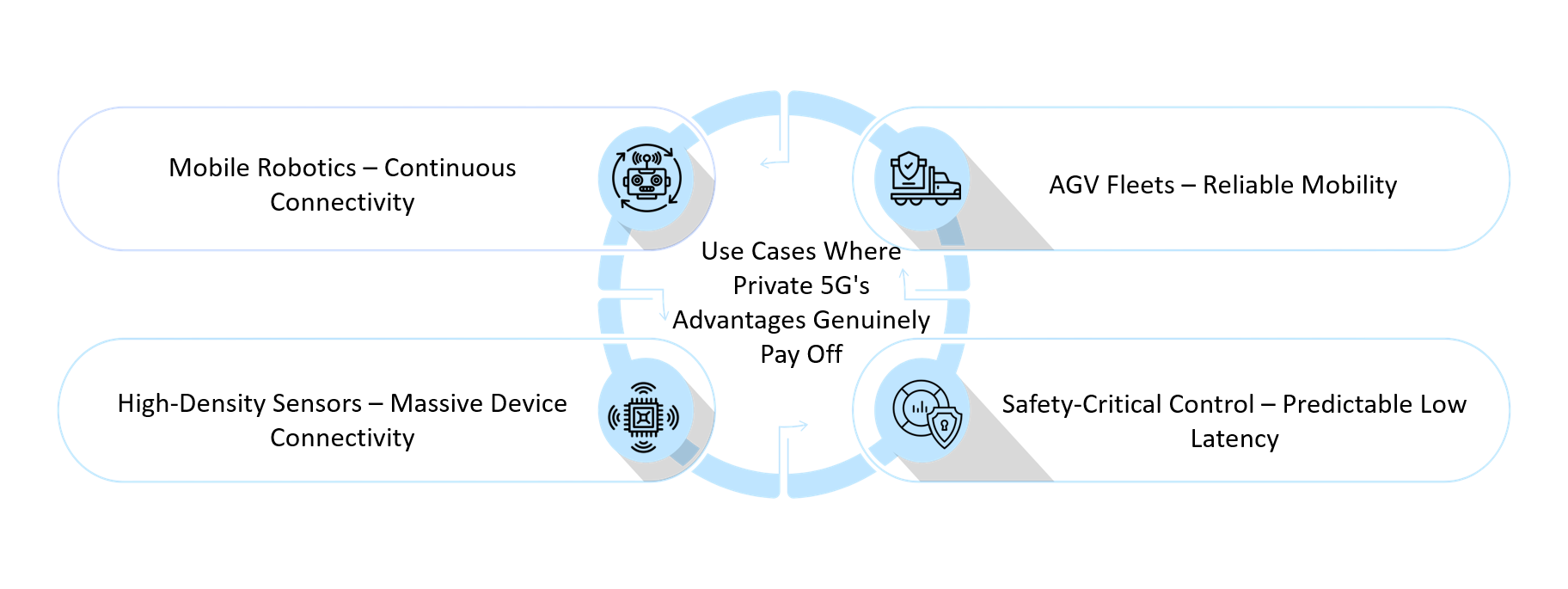
Mobile robotics and AGV fleets requiring continuous, reliable connectivity as they navigate a facility are the clearest use case where private 5G's mobility and low-latency advantages translate directly into operational value, a connectivity dropout affecting a moving robot has more severe consequences than the same dropout affecting a fixed sensor. High-density sensor deployments, where thousands of individual sensor and machine-data points need simultaneous, reliable connectivity, benefit from 5G's massive machine-type communication capability in a way that would strain a comparably-sized Wi-Fi deployment's access-point capacity. And safety-critical, latency-sensitive control applications, coordinated robotics, real-time process control, benefit from the guaranteed, predictable latency network slicing provides, a guarantee Wi-Fi's best-effort model doesn't offer with the same reliability.
Is Private 5G Worth the Investment for Manufacturing? A Practical Cost-Benefit Framework
The answer depends on weighing private 5G's meaningfully higher infrastructure and spectrum-licensing cost against the operational value its mobility, density, and guaranteed-latency advantages actually deliver for a specific facility's automation needs. A facility with mostly static, low-density sensor deployments and no mobile robotics or safety-critical latency requirements is very likely better served by Wi-Fi 6's lower cost and mature ecosystem. A facility with substantial mobile robotics, dense sensor deployment, or safety-critical real-time control requirements is far more likely to find private 5G's investment justified by the operational reliability and performance it delivers, reliability that a best-effort wireless architecture can't guarantee at the same level.
Private 5G Networks for Smart Factories: Deployment Considerations Beyond the Technology Choice
Actually deploying this kind of dedicated network involves more than the connectivity technology decision itself: spectrum licensing arrangements vary by jurisdiction and need to be understood early in planning, network design has to account for a facility's specific RF environment, metal structures, machinery, and building materials all affecting propagation differently than a typical Wi-Fi deployment's design assumptions, and integration with existing industrial control and sensor infrastructure needs careful planning so the private 5G network actually connects cleanly to the industrial communication protocols and connectivity stack already in place, rather than existing as an isolated connectivity island disconnected from the rest of the facility's automation architecture.
How This Fits Into a Broader Factory Modernization Strategy
Private 5G is one infrastructure decision within a broader factory modernization program that also includes sensor deployment, control system architecture, and data infrastructure choices, and it delivers the most value when planned as part of that broader strategy rather than as an isolated connectivity upgrade layered onto an otherwise unchanged automation architecture. A facility undertaking broader manufacturing automation and factory modernization work is well positioned to evaluate private 5G as one deliberate piece of that larger plan, rather than retrofitting it later onto infrastructure decisions that were made without accounting for the connectivity architecture's implications.
Embien's Capabilities
Embien brings industrial connectivity and IoT sensor integration experience spanning private 5G evaluation, Wi-Fi 6 and industrial Ethernet deployment, and sensor network architecture for dense, mobile, and safety-critical factory automation environments. Our engineering process evaluates connectivity technology choice against a facility's actual mobility, density, and latency requirements rather than defaulting to the newest available technology.
To discuss smart factory solutions or a connectivity architecture evaluation for a manufacturing facility, reach out to Embien's engineering team. Whichever connectivity technology fits, the right choice keeps a facility's broader smart factory solutions roadmap consistent rather than boxed in by an isolated infrastructure decision.