
Introduction
IEC 61508 is the parent standard, the generic functional safety framework for electrical, electronic, and programmable electronic safety-related systems across every industry from process control to rail. ISO 26262 is its automotive-specific derivative, adapted for the particular hazard patterns, production volumes, and lifecycle realities of road vehicles. Engineers moving between industrial and automotive programs, or evaluating an ISO 26262 compliant automotive embedded partner for the first time, often ask a fair question: if IEC 61508 already exists, why does automotive need its own separate standard, and where exactly do the two diverge? ISO 26262 vs IEC 61508 functional safety standards compared is a genuinely useful comparison for understanding both what automotive functional safety demands and why it demands it that way.
In short: ISO 26262 adapts IEC 61508's generic functional safety framework to automotive-specific realities, high production volumes, a distinct hazard and risk assessment method (HARA instead of generic risk graphs), and a driver-in-the-loop controllability factor that most other IEC 61508-derived sector standards don't share, and understanding these differences matters directly when selecting or evaluating an automotive embedded development partner's functional safety capability.
IEC 61508: The Generic Functional Safety Framework
IEC 61508 defines Safety Integrity Levels (SIL 1 through SIL 4) as its risk classification scheme, derived through a generic risk assessment approach that considers the frequency of hazardous events and the probability of failure on demand for the safety function involved. IEC 61508 was written to apply across industries broadly, process control, machinery, rail signaling, medical equipment, and its safety lifecycle, hazard analysis, safety requirements specification, safety validation, design and development phases, was intentionally kept generic enough to be adapted by sector-specific derivative standards. IEC 61508 remains directly applicable today in industries without their own derivative standard, and its influence is visible in nearly every functional safety standard published since, ISO 26262 included.
ISO 26262: The Automotive-Specific Derivative
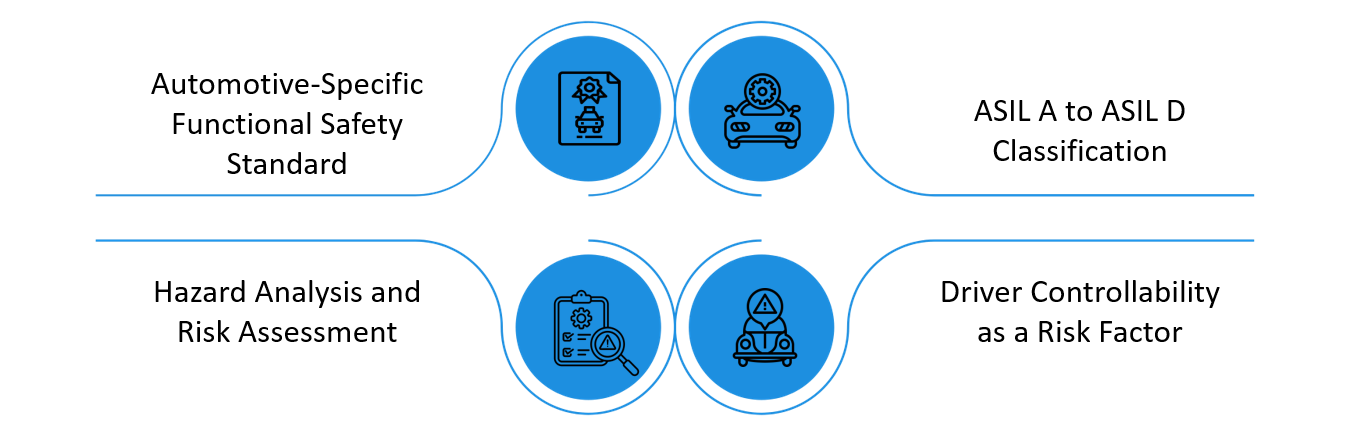
ISO 26262 was published specifically because automotive E/E systems have characteristics IEC 61508's generic framework didn't address well: extremely high production volumes (millions of nominally identical units, unlike the bespoke or small-batch systems IEC 61508 often governs), a human driver in the control loop who can often, but not always, intervene to prevent or mitigate a hazard, and a supply chain structure spanning OEMs and multiple tiers of suppliers that needed a shared, standardized safety case framework to coordinate across organizational boundaries. ISO 26262 replaced IEC 61508's generic SIL classification with ASIL (Automotive Safety Integrity Level, A through D), derived through the automotive-specific HARA process rather than IEC 61508's generic risk graph approach.
How ASIL Classification Differs From SIL
ASIL vs SIL safety integrity levels compared reveals the most consequential structural difference between the two standards. IEC 61508's SIL is derived primarily from failure frequency and probability of failure on demand, quantitative reliability engineering inputs. ISO 26262's ASIL is derived from HARA's three qualitative-then-combined factors, severity, exposure, and crucially, controllability, how reliably an average driver can act to prevent or limit harm when the malfunction occurs. This controllability factor has no direct SIL equivalent, because most IEC 61508 application sectors don't have an equivalent human-in-the-loop mitigation opportunity built into their standard risk model the way automotive does. A hazard with identical severity and exposure can land at a different integrity level under ASIL than it would under a generic SIL assessment, specifically because of how controllability is or isn't factored in.
Functional Safety Design for Automotive Electronics: Where the Automotive Adaptation Shows Up Most
Functional safety design for automotive electronics reflects ISO 26262's automotive-specific adaptations throughout the hardware and software development lifecycle, not just at the classification stage. ISO 26262's hardware architectural metrics, Single-Point Fault Metric, Latent Fault Metric, and Probabilistic Metric for random Hardware Failures, are more prescriptively defined with automotive-specific numeric targets per ASIL than IEC 61508's more generic hardware fault tolerance requirements. ISO 26262 also formalizes ASIL decomposition, splitting a high-ASIL requirement across independent lower-ASIL channels, as a standard, well-documented technique in a way IEC 61508 addresses only more generally through its own safety integrity architecture concepts. Automotive electronics design has to account for these automotive-specific mechanisms explicitly, they're not simply IEC 61508 techniques renamed.
How to Ensure Functional Safety (ISO 26262) in Automotive Software Development
How to ensure functional safety (ISO 26262) in automotive software comes down to disciplined execution of ISO 26262 Part 6's software-specific lifecycle: deriving software safety requirements traceable to the technical safety concept, applying ASIL-appropriate coding guidelines (MISRA C compliance scales with ASIL level), achieving the coverage criteria the ASIL demands, branch coverage for lower levels, full MC/DC for ASIL C and D, and maintaining independence between the engineers who write safety-critical code and those who verify it, with the strictest independence required at ASIL D. None of this differs conceptually from IEC 61508's general approach to safety-related software, but ISO 26262 specifies the targets, coverage criteria, and independence requirements in automotive-specific, audit-ready detail that makes compliance more directly verifiable across a multi-tier automotive supply chain.
Which Suppliers Actually Need Both Standards
Some automotive suppliers, particularly those whose components also serve industrial or other IEC 61508-governed sectors, end up needing genuine fluency in both standards rather than just ISO 26262 alone. A supplier developing a motor controller platform sold into both automotive and industrial machinery applications, for instance, needs to satisfy ISO 26262's ASIL requirements for automotive customers and IEC 61508's SIL requirements for industrial customers from what may be substantially shared underlying hardware and software architecture. Understanding where the two standards' requirements genuinely overlap, much of the safety lifecycle discipline, versus where they diverge, ASIL's controllability factor and automotive-specific hardware metrics, lets an engineering team design a safety architecture and evidence package that satisfies both without duplicating the underlying engineering work twice.
What This Means When Evaluating a Development Partner
An ISO 26262 compliant automotive embedded partner needs to demonstrate fluency with the automotive-specific mechanics ISO 26262 actually assesses, HARA-driven ASIL classification with correctly applied controllability reasoning, ASIL decomposition strategy, MC/DC coverage achievement at higher ASILs, and safety case compilation, rather than simply asserting general IEC 61508-style functional safety experience and assuming it transfers directly. A partner whose functional safety background comes primarily from industrial or process-control IEC 61508 work can bring valuable safety-engineering discipline, but should be evaluated specifically on whether that discipline has been demonstrably applied to ISO 26262's automotive-specific classification method and hardware/software targets, not assumed by analogy.
Embien's Capabilities
Embien brings ISO 26262 functional safety engineering experience across ASIL A through ASIL D automotive ECU programs, including HARA-driven safety goal derivation, ASIL decomposition architecture, and safety case compilation, alongside broader IEC 61508-aligned safety engineering experience for industrial and cross-domain embedded systems. Our engineering teams work with AUTOSAR Classic and Adaptive platforms across body control, ADAS, instrument cluster, and telematics domains.
To evaluate Embien as an ISO 26262 compliant automotive embedded partner for a functional safety program, reach out to Embien's engineering team.