
As the CTO of Embien Technologies, I've seen firsthand the intricate journey that Original Equipment Manufacturers (OEMs) undertake when moving a product from a promising pilot run to full-scale mass production, and then supporting it in the field. Launching a product is a triumph, but the real test lies in scaling it effectively and providing robust post launch manufacturing support services. For OEMs operating in sectors like medical, automotive, industrial, and defense, this process is fraught with challenges that can jeopardize success if not managed well. In this article, I'll outline the key hurdles OEMs face in supporting products post-launch across these domains, propose actionable remedies, and share best practices including remote diagnostics, Product Lifecycle Management for Industrials, and OTA updates to ensure your product thrives long after it reaches the market.
The Stakes of Scaling and Support
The shift from a controlled pilot run to mass production is a pivotal moment. It's where designs are stress-tested by real-world conditions, and any flaw can escalate into a crisis. Scaling isn't just about producing more units—it's about preserving quality, meeting demand, and preparing for long-term post launch manufacturing support services. In regulated and high-stakes industries like medical, automotive, industrial, and defense, the complexity multiplies due to safety requirements, regulatory oversight, and diverse operational environments. Fault tolerant designs for critical applications become essential differentiators in these sectors. Let's explore the specific challenges in each sector and how to address them.
Medical Sector: Ensuring Compliance and Patient Safety
Challenges:
- Regulatory Compliance: Medical devices must comply with rigorous standards like FDA regulations or ISO 13485. Post-launch deviations can trigger recalls or legal penalties.
- Field Failures: A malfunction in a medical device can endanger lives, necessitating rapid and precise failure analysis. Fault tolerant designs for critical applications are non-negotiable in this domain.
- Data Security: Connected devices handling patient data face constant cybersecurity risks.
Remedies:
- Establish comprehensive failure analysis processes to pinpoint and resolve issues swiftly, minimizing risks to patients.
- Deploy OTA updates to fix software bugs or security vulnerabilities remotely, avoiding the need for physical recalls.
- Maintain meticulous documentation and traceability to streamline audits and ensure compliance.
Automotive Sector: Balancing Innovation with Reliability
Challenges:
- System Complexity: Today's vehicles, packed with software and electronics, are prone to hard-to-diagnose failures requiring advanced remote diagnostics capabilities.
- Supply Chain Disruptions: Component shortages, such as semiconductors, can derail volume ramp up efforts.
- Safety Recalls: High-profile safety issues can erode customer trust and brand value.
Remedies:
- Utilize OTA updates to address software glitches remotely, reducing recall costs and downtime.
- Diversify supply chains and keep buffer inventory to cushion against disruptions.
- Perform failure analysis with telematics data using remote diagnostics to identify and fix issues before they escalate.
Industrial Sector: Maximizing Uptime and Efficiency
Challenges:
- Downtime Costs: Equipment failures can halt production lines, causing substantial financial losses.
- Harsh Environments: Devices operating in extreme conditions face accelerated wear, complicating support.
- Legacy Integration: New products must often work with outdated systems, adding complexity to manufacturing support services.
Remedies:
- Use IoT-enabled Predictive Maintenance Solutions to catch issues early, reducing downtime. Predictive Maintenance Solutions are among the highest-value investments for industrial OEMs managing large deployed fleets.
- Design products with rugged components to withstand tough conditions.
- Offer modular upgrades to ensure compatibility with legacy infrastructure.
Defense Sector: Ensuring Security and Reliability
Challenges:
- Security Threats: Defense equipment is vulnerable to cyber-attacks, demanding constant updates and monitoring via remote diagnostics platforms.
- Long Lifecycle: Products require post launch support for decades, posing logistical challenges for Product Lifecycle Management for Industrials.
- Strict Standards: Compliance with military specifications (e.g., MIL-STD) is mandatory and unforgiving.
Remedies:
- Implement secure OTA updates with advanced encryption to patch vulnerabilities without compromising security.
- Plan for long-term component sourcing or design with adaptability to future technologies.
- Maintain a specialized support team well-versed in defense standards and cybersecurity.
Best Practices for Scaling and Supporting Products
To achieve business success, OEMs must scale efficiently during volume ramp up and sustain products through effective post launch manufacturing support services. Here are proven strategies that apply across these sectors:
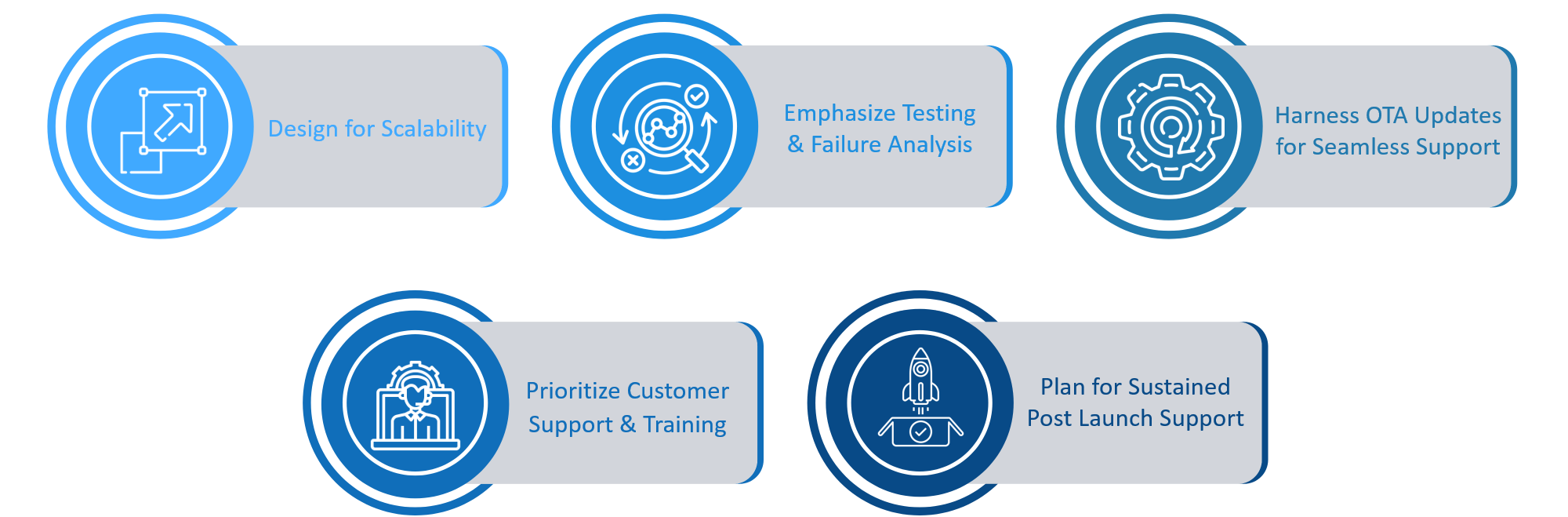
Best Practices for Scaling and Supporting Products
- Design for Scalability
- Modular Design: Build products with interchangeable components to simplify repairs and upgrades.
- Standardized Processes: Use uniform manufacturing workflows to ensure quality consistency as production scales.
- Supply Chain Resilience: Partner with multiple suppliers to prevent bottlenecks and delays.
- Emphasize Robust Testing and Failure Analysis
- Pre-Launch Testing: Simulate real-world scenarios to uncover weaknesses before mass production. Fault tolerant designs for critical applications must be verified under stress conditions.
- Post-Launch Monitoring: Collect telemetry and customer insights to refine products continuously.
- Root Cause Analysis: Conduct detailed failure analysis to eliminate recurring issues.
- Harness OTA Updates and Remote Diagnostics for Seamless Support
- Remote Diagnostics: Fix issues without physical access, saving time and resources. Remote diagnostics platforms allow engineering teams to analyze field behavior and push corrective actions in real time.
- Feature Enhancements: Deliver updates to improve functionality and maintain competitiveness.
- Security Patches: Address threats promptly to safeguard users and meet regulatory requirements.
- Prioritize Customer Support and Training
- 24/7 Availability: Provide constant support, critical for high-stakes sectors like medical and defense.
- User Training: Equip customers with resources to optimize product use.
- Feedback Channels: Use customer input to drive iterative improvements.
- Plan for Sustained Post Launch Support with Product Lifecycle Management
- Product Lifecycle Management for Industrials: Prepare for product retirement or upgrades well in advance. Product Lifecycle Management for Industrials ensures spare part availability, compliance currency, and structured end-of-life transitions.
- Spare Parts Strategy: Ensure parts availability throughout the product's lifespan.
- Documentation: Keep detailed records of updates and support activities for accountability.
Real-World Example: Turning a Crisis into a Win
Consider an automotive OEM launching an electric vehicle (EV). The pilot phase was flawless, but during mass production, instrument system failures emerged under specific conditions. Through failure analysis using field data and remote diagnostics, the issue was traced to a hardware glitch. But fortunately we identified that there was a way to avoid it by delaying certain software activities. We helped the OEM deploy an OTA update to fix it remotely, averting a recall. Further analysis led to a permanent solution in the next release, preserving customer trust and avoiding millions in losses. This case underscores the power of proactive manufacturing support services and technology in scaling successfully.
Conclusion: Building a Foundation for Success
Scaling from pilot runs to mass production and providing effective post launch support is a complex endeavor, especially in medical, automotive, industrial, and defense sectors. Challenges like compliance, reliability, and security can derail even the best products. However, by designing for scalability, leveraging remote diagnostics and OTA updates, implementing Predictive Maintenance Solutions, and managing the full journey through structured Product Lifecycle Management for Industrials, OEMs can transform obstacles into opportunities.
At Embien Technologies, we've guided countless clients through this process with comprehensive manufacturing support services, ensuring their products excel in the market. By adopting these best practices, you can drive volume ramp up, deliver exceptional post launch support, and secure lasting business success—staying ahead in a competitive, ever-changing landscape.