
Artificial Intelligence (AI) is no longer a futuristic buzzword—it is now a core component driving transformation across industries. In the world of electronics product development, AI is revolutionizing the way products are conceived, designed, tested, and optimized. From intelligent simulations to automated testing, AI is not just enhancing workflows; it is fundamentally changing them.
At Embien Technologies, we have witnessed and embraced this shift. As a leading embedded systems and electronics product development company, we understand the strategic advantages of integrating AI into our design and development pipeline. In this blog, we explore the significant impact of AI in product engineering, its real-world applications, the measurable benefits it brings, and how Embien is leveraging these advancements to deliver next-generation solutions.
AI Applications in Electronics Product Development
AI touches every stage of the electronic product lifecycle. Here are the key areas where AI-driven design and intelligent tools are transforming the electronics product development process:
1. Concept and Design Optimization
Modern electronics product development involves an overwhelming number of choices—components, layouts, protocols, power budgets, and more. AI tools can process historical design data, customer usage patterns, and failure rates to suggest optimal architectures.
- Generative design tools use algorithms to create multiple design options optimized for constraints like size, cost, and thermal management.
- AI-powered EDA Tools (Electronic Design Automation) help route PCBs more efficiently and identify bottlenecks in signal paths. Modern EDA Tools powered by machine learning can analyze thousands of layout variations to recommend the most signal-integrity-compliant configuration.
2. Component Selection and Supply Chain Intelligence
AI algorithms can assist in real-time selection of components based on pricing, lead times, obsolescence risk, and even geopolitical impacts. This is especially crucial in today's volatile supply chain environment for electronics product development.
- Machine learning models monitor vendor reliability.
- Predictive analytics help avoid supply disruptions.
3. Simulation and Predictive Modeling
Before a prototype is built, AI models can simulate and predict performance under various conditions:
- Thermal simulations based on historical heat dissipation data.
- Electromagnetic interference (EMI) estimation.
- AI-driven design tweaks based on environmental and mechanical constraints.
4. Automated Testing and Validation
Traditionally, hardware testing is time-consuming and resource-intensive. AI now enables machine learning in testing processes to:
- Automate test case generation.
- Identify anomalous behavior across signal data.
- Speed up validation cycles in consumer electronics product development.
AI-based visual inspection systems also enhance product quality by spotting minute defects that are hard to catch manually. This is especially critical for AI integration in consumer electronic devices, where quality expectations are high.
5. Firmware and Software Development
With AI assistance, firmware developers can leverage advanced AI development tools to:
- Auto-generate code snippets based on natural language descriptions.
- Detect potential bugs and inefficiencies in code.
- Use reinforcement learning to fine-tune system behavior (e.g., motor control, power optimization).
6. Field Performance Monitoring and OTA Updates
After deployment, embedded devices generate massive amounts of telemetry data. AI helps parse this information to:
- Optimize device behavior in real-time.
- Predict maintenance needs.
- Customize over-the-air (OTA) updates based on actual usage patterns.
Benefits of AI Integration in Engineering Workflows
The adoption of AI integration in consumer electronic devices and industrial products brings tangible benefits that improve both speed and quality. These advantages span every phase of electronics product development:
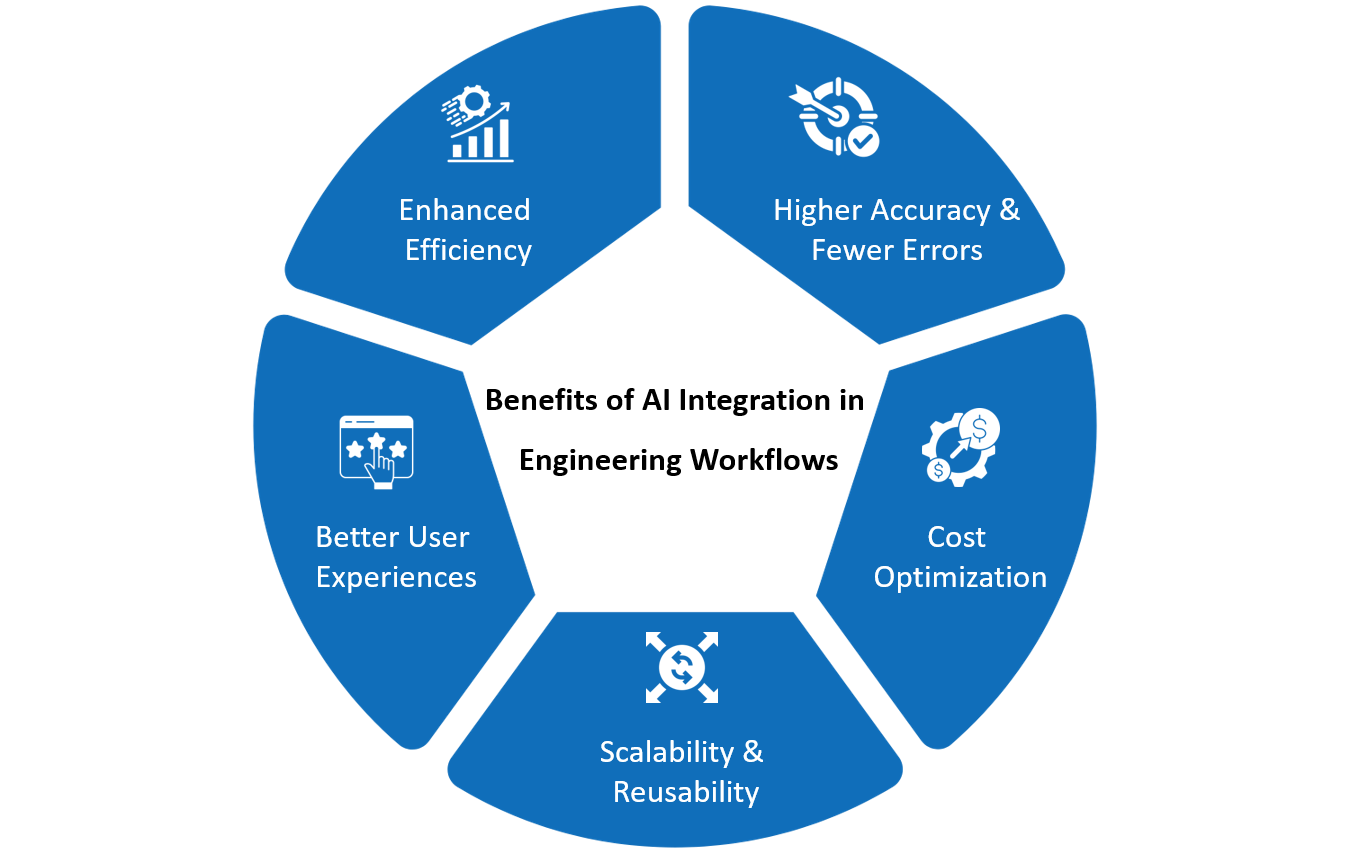
Benefits of AI Integration in Engineering Workflows
1. Enhanced Efficiency
AI reduces the effort and time required at multiple stages, especially in complex areas like PCB layout, testing, and component selection. This leads to faster iteration cycles and shorter time-to-market.
2. Higher Accuracy and Fewer Errors.
AI tools catch design flaws or signal integrity issues that might be missed by human reviewers. This increases first-pass success rates and reduces costly redesigns.
3. Cost Optimization.
By simulating designs and predicting outcomes before physical prototyping, companies can avoid unnecessary material and labor costs. Optimized component selection also results in long-term savings.
4. Scalability and Reusability.
AI-powered systems can generalize solutions from one project to another. For example, thermal behavior predictions or testing models can be adapted across a family of products.
5. Better User Experiences.
AI doesn't just help engineers. It also enhances the end-product's user experience through features like adaptive interfaces, voice recognition, and personalized settings that evolve over time. This is increasingly vital for AI integration in consumer electronic devices targeting smart home, wearables, and automotive segments.
Embien's Adoption of AI in Electronics Product Development
At Embien Technologies, we are committed to staying ahead of the curve. We have proactively integrated AI across multiple touchpoints in our electronics product development workflow. Our Product Engineering Services leverage intelligent automation throughout design, firmware, and validation phases. We also deliver cutting-edge Edge AI Computing Services for real-time inference at the device level:
1. AI-Powered Development Tools
We leverage AI-enhanced EDA Tools and coding assistants that boost efficiency and accuracy. Our engineers are trained to maximize the value of these tools in day-to-day workflows.
2. Intelligent Testing Frameworks
Our internal test automation infrastructure uses machine learning in testing to analyze signal behavior and identify inconsistencies across multiple iterations. This has drastically reduced manual test cycles and improved reliability.
3. Predictive Maintenance and Diagnostics
For our industrial clients, we deploy AI models that monitor equipment behavior in real-time and predict failures before they happen. This has helped reduce downtime and improve asset longevity.
4. Custom AI Embedded Solutions
We develop AI Embedded Solutions that integrate edge AI—such as voice recognition, anomaly detection, and camera-based inspection—for smart devices in domains like healthcare, automotive, and consumer electronics.
5. Knowledge Reusability
We maintain a knowledge base built from AI-analyzed project data, enabling our engineers to reuse design insights and testing strategies, accelerating project ramp-up.
Challenges and Future Outlook
Despite its transformative benefits, AI adoption in electronics product development is not without challenges:
- Data Dependency: High-quality datasets are essential for training useful models.
- Toolchain Integration: Ensuring AI tools play well with existing CAD, EDA Tools, and versioning systems.
- Skill Gaps: Bridging embedded engineering with AI/ML expertise requires cross-disciplinary training.
- Validation Complexity: Verifying AI-generated design suggestions still requires human oversight.
However, as tools mature and datasets become richer, AI's role will only grow. Generative AI, in particular, promises to bridge the gap between human creativity and algorithmic optimization—making intelligent co-pilots a staple of engineering workbenches.
Conclusion: Intelligence as a Catalyst for Innovation in Electronics Product Development
The integration of AI into electronics product development is not a trend—it is an evolutionary step that is redefining the industry's DNA. From AI-driven design to machine learning in testing, the technology is reshaping how we build, test, and deliver electronic products. The growing role of AI integration in consumer electronic devices and the availability of powerful EDA Tools are accelerating this transformation.
At Embien Technologies, we recognize that staying competitive means staying intelligent. Our commitment to leveraging AI in design, development, and validation ensures that our clients not only keep pace but lead in their respective markets. As AI continues to evolve, Embien will remain at the forefront, pushing the boundaries of what is possible in electronics product development.