
Enclosure-to-strap attachment is one of the most under-engineered decisions in wearable product design. It directly determines retention under real-world forces, whether the device can be removed for charging without disturbing the wearer, how well an embedded NFC antenna maintains its geometry against the body, and whether IP sealing at the strap-enclosure junction survives the product's service life.
This guide covers four integrated and primary retention mechanisms, the structural foundation of how a wearable module attaches to its strap. Part 2 covers clamping, supplementary, and specialised attachment mechanisms.
What Is an Enclosure-to-Strap Attachment Mechanism?
An enclosure-to-strap attachment mechanism is the mechanical interface that connects a wearable electronics module to the band, collar, or strap it is worn on. It must retain the device securely under demanding conditions; not damage any electronics, antenna traces, or conductors embedded in the strap; be manufacturable within production constraints; and remain comfortable and safe for the wearer.
Key Engineering Factors Before Choosing a Mount
- Device weight and form factor
- Frequency of enclosure removal, user-serviceable vs. factory-only
- Embedded electronics or antenna in the strap (NFC, flex circuit, conductive traces)
- Environmental exposure: wet, dirty, high-activity conditions
- Wearer comfort: human skin-safe vs. animal collar applications
- Manufacturing intent: prototype vs. production tooling
1. Loop-Through Mount
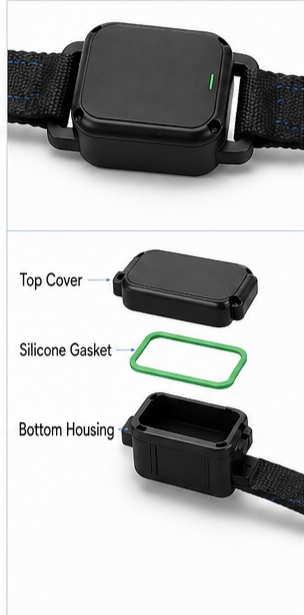
The loop-through mount is the simplest and most structurally direct enclosure-to-strap attachment. One or two slots are moulded integrally into the enclosure housing, and the strap is physically inserted through these slots. The enclosure cannot be removed from the strap without sliding it off or removing the strap from the wearer entirely.
Best Application: Primary retention across collar-format pet wearables, industrial body-worn devices, and band-format electronics. Particularly well-suited for NFC-embedded strap applications as it naturally maintains flat strap geometry against the enclosure base.
Pros: Very high retention force; no additional components; naturally prevent enclosure rotation; compatible with injection-moulded housing.
Cons: Enclosure removal requires strap removal from wearer; strap width and thickness constrained by slot geometry.
2. Spring Bar / Lug Mount
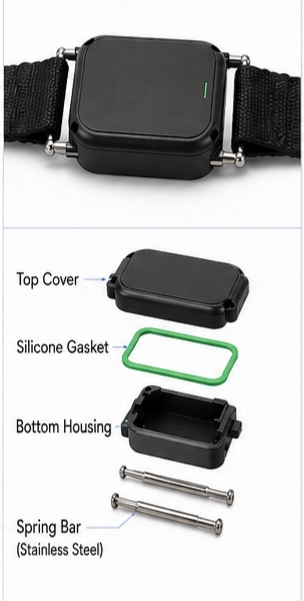
A spring bar is a spring-loaded cylindrical pin whose compressed shoulders seat into lug slots on the enclosure of inner walls. The strap end loops around the bar. This mechanism is the global standard for smartwatches and fitness trackers. Standard lug widths from 16mm to 24mm ensure broad strap interchangeability.
Quick-release spring bars add a fingernail-actuated lever for tool-free strap removal in seconds, now the dominant specification for consumer wearables where strap interchangeability is a product differentiator.
Best Application: Wrist-worn smartwatches, fitness trackers, medical wrist monitors, any wearable where strap interchangeability is a core product requirement.
Pros: Tool-free strap swap (quick-release variant); enables strap interchangeability; standardized lug widths (16–24mm); low profile; fully NFC-compatible.
Cons: Lug walls must have sufficient thickness to resist outward bar force; quick-release lever adds a small protrusion on strap underside.
3. Rivet / Eyelet Through-Mount
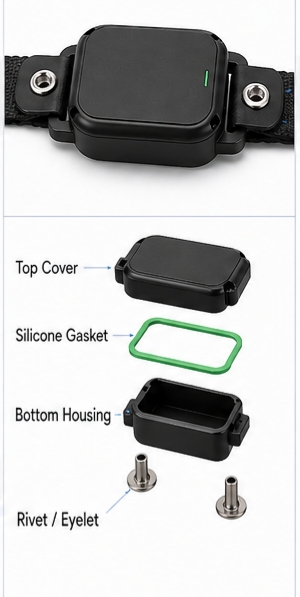
Metal rivets or hollow eyelets are driven through the strap fabric and clamped into corresponding recesses on the enclosure base. The rivet physically penetrates the strap material, distributing the tensile and shear load across the fabric rather than relying on surface friction. Rivet heads can be finished flush with the strap surface on the wearer-facing side.
Critical Design Requirement: Antenna trace layout must be mapped, and rivet positions confirmed against that layout before tooling is specified. Rivets must be confined to antenna-free zones of the strap.
Best Application: Factory-assembled wearables where the strap-enclosure joint is designed to be permanent or semi-permanent.
Pros: Very high tensile and shear retention; low profile; no dependence on surface friction; permanently prevents sliding and rotation.
Cons: Effectively permanent, removal requires drilling out the rivet; antenna trace clearance mapping mandatory; requires assembly tooling.
4. Over-Mold / Integrated Strap Termination
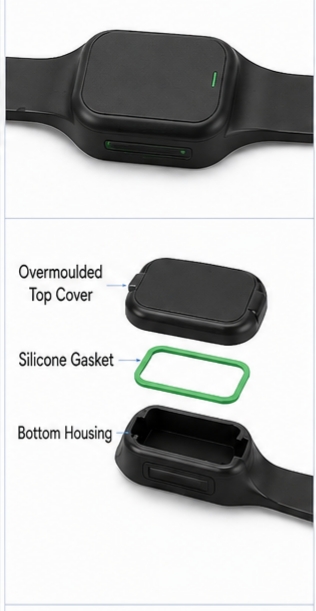
Over-moulding (insert molding) places the strap end into a mold as a physical insert, and the housing polymer is injected around it, permanently encapsulating the strap within the housing body. The result is a unibody strap-enclosure joint with no discrete mechanical interface, no slot, no pin, no fastener.
The over-mould zone must be designed to terminate before the active antenna section. The mold fill process exposes the strap insert to elevated temperatures and injection pressure, both of which can damage antenna traces or flex circuit materials if present within the mold-fill zone.
Best Application: Production-intent designs where the strap and enclosure are conceived as a single replaceable unit. Contributes directly to IP67 at the strap-enclosure interface.
Pros: Highest possible retention strength; inherently sealed at strap-enclosure junction; permanently maintain NFC antenna alignment; cleanest exterior aesthetics.
Cons: Strap and enclosure permanently joined design complexity for antenna and electrical routing requires specialized insert molding tooling; higher manufacturing cost and longer tooling lead time.
Side-by-Side Comparison: 4 Primary Enclosure-to-Strap Attachment Mechanisms
| Mechanism | Retention Strength | Tool-Free | Antenna-Safe | User-Serviceable | Best Use |
|---|---|---|---|---|---|
| Loop-Through | Very High | ❌* | ✅ | ❌ | Primary retention, collar/band format |
| Spring Bar / Lug | High | ✅** | ✅ | ✅ | Smartwatches, fitness trackers |
| Rivet / Eyelet | Very High | ❌ | ⚠️ | ❌ | Factory-permanent designs |
| Over-Mold | Highest | N/A | ✅ | ❌ | Production unibody designs |
Special Consideration: Protecting Embedded Strap Electronics
Any mechanism that penetrates the strap (rivets, eyelets, screws), severely compresses the strap (bracket clamps, screw mounts), or thermally stresses the strap (over-moulding) must be evaluated against the antenna trace layout before the mechanism position is finalised. Always map the active and passive zones of the strap before specifying any attachment mechanism that contacts or penetrates the strap material.
Frequently Asked Questions
For raw retention strength, over-moulding delivers the highest bond, there is no mechanical joint to loosen or fatigue. For a mechanically discrete joint, rivet or eyelet through-mounting provides the highest shear and tensile retention because the fastener physically passes through the strap fabric.