
What is mqtt and how does it work for iiot? MQTT is a lightweight publish-subscribe messaging protocol built for exactly the kind of constrained, unreliable-network conditions common in industrial IoT deployments, in sharp contrast to the request-response model this folder's Modbus and OPC UA content otherwise covers. A publishing device sends a message to a named topic on a central broker without needing to know who, if anyone, is listening; subscribing clients register interest in specific topics and receive messages as they arrive, decoupling publishers from subscribers entirely and letting new consumers, a dashboard, a historian, an analytics pipeline, come online and start receiving data without any change to the devices publishing it.
Modbus and, in its classic client-server mode, OPC UA are fundamentally request-response: a master or client asks a specific question and waits for a specific answer, a model that works well for tightly-coupled local polling but scales awkwardly once many consumers want the same data. MQTT inverts that relationship, a device publishes once, and the broker handles distributing that single message to however many subscribers actually want it, which is precisely why a comprehensive guide to mqtt for industrial iot matters for teams designing systems where the same field data needs to reach a SCADA historian, a cloud analytics platform, and an operator dashboard simultaneously, without multiplying the polling load on the originating field device for every additional consumer.
Mqtt broker architecture for industrial deployments generally takes one of three shapes. A centralized broker, cloud-hosted or on a central plant server, is the simplest to operate and works well for a single-site deployment with a modest device count. A clustered broker architecture spreads load and adds redundancy across multiple broker nodes, appropriate once message volume or availability requirements outgrow what a single broker instance can reliably handle. And an edge-local broker, running on-site or even on the gateway device itself, keeps local publish-subscribe traffic, HMI-to-PLC-adjacent messaging, for instance, working even during a wider network outage, forwarding a subset of that traffic upstream to a central or cloud broker only once connectivity allows. Choosing the right MQTT broker architecture for industrial deployments comes down to matching topology to the deployment's actual scale, latency tolerance, and connectivity reliability, not defaulting to whichever is simplest to stand up first.
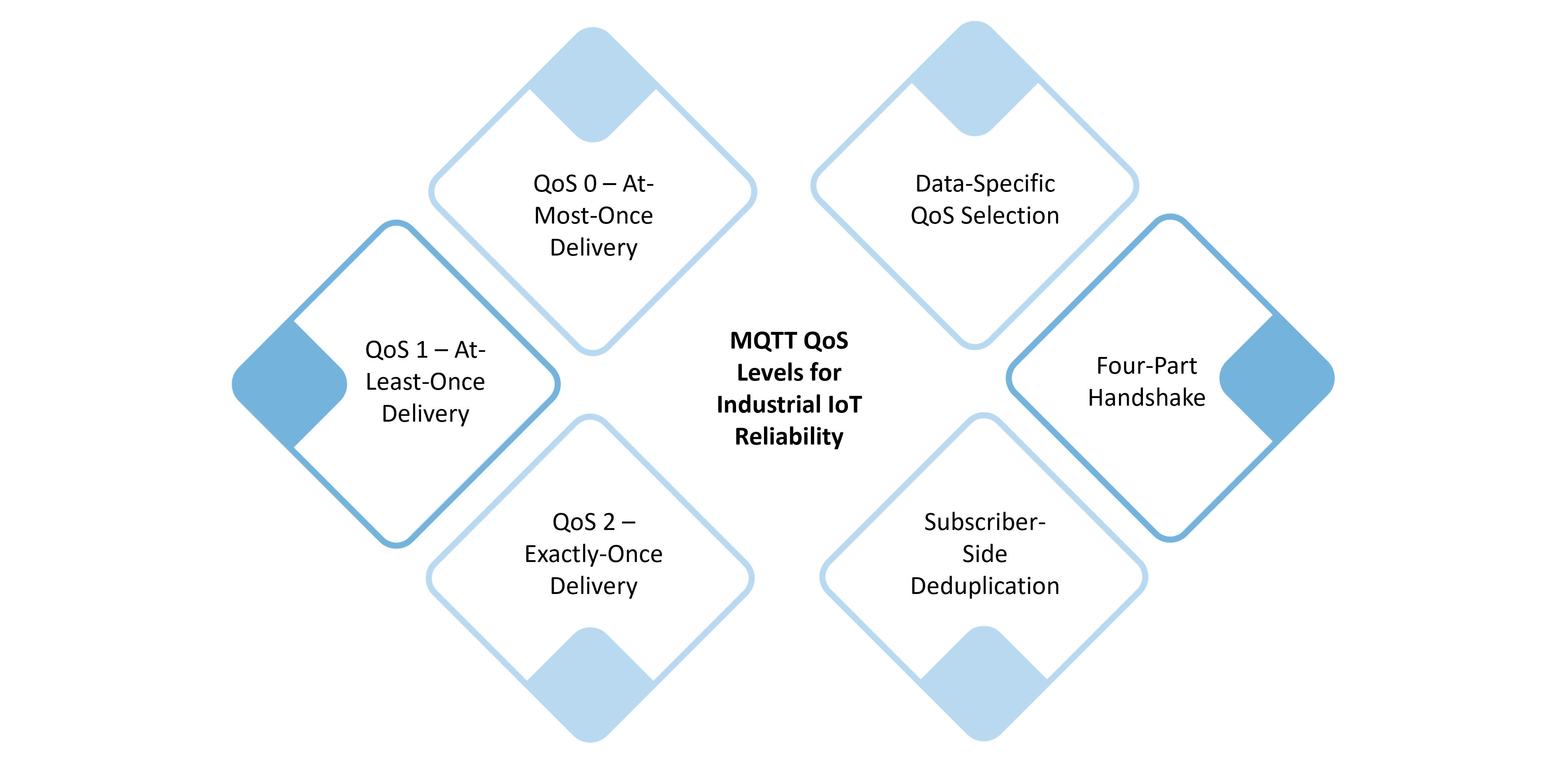
Mqtt qos levels for industrial iot reliability give a publisher explicit control over delivery guarantees, and choosing the right level per data stream is a real design decision rather than a default setting left unexamined. QoS 0, at-most-once delivery, fires and forgets with no acknowledgment, suitable only for high-frequency, low-consequence data where an occasional dropped message genuinely doesn't matter. QoS 1, at-least-once delivery, guarantees the message arrives but may deliver a duplicate, requiring subscriber-side deduplication logic for data where duplicates would corrupt downstream processing. QoS 2, exactly-once delivery, adds a four-part handshake that guarantees both delivery and no duplication, at real additional latency and broker overhead cost, reserved for the data, commands, financial or safety-relevant transactions, where duplication or loss genuinely can't be tolerated. Matching MQTT QoS levels for industrial IoT reliability to what each specific data stream actually requires, rather than defaulting every topic to the highest QoS level out of caution, keeps broker and network load proportional to genuine reliability need.
MQTT topic design determines whether a deployment stays navigable as it scales or turns into an unmanageable flat namespace within a year. A well-designed hierarchy encodes deployment structure directly into the topic path, something like site1/line3/tank2/level, letting subscribers use MQTT's built-in wildcard subscriptions to cleanly select an entire site, a single line, or one specific point without needing separate subscription logic for each. Mqtt topic design best practices for industrial iot generally call for keeping the hierarchy consistent across every site in a multi-site deployment, even where individual sites have different equipment, since a consistent topic structure is what lets a single downstream analytics or dashboard application scale across a growing site count without bespoke integration work for every new location added.
Two MQTT features specifically address a gap plain publish-subscribe otherwise leaves open: knowing a device's current state without waiting for its next scheduled publish. A retained message stores the last published value on a topic at the broker, so a client subscribing fresh immediately receives the most recent known state rather than an empty topic until the next update arrives. Last-will-and-testament lets a device register a message with the broker to be published automatically on its behalf if it disconnects ungracefully, network failure, power loss, crash, giving downstream systems a reliable, broker-guaranteed signal that a device has gone offline rather than relying on a timeout to infer the same thing indirectly.
MQTT carries no security model of its own by default, which means production industrial deployments need to add it deliberately rather than assume the protocol handles it. TLS encrypts the broker connection against eavesdropping and tampering, a baseline requirement for any deployment touching a network beyond a fully isolated local segment, and client-certificate authentication, each device holding a unique certificate the broker validates before accepting a connection, provides materially stronger device identity assurance than username-and-password credentials, particularly important given how directly MQTT topics can expose live process data to anyone able to connect and subscribe.
This guide deliberately goes deeper into MQTT on its own terms rather than repeating the buyer-facing comparison already covered in Embien's MQTT vs OPC UA protocol comparison, and it pairs naturally with this folder's own OPC UA information model guide for teams evaluating both protocols' data-modeling approaches side by side. A comprehensive guide to MQTT for industrial IoT is most useful once a team has already decided MQTT is the right fit and needs the broker, QoS, and topic-design depth this piece covers.
Embien Technologies designs MQTT broker architecture, topic hierarchies, and QoS strategy for industrial IoT deployments, alongside the protocol gateway and edge translation work that gets field data onto MQTT in the first place. Our IoT gateway and protocol translation engineering covers MQTT integration end to end, from broker selection through TLS and certificate-based device authentication.
To discuss a comprehensive guide to mqtt for industrial iot tailored to a specific deployment, reach out to Embien's engineering team.

Embien's product engineering services support the development of connected industrial products, covering embedded hardware and firmware, IoT connectivity, protocol integration, gateway development, and end-to-end product engineering for reliable industrial deployments.

Embien supports industrial automation through embedded control systems, industrial communication protocols, IoT gateways, and protocol integration, enabling MQTT-based data exchange between field devices, SCADA systems, edge platforms, and cloud applications.

A case study on rapid product development using Embien's eStorm-L1 platform, highlighting an approach to accelerating embedded product development and supporting industrial IoT applications that require device connectivity, data acquisition, and protocol integration.