
This folder has already made the case, in Embien's own platform reuse myth piece, that generic embedded engineering experience does not automatically translate into a reusable, certification-ready industrial platform. That same gap shows up on the buying side: choosing an embedded systems partner for a protocol-heavy, certification-bound industrial device is a different evaluation from choosing a general-purpose product design firm, and a choosing an industrial automation engineering partner checklist has to test for that difference directly rather than trusting a polished portfolio at face value.
A firm can have a genuinely strong track record in consumer electronics, medical devices, or automotive infotainment and still have never actually implemented a Modbus, PROFINET, or EtherCAT stack from the wire up, the kind of work covered across this folder's own deep protocol guides. Protocol-stack development carries its own specific competence, conformance testing experience, familiarity with real-time Ethernet timing budgets, an understanding of how Modbus TCP and Modbus RTU actually differ at the framing level, that a team can only have built by doing the work before, not by being generally strong embedded engineers. Choosing an embedded systems partner on the strength of an impressive but protocol-adjacent portfolio is one of the most common mistakes an industrial buyer makes.
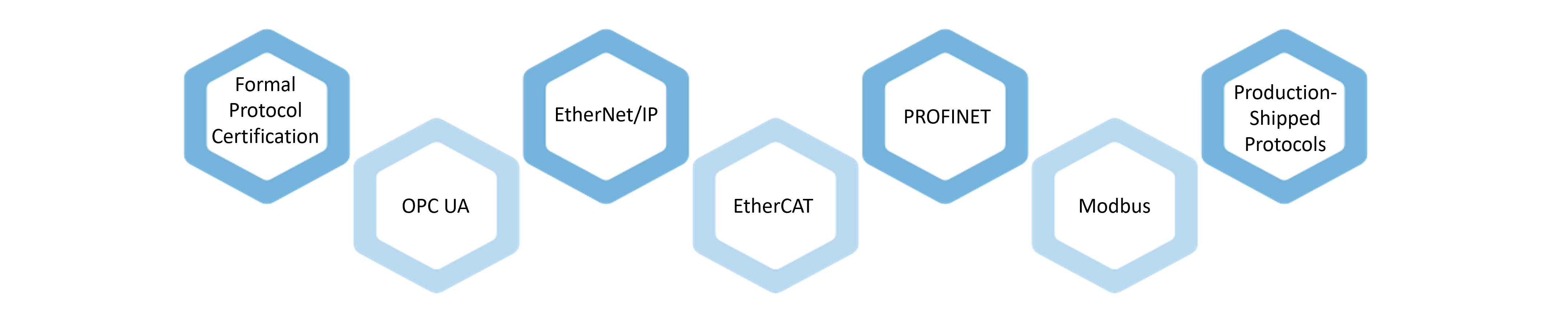
Choosing the right embedded development partner starts with specific, checkable questions rather than general ones. Which protocols has this team actually shipped in production, not merely prototyped or evaluated? Can they name the specific fieldbus or industrial Ethernet standards, Modbus, PROFINET, EtherCAT, EtherNet/IP, OPC UA, and describe a real device that carried that stack into the field? Have they taken a device through formal protocol certification, not just internal conformance testing, and can they speak concretely to what failed the first time and what it took to fix it? A partner who answers these questions with specific project detail is demonstrating real fieldbus and IIoT delivery history; a partner who answers only in general capability language usually is not.
An embedded engineering partner working in industrial automation should be able to speak concretely to functional safety and security compliance experience, specifically IEC 61508 for functional safety and IEC 62443 for industrial control system cybersecurity, not just claim familiarity with "industry standards" in the abstract. Ask for a real example of a device or system the team took through IEC 62443 zone-and-conduit security architecture, or IEC 61508 safety lifecycle documentation, and ask what SIL or security level that work targeted; a vendor with genuine compliance experience will have specific, defensible answers, while a vendor repackaging general IoT security awareness as industrial compliance experience typically cannot go beyond generic statements when pressed for that level of detail.
Several patterns reliably signal that a vendor's "industrial" positioning is thinner than it looks. Case studies that describe outcomes in only business terms, faster time to market, improved reliability, without naming a single protocol, standard, or certification actually involved is one; an inability to explain, at a technical level, why a specific protocol was chosen over an alternative for a past project is another; and a proposal that treats every industrial project as fundamentally the same generic embedded development engagement, regardless of whether it involves a fieldbus stack, a safety-rated system, or a security-critical gateway, is a third. An embedded engineering partner genuinely experienced in industrial work distinguishes between these project types unprompted, because the engineering challenges are genuinely different.
A proof-of-concept engagement is where a buyer gets to see a candidate partner's real capability rather than their sales narrative, and a meaningful one has specific characteristics: a scoped technical objective tied to the actual protocol, certification, or hardware challenge the final product will face, not a generic "build a demo" exercise; a fixed, short timeline that tests the team's actual working speed and technical judgment under real constraints; and a deliverable the buyer's own engineers can independently evaluate against the original technical objective, rather than a polished demo that is hard to assess against anything concrete. Best embedded engineering partner for OEMs candidates should welcome a proof-of-concept structured this way, since it is exactly the kind of engagement that lets their real capability, rather than their marketing, do the talking.
Embien Technologies has built and delivered Modbus, PROFINET, EtherNet/IP, EtherCAT, OPC UA, and MQTT protocol stacks across industrial gateways and controllers, backed by the RAPIDSEA platform's silicon-agnostic, pre-certified middleware architecture and Embien's own protocol conformance and certification testing experience covered elsewhere in this folder. Teams working through a checklist for choosing an embedded systems partner for an upcoming industrial protocol or IIoT program are welcome to bring their specific protocol, compliance, and delivery requirements to Embien's engineering team, and to evaluate Embien as an embedded engineering partner on exactly the specific, checkable terms this checklist recommends.

Embien's product engineering services support the development of industrial automation products, covering embedded hardware and firmware engineering, industrial communication integration, protocol-stack development, and system validation for reliable industrial devices and controllers.

Embien's embedded software development services cover firmware development, device drivers, real-time software, and industrial protocol-stack integration for connected devices and gateways using technologies such as Modbus, PROFINET, EtherCAT, EtherNet/IP, and OPC UA.

A case study demonstrating Embien's industrial embedded engineering capabilities through the development of a protocol converter for wind turbine systems, highlighting industrial communication, protocol translation, and integration between equipment and monitoring networks.