
Choosing an RTOS for industrial fieldbus devices is a narrower, more constrained decision than picking an RTOS for a general embedded product. A fieldbus device, a Modbus slave, a Profinet node, an EtherCAT drive, isn't just running application logic on top of the RTOS; it's running a protocol stack with its own strict timing requirements, often on hardware sized to a specific cost and power budget the fieldbus device's bill of materials can't exceed. Choosing an RTOS for industrial fieldbus devices means evaluating the RTOS against the protocol stack's own real-time requirements first, and general application convenience second, which inverts the priority order a typical consumer or general industrial embedded product would apply.
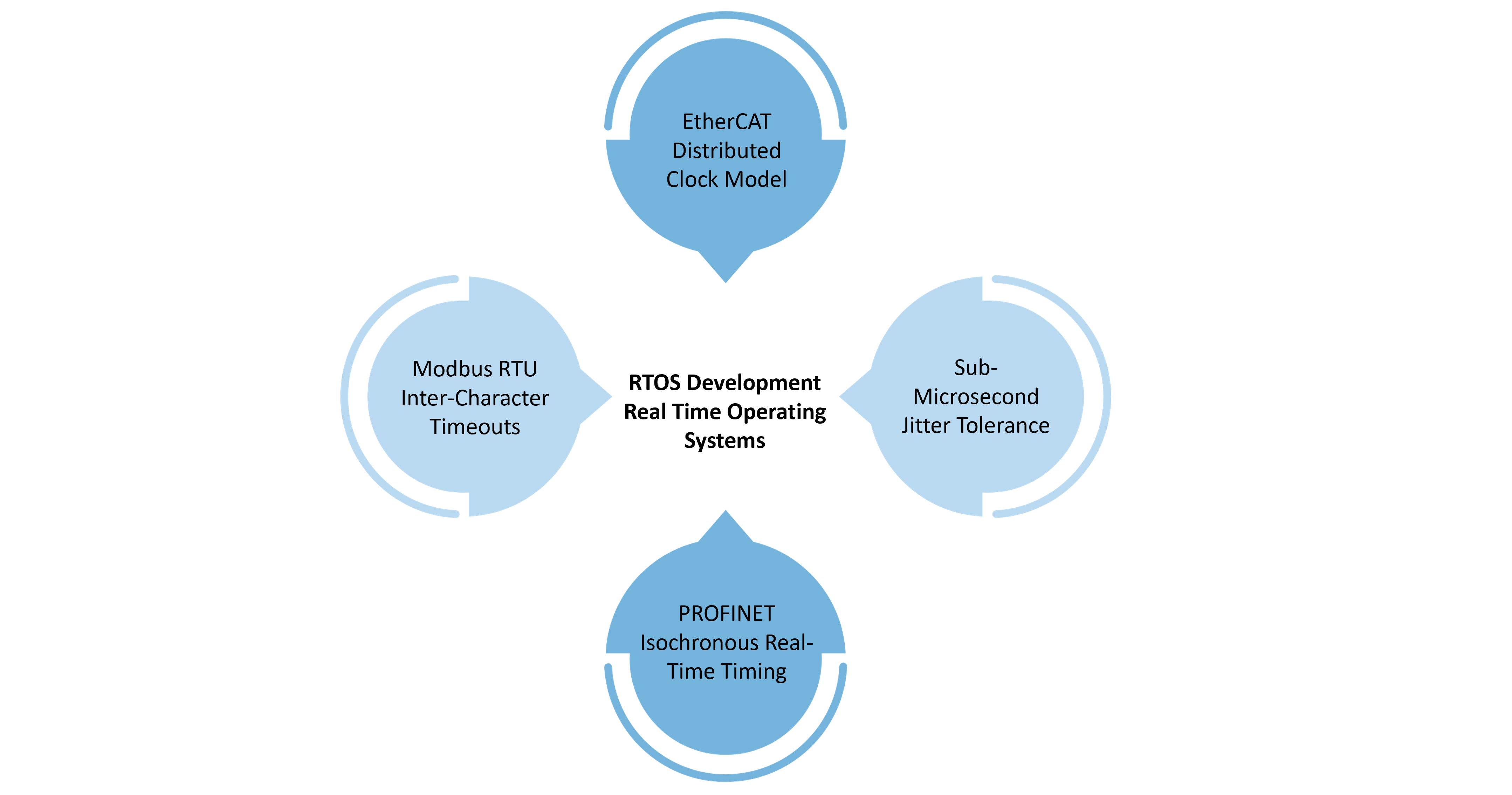
RTOS development real time operating systems work for a fieldbus device has to satisfy the specific timing the protocol itself demands, not a generic real-time budget. EtherCAT's synchronized distributed clock model and sub-microsecond jitter tolerance, Profinet's isochronous real-time class timing, and even Modbus RTU's inter-character timeout requirements each impose a different, protocol-specific determinism bar that the underlying RTOS's scheduler and interrupt latency have to meet reliably. RTOS development real time operating systems chosen without validating against the specific protocol stack's timing requirements is a common way a fieldbus device project discovers a scheduling or jitter problem late, during protocol conformance testing, rather than early during RTOS selection.
Many fieldbus devices, particularly cost-sensitive sensors, actuators, and simple I/O modules, run on microcontrollers with a fraction of the RAM and flash a general embedded product would have available, which makes RTOS and protocol stack footprint a hard constraint rather than a nice-to-have optimization. An RTOS kernel and its accompanying fieldbus protocol stack both have to fit comfortably within that budget alongside the device's own application logic, and a technically excellent RTOS that simply doesn't fit the target microcontroller's memory budget isn't a viable option no matter how well it otherwise scores on determinism or ecosystem maturity.
A fieldbus device destined for a safety-related function needs an RTOS with a genuine safety-certification pedigree, pre-certified to IEC 61508 or a related functional safety standard, with the certification evidence and safety manual documentation a certification body will actually accept, rather than an RTOS that's merely reliable in practice but was never taken through formal certification. This requirement alone eliminates a meaningful share of otherwise capable RTOS options for a safety-rated fieldbus device, since building a certification case from scratch on an uncertified RTOS is a materially larger and more expensive undertaking than starting from an RTOS vendor's existing certification package.
Embedded RTOS development services for a fieldbus device rarely start from a bare RTOS kernel; they typically build on a vendor or third-party protocol stack, an EtherCAT slave stack, a Profinet device stack, a CANopen stack, that has to be available, licensed appropriately, and proven compatible with the chosen RTOS. Embedded RTOS development services have to evaluate stack availability and licensing terms alongside the RTOS decision itself, since an RTOS with excellent technical characteristics but no available, appropriately licensed protocol stack for the target fieldbus isn't actually a usable choice for that specific device.
RTOS firmware development for a fieldbus device benefits from the same foundational RTOS evaluation covered in Embien's general FreeRTOS vs Zephyr vs ThreadX comparison, scheduler behavior, ecosystem maturity, community and vendor support, but layers the fieldbus-specific constraints, protocol stack timing, certification pedigree, and stack licensing, on top of that general comparison rather than replacing it. RTOS firmware development that only evaluates the general-purpose criteria from that comparison, without separately validating protocol stack timing and certification fit, risks choosing an RTOS that's a good general fit but a poor fit for the specific fieldbus device's real requirements.
Why use RTOS development for time-critical applications rather than a simple bare-metal superloop or general-purpose embedded Linux? A fieldbus device's protocol stack timing, and any safety-related response deadline it has to meet, needs the deterministic task scheduling, priority-based preemption, and bounded interrupt latency an RTOS provides, guarantees a bare-metal superloop struggles to give as application complexity grows, and guarantees a general-purpose OS like standard Linux, discussed alongside PREEMPT_RT in Embien's real-time Linux for industrial controllers piece, often can't match on resource-constrained fieldbus hardware.
Embien's own in-depth guide to the Modbus protocol covers the register mapping and timing conventions that even a comparatively relaxed protocol like Modbus RTU still imposes on the underlying RTOS's interrupt and timer handling, which is a useful baseline before evaluating an RTOS against a tighter-timed protocol like EtherCAT or Profinet real-time class 3.
Embien Technologies provides embedded RTOS development services and RTOS firmware development for industrial fieldbus devices across Modbus, Profibus, Profinet, EtherCAT, and CANopen protocol stacks, evaluating determinism, memory footprint, and IEC 61508 certification pedigree against each device's actual fieldbus requirements. To discuss RTOS development real time operating systems for a fieldbus device, reach out to Embien's engineering team.

Embien delivers embedded engineering services across industrial automation and IoT, covering hardware and firmware development, RTOS-based systems, device connectivity, and industrial communication for a wide range of connected products.

Embien supports industrial automation projects through embedded software development, RTOS integration, industrial protocol-stack engineering, and real-time communication solutions for fieldbus devices, controllers, gateways, and connected equipment.

A case study on developing an industrial Sub-1GHz wireless sensor network and IoT gateway, highlighting embedded firmware, wireless sensor connectivity, data acquisition, and gateway integration for industrial monitoring applications.