
What is conformance testing in industrial protocols? It is a formal, third-party-administered verification that a device's protocol implementation matches the published specification closely enough that it will interoperate with other vendors' devices on the same network, not merely that it works against the one master or scanner an engineering team happened to test with in-house. This folder has covered Modbus, PROFINET, EtherNet/IP, and a dozen other industrial protocols in technical depth, but none of that coverage addresses the gate every one of those protocols imposes before a device carrying its logo can actually reach the market: certification. Embedded system certification testing services exist precisely because a protocol stack that technically transmits and receives valid frames on a bench is not the same thing as a stack that has been proven, against an accredited test suite, to conform.
A device manufacturer can verify its own protocol stack against its own test cases and still ship a device that fails to interoperate with a competitor's controller, because the specification itself leaves room for interpretation, and two engineering teams reading the same document can implement subtly different, individually defensible behavior at the edges. Formal certification exists to remove that ambiguity by testing every conformant device against the same independently maintained suite, administered by the protocol's owning organization, ODVA for EtherNet/IP and CIP, PROFIBUS & PROFINET International for PROFINET, and the Modbus Organization for Modbus, so that a certification mark means something consistent across vendors rather than each vendor's own definition of "it works."
Conformance testing for industrial protocol stacks differs meaningfully by protocol. Modbus conformance testing, historically lighter-weight given the protocol's simplicity, focuses on correct function code handling, exception response behavior, and register addressing edge cases; there is no single mandatory certification body, but the Modbus Organization's guidelines still define what a conformant implementation looks like. PROFINET conformance testing is far more rigorous, requiring accredited test lab execution against the PROFINET Test Specification, covering device description file (GSDML) correctness, real-time class behavior for PROFINET RT and IRT, and diagnostic alarm handling, before a device earns its conformance class certificate. EtherNet/IP conformance testing runs through ODVA's own test tool suite against the CIP object model described in Embien's guide to the ODVA EtherNet/IP protocol, verifying explicit and implicit messaging, required objects, and encapsulation behavior. Protocol stack certification testing for industrial devices, across all three, tends to surface the same class of defect: correct behavior on the happy path, and inconsistent behavior on the malformed-input and edge-case paths the specification actually requires a device to handle gracefully.
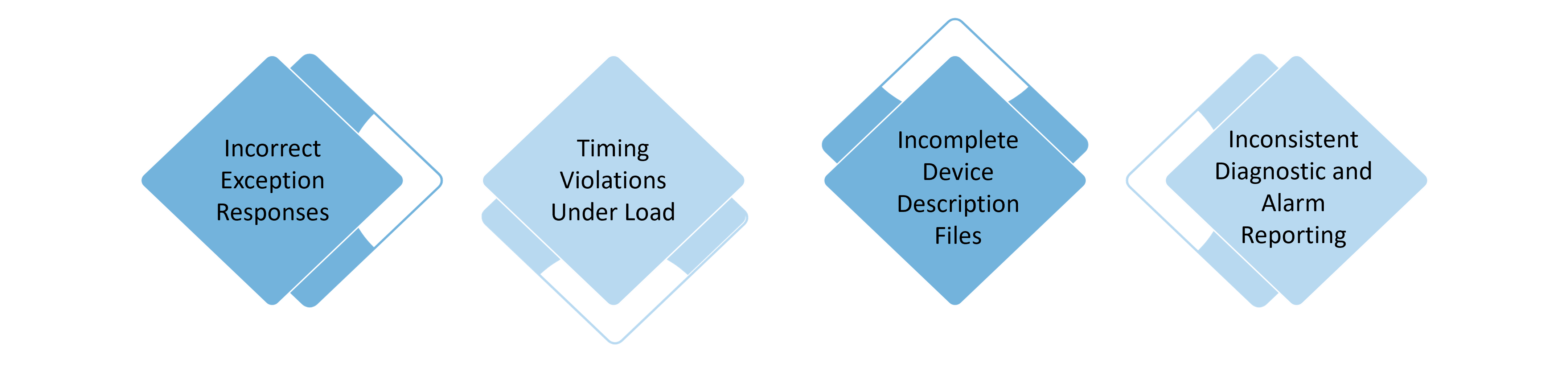
Devices rarely fail certification on the core data-exchange path; they fail on the paths engineering teams test least during in-house development. Common failure points include incorrect exception or error responses to malformed requests, timing violations under load that only appear once a test suite pushes traffic at the specification's maximum rate rather than a comfortable engineering-bench rate, incomplete or inconsistent device description files that pass casual inspection but fail automated schema validation, and diagnostic or alarm reporting that works for the one fault condition an engineer manually triggered but not for the full fault taxonomy the specification defines. Lessons from real industrial protocol conformance testing consistently point back to the same root cause: teams validate the protocol stack against their own controller and their own test cases, and certification is the first time the stack meets a test harness built independently of any single vendor's assumptions.
Formal certification proves a device conforms to the written specification; a plugfest, a scheduled multi-vendor event where devices from different manufacturers connect to the same network and are tested against each other directly, proves it actually interoperates with real devices in the field, which is a related but distinct question. A device can pass certification and still surface an interoperability issue at a plugfest, because the certification suite tests conformance to the spec, while a plugfest tests behavior against another team's specific, real-world interpretation of that same spec. Teams shipping protocol-critical industrial devices generally treat plugfest participation as a complement to certification testing, not a substitute for it, catching the class of issue that only shows up when two independently developed stacks actually talk to each other.
Certification testing has to be planned into a product schedule as its own milestone, not treated as a final checkbox after development wraps, because accredited lab slot availability, pre-test self-certification against the vendor's own test tools, and remediation cycles for any failures found all take real calendar time, typically weeks to a few months depending on the protocol and how much rework a failure requires. Budgeting for protocol stack certification testing for industrial devices means budgeting for at least one round of failure and fix, since first-pass certification success on a first-generation stack is the exception rather than the rule, and building schedule margin for that round in rather than discovering the need for it mid-certification is what keeps a certification milestone from turning into a launch-date risk.
Embien Technologies develops Modbus, PROFINET, EtherNet/IP, and other industrial protocol stacks for embedded gateways and controllers, and pairs that protocol stack development with testing and quality assurance engineering built for certification readiness, conformance test preparation, and pre-certification validation ahead of formal lab testing. Product teams planning a certification milestone for a protocol-carrying device are welcome to discuss their specific protocol, timeline, and target certification body with Embien's engineering team, drawing on Embien's embedded system certification testing services experience across Modbus, PROFINET, and EtherNet/IP stacks.

Embien's product engineering services support the development of industrial embedded devices, gateways, and controllers, covering hardware and firmware engineering, industrial protocol-stack integration, system integration, and product validation for reliable deployment.

Embien's quality assurance services support embedded product validation through functional testing, protocol conformance checks, interoperability testing, automated test execution, and verification to identify communication errors and improve software reliability before product release.

A case study on developing a Modbus RTU-to-Modbus TCP protocol converter, demonstrating industrial protocol integration, communication between serial and Ethernet-based networks, and embedded gateway development for connecting industrial devices.